Composer will now build your segments for you. You describe the audience in plain English, it drafts the logic, and you preview it before it saves. The same release also lets a campaign run a content A/B test and Personalized Send Time together, which used to be an either/or.
So the building is handled. Which means the part it can't do is now the only part that matters.
Here's the thing nobody puts in the release notes: Composer will build a segment for any prompt you give it. It will not come back and tell you the prompt was wrong for your business.
Type "customers who have lapsed and haven't bought in a while" and you'll get something clean. For a supplement brand reordering every 30 days, no purchase in 90 days means three missed reorders and those people are genuinely gone. For a mattress brand, that same segment is nearly every happy customer you have, and you've just queued winback messaging to people who bought last quarter.
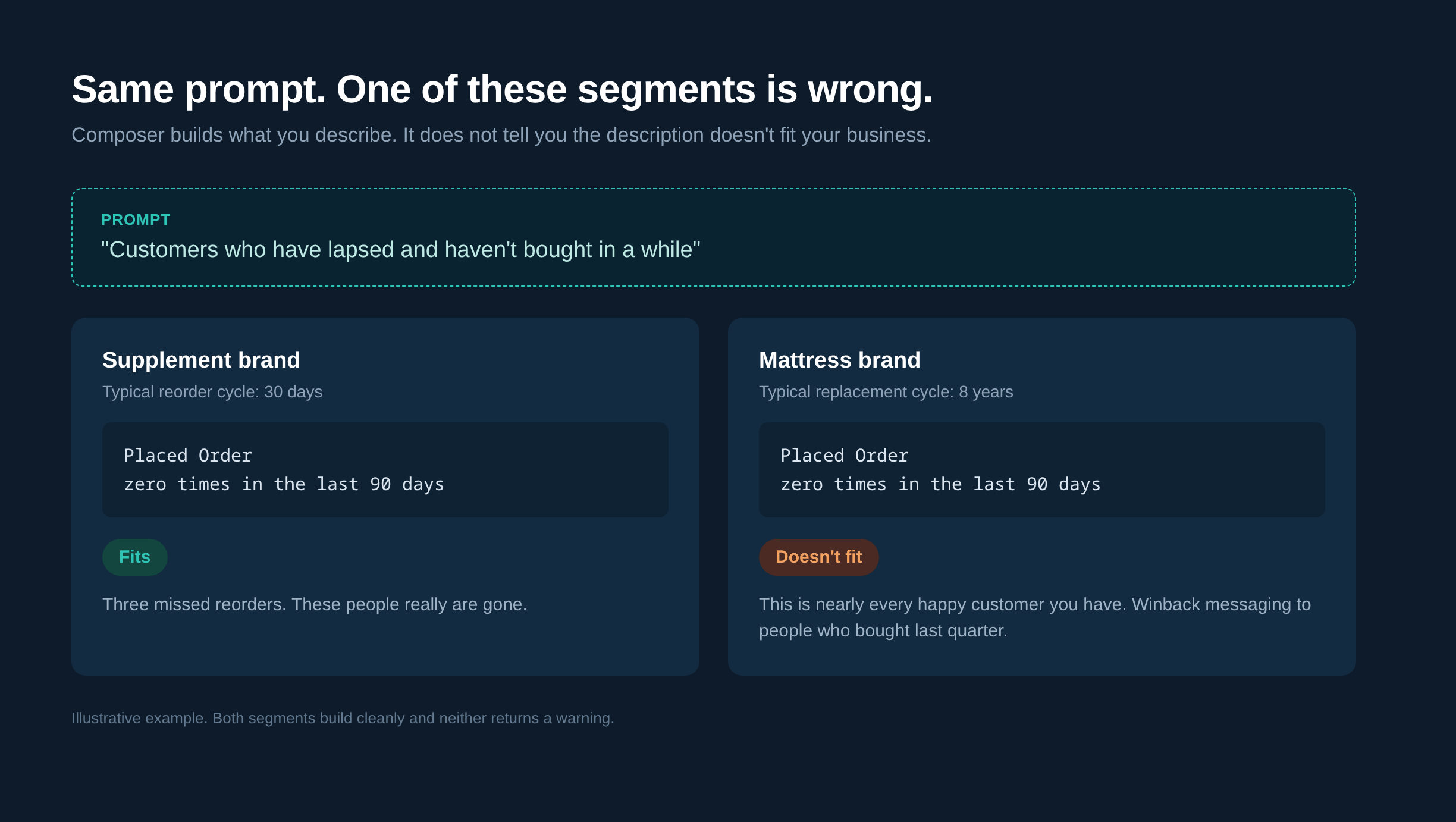
Same prompt. Same output. One of them is a decent audience and one of them is an apology email waiting to happen. Nothing in the tool flags the difference, because the difference isn't in the data. It's in knowing what your product's purchase cycle actually looks like.
That's the shape of the risk with any auto-pilot feature. It isn't that the machine builds bad segments. It's that a bad segment now looks exactly as clean and confident as a good one, and it shows up in seconds instead of after twenty minutes of clicking, which is twenty fewer minutes of somebody thinking about whether it's right.
Where the AI genuinely earns it
We're not arguing against using this. Nobody's strategy ever lived in the property and value dropdowns, and rebuilding "purchased from this category in the last 90 days" for the fortieth time is not a good use of a strategist's afternoon. Hand that part over.
And there's decent evidence on where it does more than save time. Flourish Commerce tested AI-assisted segments against manually built RFM segments across 14 Shopify stores over six months. AI segments won clearly on abandonment and winback, and showed no meaningful lift on promotional sends.
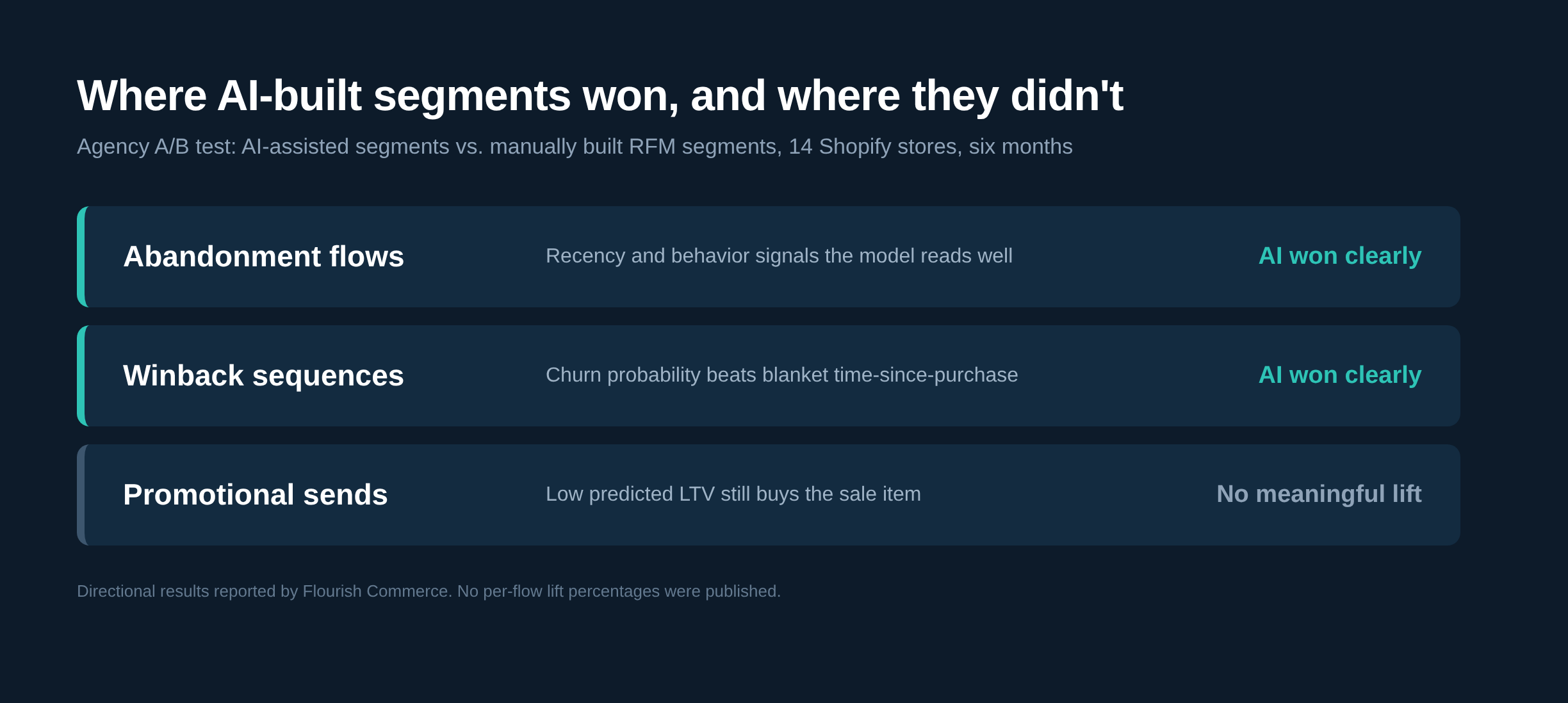
Founder Katie Steckly's explanation is the whole point. The model reads purchase cadence and lifetime value well. It doesn't know that a customer with a low predicted lifetime value score would still happily buy the thing that's on sale. That's context, and the model doesn't have it.
That tracks with what we see. Flows where recency and behavior are the whole story are where a machine-built audience does great. It's why a winback flow built on blanket time-since-purchase trains people to ignore you, and why browse abandonment works when it stops trying to sell. Promotional sends are decided by brand affinity, price sensitivity, and what someone thinks of you, and none of that is in the dataset.
The defaults have opinions you didn't set
Small example of the same pattern from the same release. Personalized Send Time only works alongside a content A/B test if test size is set to 100%. Split your list 50/50 to test two subject lines and Personalized Send Time quietly isn't available for that send. It also sits inside the higher analytics packages, so it may not be waiting for you on your current plan.
Neither of those is a scandal. But they're the kind of thing that eats an afternoon three weeks later when a campaign underperforms and nobody can work out why. Automation doesn't remove the need to know what the tool is doing on your behalf.
Worth noting that Klaviyo's own numbers on Personalized Send Time are good: top performing campaigns in the beta saw a 35% increase in click rates, and Shady Rays reported better than a 10% lift in placed order rate across 30-plus campaigns. Just read that as the top of the range, not the plan.
The data underneath doesn't get smarter
Apple Mail Privacy Protection pre-fetches the tracking pixel on messages delivered to Apple Mail addresses whether anyone opens them or not. Litmus had Apple Mail at roughly half of the global email client market earlier this year. So an "engaged" segment built on open rate is partly built on machines.
An AI segment builder working from that same signal doesn't fix it. It builds a more confident-looking segment on top of it. The fix has nothing to do with AI: whoever is doing the segmenting, human or Composer, needs to be working from clicks, purchases, and site behavior instead of opens. Same problem we wrote about in why your ESP dashboard won't tell you what's actually landing.
So what stays with you
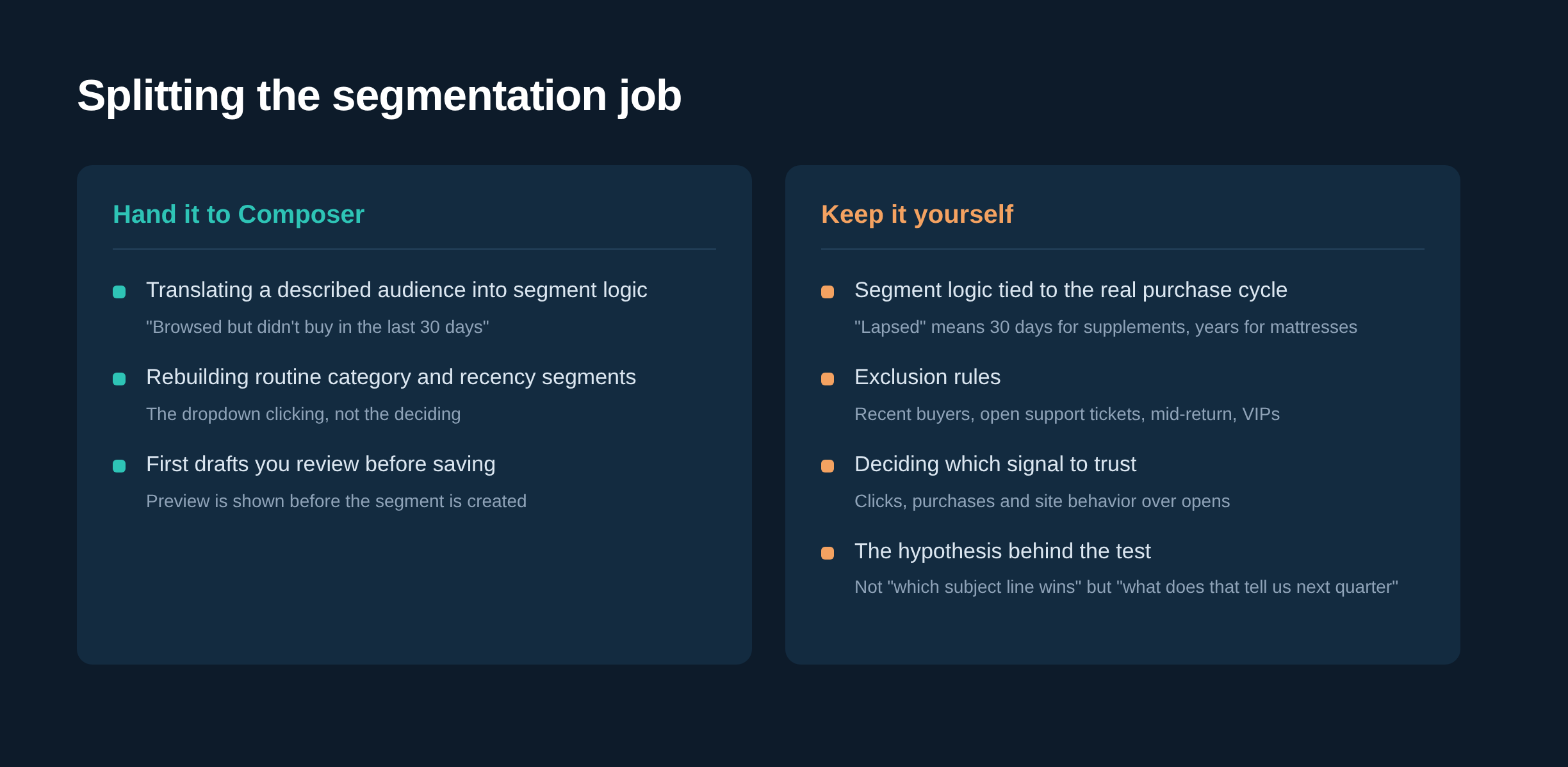
- Segment definitions that match your real purchase cycle. Composer builds what you describe. Deciding what "lapsed" means for your product is still yours.
- Exclusion rules. Recent purchasers, open support tickets, VIPs, people mid-return. The reasons to leave someone out are specific to what you're sending, and a general prompt won't catch them.
- What you're testing for. A test needs a hypothesis before it needs a build. "Which subject line wins" is a different question from "does urgency beat social proof with this audience," and only one of those is still useful next quarter. Same discipline behind reading revenue per click instead of click rate.
Klaviyo's own line against using ChatGPT for this is that Composer works from your actual customer data instead of a blank prompt, and that's fair. It's connected to something real.
But "connected to your data" and "knows which segment is worth building" are different claims. The first one shipped. The second one is the job, and it's usually what brands run into when they've outgrown their setup rather than their platform.


