Open almost any ecommerce winback flow and you'll find the same three emails. 10% off. 15% off. 20% off. Sent on a flat 30/60/90-day schedule to everyone who hasn't purchased.
It works, technically. Some percentage of lapsed customers will click a big enough number. But here's the part nobody talks about: you're not just winning back customers. You're teaching your entire list that the smart move is to stop opening your emails and wait for the discount to show up.
We manage a lot of Klaviyo accounts. And the brands that have the hardest time growing email revenue almost always have the same thing in common - an aggressive discount-ladder winback that's been running untouched for a year or more.
What Happens When Every Winback Opens With a Coupon
Three things, and none of them are good.
First, you anchor customers to a price instead of a relationship. Once someone figures out that a 20% code shows up every time they stop buying for two months, your regular full-price campaigns become the emails they skip. Why would they open a "new arrivals" email when they know a better deal is coming?
Second, you hand discounts to people who would have come back anyway. A real chunk of "winback conversions" are just coupons given to customers who were already planning to reorder. You're giving away margin for nothing.
Third - and this is the big one - you skip the actual reason they left. Price is rarely the real objection for a lapsed ecommerce customer. Timing, forgetting, a bad last experience, or simply not being reminded usually rank higher. A discount doesn't address any of those. It just papers over them.
The 6-to-12-Month Decay Problem
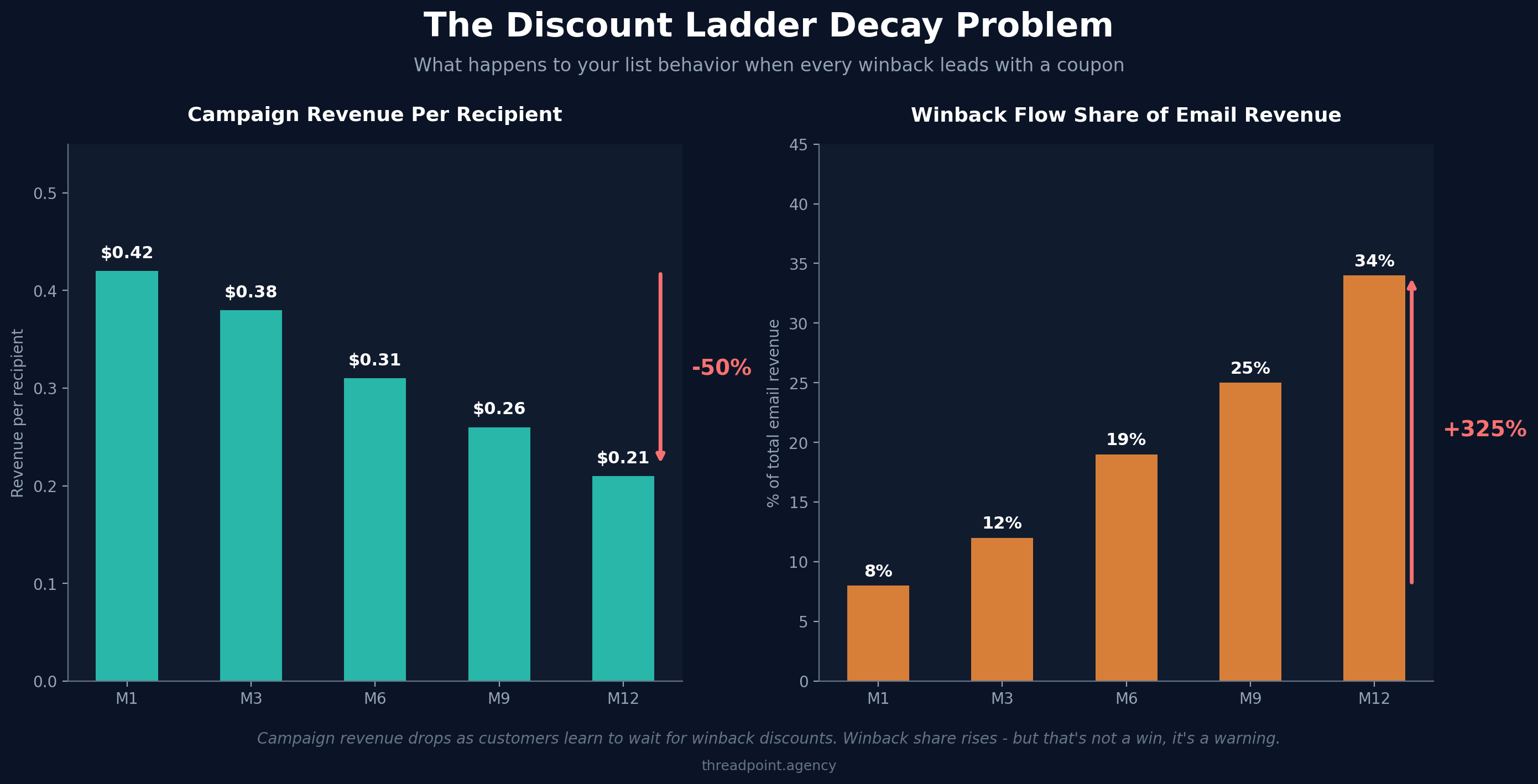
This is what the discount ladder actually does to your list behavior over time.
Month one, you launch a winback flow with a 15% off incentive. Conversion rate looks solid. Month three, your returning customers start buying less at full price because they've figured out the pattern. Month six, a growing chunk of your list isn't engaging with campaigns at all - they're just waiting for the winback trigger. Month twelve, your discount rate is up, your campaign revenue per recipient is down, and your "winback flow" is the highest-revenue flow in your account. That last one sounds like a win. It's not. It means your other flows and campaigns lost ground because the winback trained people to skip them.
The discount ladder doesn't fix churn. It formalizes it.
Earn the Click Before You Buy It
The framework we use flips the standard approach. Discounts still have a place - they're just the last lever, not the first one.
The biggest shift is the trigger. Instead of a single "no purchase in 60 days" rule for your whole list, you trigger relative to each customer's expected repurchase window. If someone buys a product that typically runs out in 45 days, your winback should start around day 35-40 - not day 60 when they've already bought from someone else.
If you don't have exact repurchase timing, start with average days-between-orders per SKU or category. Even a rough estimate beats a flat 30/60/90-day trigger applied to everyone.
The Flow, Touch by Touch
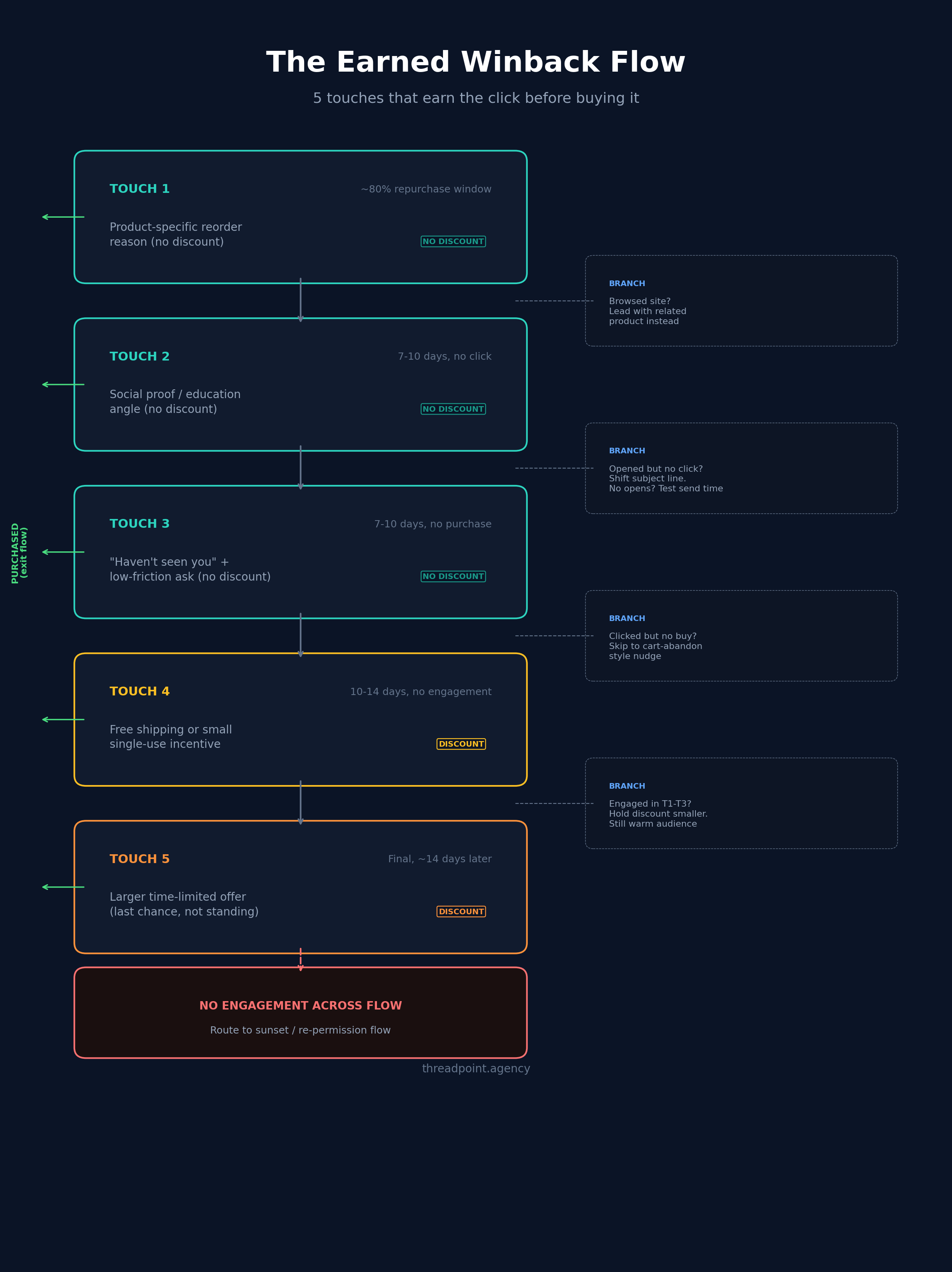
Touch 1 - Around 80% through expected repurchase window
Reference the specific product they bought, tied to a real reason to reorder. Running low, new use case, seasonal relevance. No discount. If they've browsed the site since their purchase, lead with a related product instead of a "running low" message.
Touch 2 - 7 to 10 days later, no click
Social proof or education angle. Reviews, a "how customers use this" angle, or new product info relevant to their past purchase. Still no discount. If they opened but didn't click Touch 1, shift the subject line angle. If no opens at all, test a different send time or from-name before assuming disinterest.
Touch 3 - 7 to 10 days later, no purchase
Direct but still no discount. A genuine "haven't seen you in a while" message that references their last order, plus a low-friction ask - reply, update preferences, browse a curated pick. If they clicked but didn't purchase on Touch 1 or 2, skip straight to a cart/browse-abandon style nudge instead of a generic "we miss you."
Touch 4 - 10 to 14 days later, still no engagement
This is where price enters. Start with free shipping or a small, single-use incentive rather than jumping to your largest discount. If they've engaged anywhere in Touches 1-3 but not purchased, they're a warmer audience - hold the discount smaller.
Touch 5 - Final touch, around 14 days later
Larger, clearly time-limited offer. Positioned as a last chance, not a standing discount. If there's been no engagement across the entire flow, this is also your signal to suppress from regular sends and route to a re-permission or sunset flow - not to keep repeating the winback.
The Branching Is Where the Real Money Is
The touch-by-touch structure above is the skeleton. The part that separates this from a generic drip is how you split customers within the flow based on behavior, not just time.
Engaged-but-not-purchased vs. fully dark. Anyone who opens or clicks anywhere in touches 1-3 should never see the same email as someone who's gone completely dark. Route engaged non-purchasers into a lighter-touch, product-recommendation path. Route fully dark contacts toward channel or format tests - shorter emails, plain-text style, different from-name - before assuming a discount is the answer.
Category-based repurchase timing. A consumable product and a durable one-time purchase shouldn't share a trigger window. Split the flow entry point by product category so the "running low" framing only fires for products that are actually running low.
Past discount sensitivity. If you're tracking whether a customer has historically only ever purchased on a discount, it makes sense to shorten their no-discount runway. They may reach Touch 4 faster than a customer with a history of full-price purchases.
Post-entry activity. Any site visit, browse, or cart action during the flow should pull a contact out of the standard sequence and into a more specific abandonment-style path. That behavior is a stronger signal than anything you scheduled in advance.
Where Discounts Still Belong
This isn't a no-discount philosophy. It's a discount-last philosophy.
By the time a lapsed customer reaches Touch 4 or 5, you've already ruled out "they just forgot" or "they didn't see anything relevant." At that point, a real incentive is a legitimate lever, not a crutch. It also means the discount you do send actually needs to convert, since anyone still not covered by relevance-based messaging is genuinely price-sensitive or gone.
What You Need to Build This
At minimum:
- Purchase history at the SKU or category level, not just "last order date"
- Some estimate of expected repurchase timing per category - even a rough average is enough to start
- Engagement tracking granular enough to branch on opens vs. clicks vs. site activity mid-flow
- The ability to build conditional splits inside your ESP, not a single linear send-to-everyone sequence
If your current winback is a three-email discount ladder, you don't need to rebuild everything at once. Start by splitting the entry trigger by product category, and add the engaged-vs-dark branch before you touch anything else. Those two changes alone usually do more for retention economics than swapping in a bigger discount ever will.


