If you're reading this, you probably already know you need to move off Omnisend. Maybe your flows are getting too complex for the builder. Maybe you've hit the ceiling on segmentation. Maybe you watched a Klaviyo demo and realized how much you're leaving on the table.
The thing holding you back isn't whether Klaviyo is better. You know it is. The thing holding you back is the migration itself.
Time is money. You don't have someone on staff who's done this before. You're picturing weeks of your team getting pulled into export/import spreadsheets, rebuilding every flow from scratch, and praying nothing breaks during the switch. It feels like a massive headache, and nobody wants to sign up for that.
Here's what we'd tell you on a call: it's not nearly as bad as you're imagining it. We've done these migrations dozens of times - from Omnisend, from Mailchimp, from Drip, from Bronto (RIP). The daunting part is almost entirely in your head. Let's walk through what actually happens.
What Transfers Cleanly
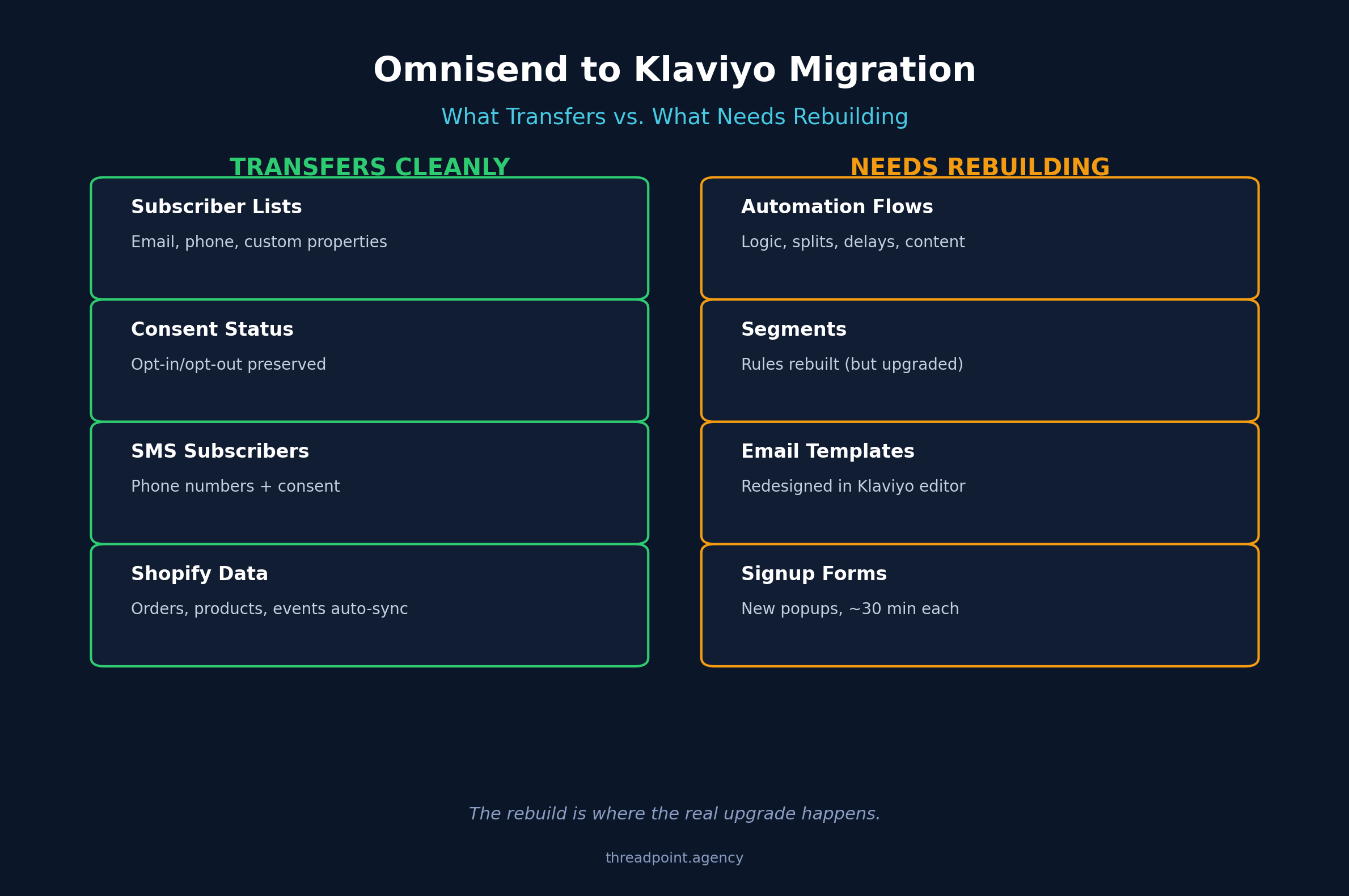
Your subscriber list - including email addresses, phone numbers, names, and any custom properties you've been tracking - all of that comes over. Klaviyo has a direct integration with Omnisend that makes the contact import straightforward. Consent status (opted in, opted out) transfers too, so you're not starting from zero on compliance.
Your Shopify data - orders, products, customer events - that's even easier. Klaviyo pulls directly from Shopify the moment you connect it. It'll backfill historical order data automatically. So all that purchase history, browse behavior, and cart activity? It's there from day one.
If you've been running SMS through Omnisend, those subscriber lists transfer as well. Same deal - export, import, consent preserved. We always re-verify consent records during the move to stay clean on TCPA.
What Needs Rebuilding
This is the part that scares people, so let's be direct about it.
Your flows don't transfer. The automation logic, the conditional splits, the time delays, the specific email designs inside each flow - none of that carries over as a working automation. You can't export an Omnisend flow and import it into Klaviyo.
Same with segments. Whatever rules you've built in Omnisend to define your engaged subscribers, your VIPs, your sunset list - those need to be recreated in Klaviyo's segment builder. The good news is that Klaviyo's segmentation is significantly more powerful, so most of those segments actually get better in the rebuild.
Your email templates need to be rebuilt too. You can reference the old designs, but they won't import as editable templates. Klaviyo's drag-and-drop editor is different from Omnisend's, and honestly, most brands use the migration as a chance to clean up templates that had gotten messy over time.
Signup forms are the same story. Omnisend popups don't transfer. You'll need new ones in Klaviyo. This takes about 30 minutes per form if you know what you're doing.
The Part Nobody Talks About: It's Actually an Upgrade
Here's what usually happens in a migration. A brand comes to us dreading the rebuild. Then we start mapping their Omnisend setup to Klaviyo, and they realize their old flows were... not great. Maybe they had a welcome series that was three emails long with no conditional logic. Maybe their abandoned cart flow was a single email with a 10% discount. Maybe their segments were just "opened in 30 days" and "everyone else."
When you rebuild in Klaviyo, you're not just recreating what you had. You're upgrading it. Klaviyo's flow builder supports branching logic that Omnisend can't match. You can split by predicted lifetime value, by product category, by acquisition source. Your welcome flow goes from three generic emails to a series that actually adapts to who the person is and what they did.
Most brands see better performance within the first 30 days after migration - not because Klaviyo is magic, but because the rebuild forces you to fix everything you'd been meaning to fix for the last two years.
What the Timeline Actually Looks Like
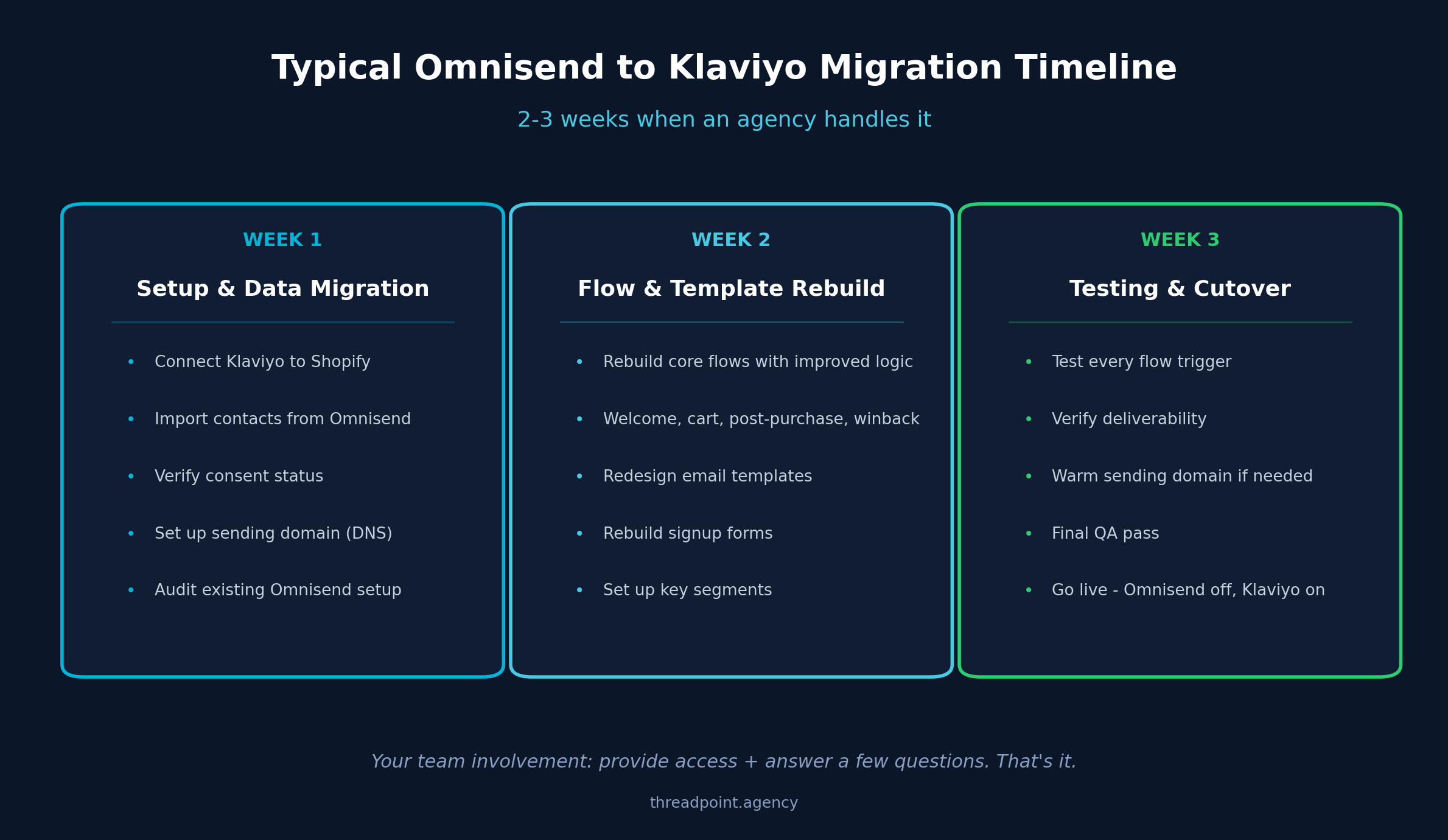
Once we have access, a typical Omnisend to Klaviyo migration takes two to three weeks of active build when an agency handles it. The one thing that can extend it is deliverability - more on that below. Here's how the build breaks down:
Week 1: Setup, data migration, and domain warming. We connect Klaviyo to Shopify, import your contact lists from Omnisend, and verify consent status. We also authenticate your sending domain (DNS records). If you're moving to a new or previously dormant sending domain, we start warming it now - sender reputation builds gradually over days and weeks, so this runs in parallel with everything else rather than getting squeezed in at the end. This is also when we audit your existing Omnisend setup to understand what you have and what needs to come over.
Week 2: Flow and template rebuild. This is the heavy lift. We rebuild your core flows - welcome series, abandoned cart, post-purchase, browse abandonment, winback - in Klaviyo with improved logic and design. We also rebuild your key email templates and signup forms.
Week 3: Testing and cutover. We test every flow trigger, run deliverability checks, confirm domain warming is complete, and do a final QA pass. Then we flip the switch - turn off Omnisend automations, turn on Klaviyo flows, and you're live.
During that entire process, your team's involvement is minimal. We'll need access to your Omnisend account and your Shopify store. We'll have a few questions about your current setup and goals. That's pretty much it.
How long really depends on your program. A newer or mid-size list already sending from a warm domain is a genuine two to three week build. An established, high-volume program - especially one moving to a new dedicated sending domain - is a six to eight week project by design: we warm the domain and shift sending over gradually instead of hard-cutting, so deliverability and revenue never take a hit. We scope the exact window at kickoff.
One honest note on timing. That build window assumes two things - you keep an already-authenticated sending domain (or we've had a couple of weeks to warm a new one in parallel), and we get timely access and sign-off. Domain warming and approval turnaround are the two factors that can stretch a project, so we flag both at kickoff. No surprises.
The Fear Is Worse Than the Reality
We've had clients put off this migration for a year. A full year of knowing they needed to switch, knowing Klaviyo would give them better tools, but avoiding it because it felt like too much. Then they finally do it and it's done in three weeks with barely any disruption.
The honest truth is that Omnisend is a good starter platform. It does what it says. But if you're doing more than about $1M in revenue, or if you need real segmentation, or if you want flows that actually respond to customer behavior in a meaningful way, you've outgrown it. And the longer you wait, the more you're leaving on the table.
Klaviyo isn't just an upgrade in features. It's the platform that grows with you. The segmentation, the predictive analytics, the depth of Shopify integration - it meets you where you are whether you're doing \$500K or \$50M.
If you've been putting this off, stop overthinking it. The migration is smoother than you think, especially when someone who's done it before handles the heavy lifting. You don't have to figure it out yourself, and your team doesn't have to get pulled in to try and piece it together. That's what agencies like us exist for.


