Most brands can tell you their revenue number. They can tell you how many new customers they got last month. Some can even tell you their CAC down to the penny.
But ask them their repeat purchase rate and you'll usually get a blank stare. Or worse - a guess.
That's a problem. Because your repeat purchase rate tells you more about the health of your business than almost anything else in your dashboard. It tells you whether your customers actually like what you're selling, whether your post-purchase experience is working, and whether your retention efforts are doing anything at all.
And yet, almost nobody tracks it over time.
Not All Revenue Is Created Equal
This is the thing that gets lost in most revenue conversations. A dollar from a repeat customer is worth more than a dollar from a new one. Not philosophically - financially.
Here's why: you already paid to get that repeat customer. That acquisition cost is sunk. Every subsequent purchase they make is gravy. The cost to reach them through email and SMS is somewhere between $5 and $15 per year. Compare that to the $45 to $200+ it costs to acquire a new customer through paid channels, and the math gets real obvious real fast.
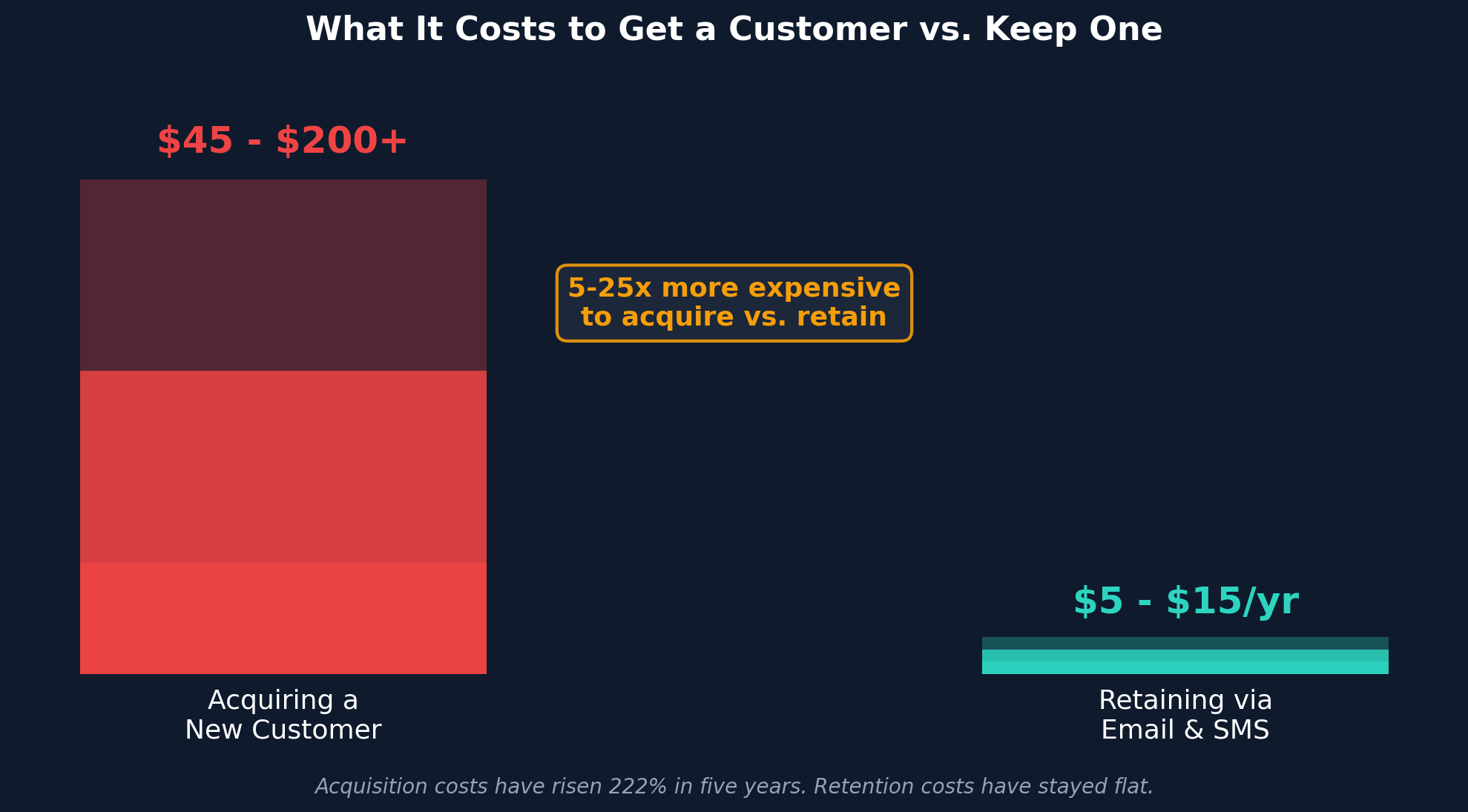
Acquisition costs have jumped 222% in the last five years. Meta CPMs keep climbing. Google Shopping CPCs are up over 33%. Meanwhile, the cost to send an email hasn't really changed. The gap between getting a customer and keeping one gets wider every quarter.
So when you're looking at your revenue dashboard, the question isn't just "how much did we make?" It's "how much of that came from people we already had?"
The 21% That Carries the Business
Here's a stat that should change how you think about your customer base: repeat customers make up roughly 21% of the average ecommerce store's customers. But they generate 44% of revenue and 46% of orders.
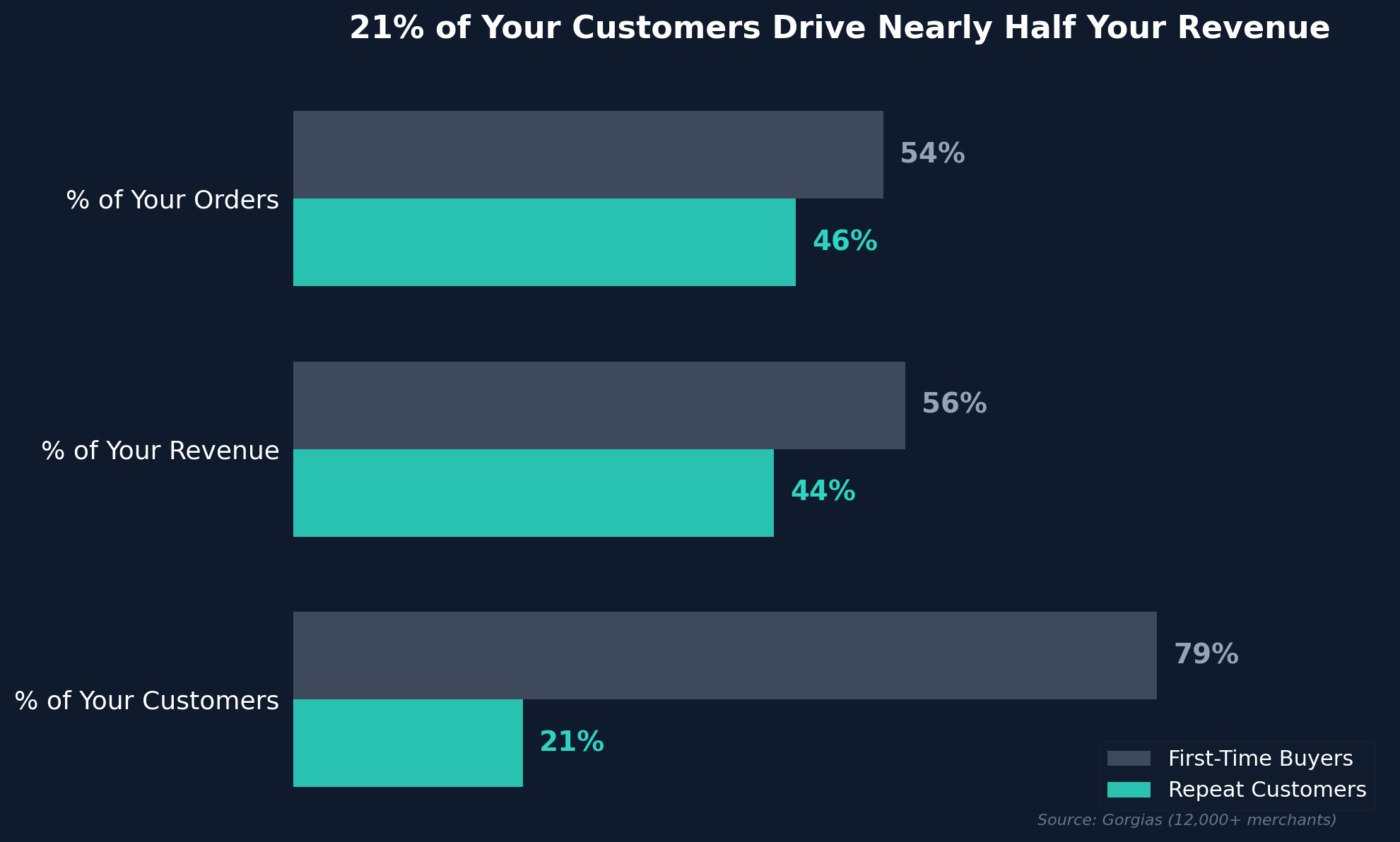
Read that again. One-fifth of your customers are producing almost half your money.
And it goes deeper than that. Repeat customers spend about 67% more per order than first-time buyers. Their conversion rate on your site is 60-70%, compared to 5-20% for new visitors. By the time a customer has been with you for two to three years, they're spending 67% more per order than they did in their first six months.
The top 1% of customers? They spend 5x more per transaction than the bottom 90%.
These aren't theoretical numbers. This is data from tens of thousands of ecommerce stores. And the pattern is consistent: a small group of repeat buyers is quietly funding the majority of your growth. If you don't know who they are or what's driving them back, you're flying blind.
Where Does Your Industry Actually Land?
The average ecommerce repeat purchase rate sits around 28%. That means roughly 7 out of 10 people who buy from you once never come back.
But that average is pretty misleading on its own. The range across industries is massive.
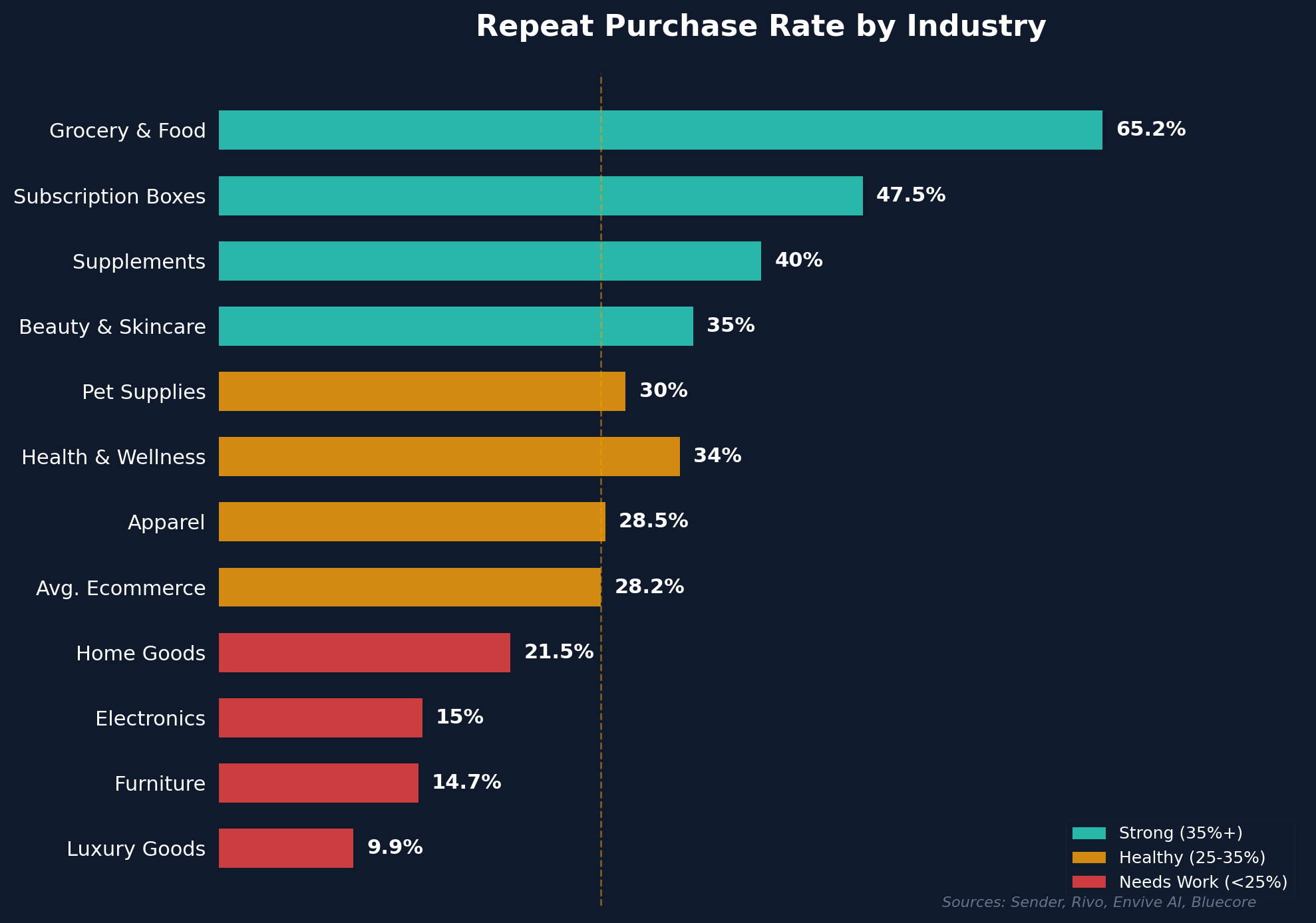
Grocery and food delivery sit above 65% because people need to eat every week. Supplements and consumables land between 35-45% because the product literally runs out. Beauty and skincare hover around 30-40% when there's a routine involved.
Then you get to apparel at 25-32%, home goods at 18-25%, and electronics way down at 12-18%. Luxury goods? Under 10%.
The product dictates the baseline. How often someone needs to repurchase, how high the price point is, how much emotional attachment they have - those factors set your floor before any strategy even comes into play.
That doesn't mean a home goods brand should just accept 20% and move on. It means they need to understand that their path to a higher RPR looks completely different from a supplement brand's path. And comparing yourself to a cross-industry average without knowing where your vertical sits is a recipe for bad decisions.
Customers vs. High-AOV Customers vs. Repeat Customers vs. High-AOV Repeat Customers
This is where most brands fall short. They lump everyone together as "customers" and call it a day.
But getting a customer is one thing. Getting a high-AOV customer is another. Getting a repeat customer is another thing entirely. And getting a high-AOV repeat customer - that's the real prize.
Each of those is a fundamentally different type of relationship, and they need to be tracked and communicated with differently.
A customer who spent $42 on their first order has a 22% chance of coming back within 90 days, with an average lifetime value around $67. A customer who spent $128 on their first order? Their repeat rate jumps to 68%, with a lifetime value closer to $487.
First-purchase AOV is one of the strongest predictors of long-term retention. It signals commitment, confidence, and engagement with your brand. And it creates a virtuous cycle - a meaningful first purchase creates psychological investment, which drives a return visit, which leads to an even bigger basket, which deepens the commitment further.
So tracking "how many customers did we get this month" tells you almost nothing useful. You need to know how many high-AOV customers you got. How many of your existing customers came back. And how many of your repeat customers increased their spend.
If you're not segmenting on those dimensions, you're treating a one-time $30 buyer the same as a three-time $150 buyer. And your emails probably sound like it, too.
This Is Relationship Management
At the end of the day, retention is relationship management. And good relationships pay dividends.
The brands that actually move their repeat purchase rate aren't just running better abandoned cart flows. They're thinking about the entire post-purchase experience. Are you acknowledging the purchase in a way that feels human? Are you educating people on how to use what they bought? Are you reaching out at the right time when they might need to reorder - not too early, not too late?
The probability of selling to an existing customer is 60-70%. For a new prospect, it's 5-20%. That gap exists because existing customers already trust you. They already know your product works. The relationship is already there.
But relationships need maintenance. They need thoughtful communication. And they need you to actually understand what different segments of your customer base need to hear.
A first-time buyer needs reassurance and education. A repeat buyer needs recognition and relevant cross-sells. A lapsed customer needs a reason to come back that doesn't feel like desperation. Each of those is a different conversation, and if you're sending the same campaign to all of them, you're having the wrong conversation with most of your list.
The Retention Cost Nobody Tracks
Here's a question most brands have never asked themselves: what does it cost you to generate a second purchase?
Everyone knows their CAC. Very few brands track their cost per retained customer. But that number is what tells you whether your email and SMS program is actually working or whether you're just waiting for organic repurchase.
The math is pretty straightforward. Add up everything you're spending on retention - your email platform, your SMS costs, your loyalty program, the agency or team managing it all. Divide that by the number of customers who made a repeat purchase in the same period.
If that number is $15 and your average repeat order is $85, you're printing money on the retention side. If it's $50 and your average repeat order is $60, your retention program needs work even though customers are technically coming back.
This is the metric that connects your retention spend to actual outcomes. And it's the metric that makes the case for investing more in email and SMS instead of dumping everything into acquisition.
Because here's the thing: a 5% increase in customer retention produces a 25-95% increase in profit. A 2% improvement in retention has the same bottom-line impact as cutting costs by 10%. Those aren't aspirational numbers - that's Bain & Company research that's held up for decades.
What You Should Actually Be Looking At
If you're not tracking your repeat purchase rate already, start. It's the simplest, most honest number in your business. Total customers who bought more than once divided by total unique customers.
But don't stop there. Break it down:
- RPR by acquisition source. Are customers from Meta ads coming back at the same rate as organic? If your paid customers have a 12% RPR and your organic customers are at 35%, your ad targeting might be optimized for the wrong thing.
- RPR by first-purchase AOV tier. Segment your customers by how much they spent the first time. You'll almost certainly find that higher first-order AOV correlates with higher repeat rates. That insight should change how you think about welcome offers and first-purchase incentives.
- RPR by product category. Some products naturally drive more repeat purchases than others. If your consumable line has a 40% RPR but your accessories are at 12%, your post-purchase flows should look very different for each.
- Time to second purchase. How long does it typically take for a customer to come back? That window is when your retention emails matter most. If your average time to second purchase is 45 days and your post-purchase flow ends at day 14, you're going silent during the most critical window.
- Cost per retained customer. Total retention spend divided by repeat customers. This is the number that tells you whether your retention program is actually efficient or just expensive.
These aren't vanity metrics. They're the numbers that tell you whether your business can survive and grow without constantly feeding the acquisition machine. And with Q3 underway and acquisition costs only climbing toward Q4, the brands that know these numbers are the ones that will come out ahead.
Your revenue dashboard tells you what happened. Your repeat purchase rate tells you what's going to happen next.


