I hear some version of this on almost every intro call. The site's dated, the ads are underperforming, the email program is three flows built by an intern in 2023. And the plan is always the same order: fix the site, then fix the ads, then get to email.
Nobody's wrong about the pieces. Site, ads, email - all three matter and none of them is optional. The argument isn't about which one deserves less attention. It's about when each one happens. And when you put email last, you're not deprioritizing it for a few weeks. You're usually pushing it a quarter or more, because site redesigns run long and then ads need a few weeks of learning before anybody feels good about the numbers.
Ads and email have opposite cost curves
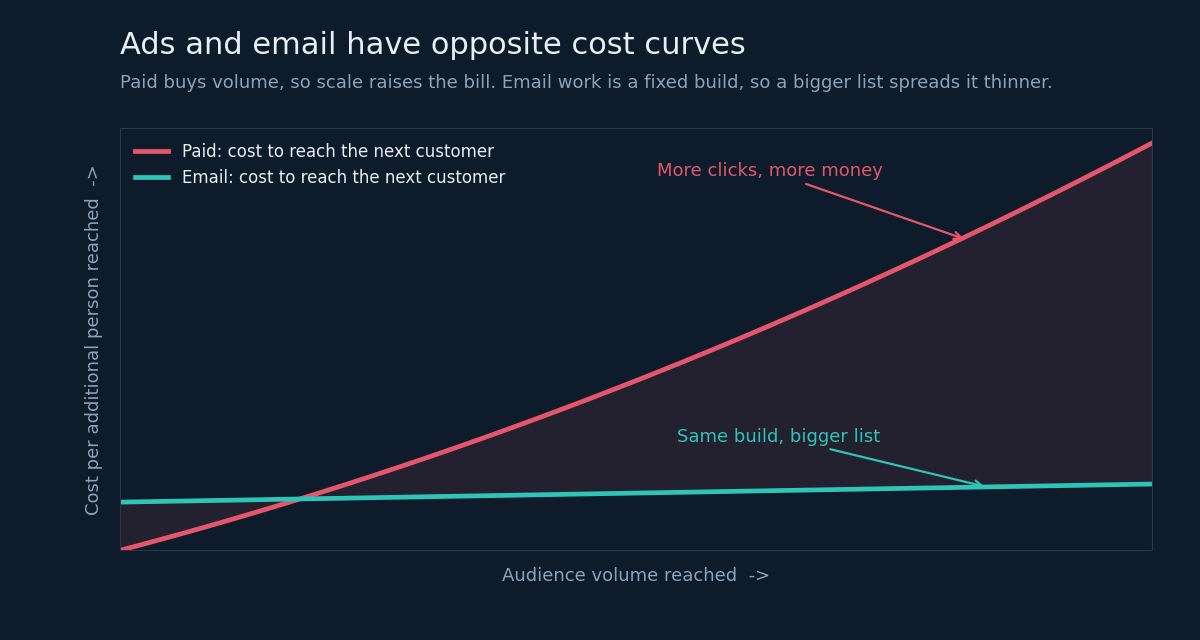
This is the part most founders haven't thought through, and it's the whole reason the order matters.
With paid, you're buying volume. If you want more prospective customers in front of your product, you pay for them. If your category is competitive, you pay more for them. More clicks, more money. That relationship doesn't really break in your favor at any point - scale up and the bill scales with you, usually faster than you'd like once you're past the easy audiences.
Email runs the other way. Your cost is tied to the volume of contacts you're storing and sending to, but the work is mostly a fixed cost. You build the campaign once and send it to whoever's on the list. You build a flow once and it runs for everybody who enters it. Assuming your conversion rate holds steady, a bigger list on the same build means more buyers for basically the same effort.
So every week you're not collecting emails is a week of compounding you don't get back. The ad spend from those weeks is gone the moment the campaign ends. The list from those weeks would still be earning in 2027.
What "waiting" actually costs
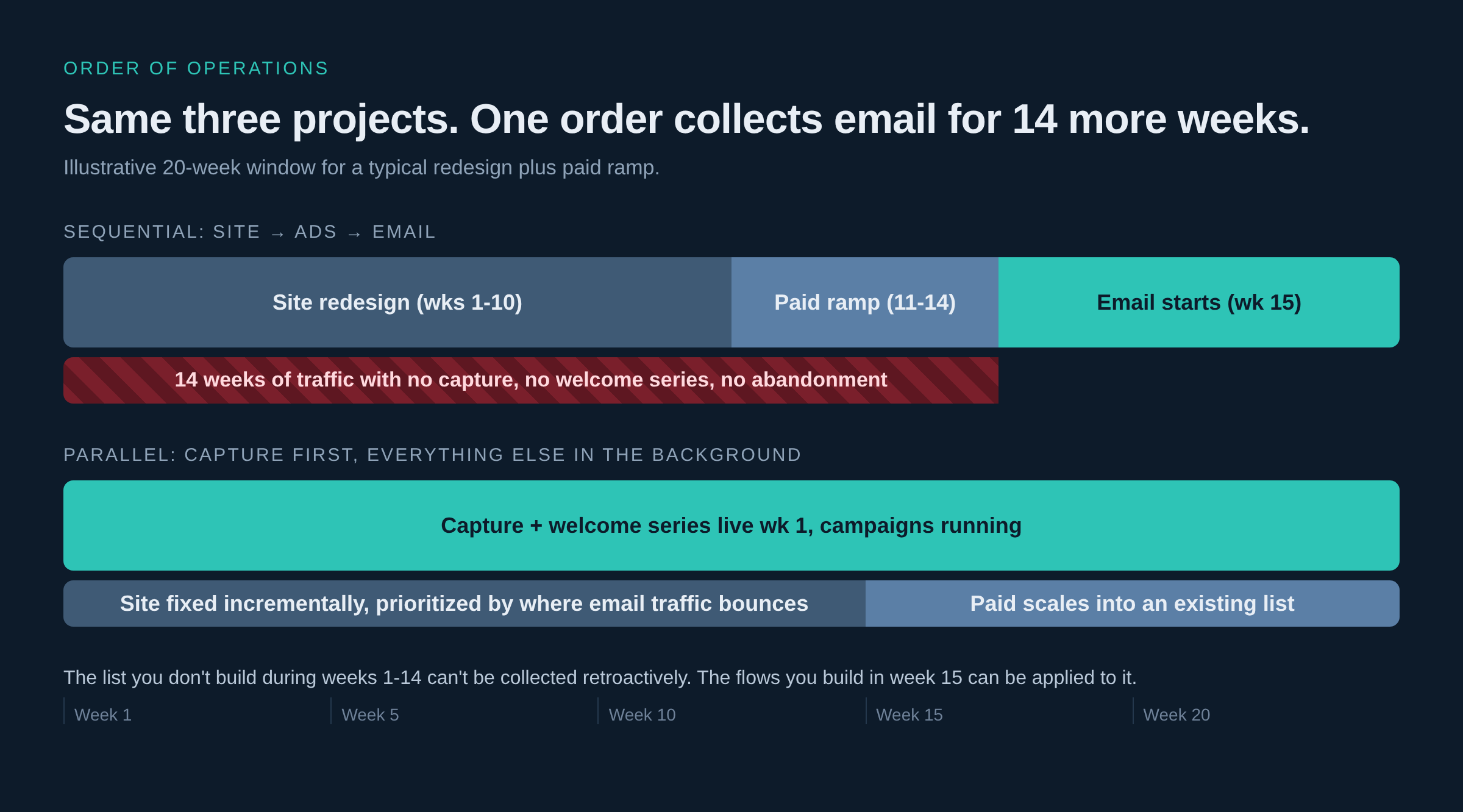
Here's the sequencing problem in plain terms. Say the redesign takes ten weeks. Then ads get four weeks of testing. Then you start on email. That's roughly a quarter of traffic hitting your site with no meaningful capture, no welcome series, no abandonment coverage, no reason for anybody to hear from you again.
Those people didn't wait for you. They're gone.
And it's worse than a pause, because the redesign and the ad push are usually the highest-traffic period you'll have all year. You spent money to bring people in during the exact window where you had the least ability to keep them.
Perfect is not a prerequisite
The reasoning behind the "site first" instinct is fair on its face: why send people to a page you're not proud of? But if you're waiting until everything is right before you send anything, spoiler, it's never going to be right. There's always another fix.
You miss 100% of the emails you don't send. Even a mediocre email program beats a nonexistent one - one is greater than zero. As long as you're not sending anything scammy or so bad it makes people leave the list, a decent email with decent content still generates activity, still generates revenue, and still tells you something.
The only real risk in starting early is list damage, and list damage comes from being annoying or deceptive, not from being unpolished.
Start the list before you start anything else
If I could get founders to do one thing before a redesign kicks off, it's this: get capture working and get a welcome series live. That's it. Not the full program.
The most important long-term asset in this whole thing is list generation - getting people into a position where they can actually receive an email from you. Everything else you build later gets applied to that list retroactively. Build a great flow in November and it works on everybody you collected in August. But you can't retroactively collect August's traffic.
That's why capture comes first, even on a site you're about to tear down. The signup form moves to the new theme in an afternoon. The three months of subscribers you didn't collect don't move anywhere.
Sites improve in increments, not events
The other thing worth pushing back on is the idea that a site gets fixed in one big lift. You don't need a full redesign to make progress. Most of what hurts you is a handful of specific things - a slow PDP, a checkout step that leaks, a mobile nav nobody can use, product photography that doesn't answer the obvious question.
Those are small fixes, and more to the point, they can happen in the background while the email program runs. Nothing about running email prevents you from improving the site at the same time. They're not competing for the same hours in the same way founders assume.
We spend real time at Threadpoint on how email traffic behaves once it lands on the site, because that's where the email program either pays off or doesn't. Which brings up the useful side effect of running email early.
Email traffic tells you where the site is broken
When you send email to your own list, you're sending people who already know you and already want the thing. That's the highest-intent traffic you will ever put on your site.
So if that traffic still doesn't convert, you've learned something specific. It's not an audience problem, it's not a targeting problem, and it's probably not a copy problem. It's the page. When people who like you land and bounce, the site is telling you exactly which page to fix, and now you can prioritize the redesign around real behavior instead of somebody's opinion in a kickoff meeting.
Run it the other way - redesign first, on instinct - and you've spent the money before you had the data.
The order I'd actually run
If it were up to me, most brands would sequence it roughly like this:
Get capture live and a welcome series running, on the current site, whatever shape it's in. Start sending campaigns at a normal cadence with real content, not just discounts. Start the site work in parallel, prioritizing the pages your email traffic is bouncing off. Then scale paid once you have a list to catch the traffic you're buying, because paid gets a lot more defensible when a meaningful slice of the people you paid for become people you can email for free.
The version of this that goes wrong isn't the brand that runs all three at once. It's the brand that runs them strictly one at a time and treats email as the reward for finishing the other two.
Site first, ads second, email third doesn't protect the email program. It just delays it. And email is the one channel in the mix that punishes you for waiting.


