Every vitamin brand I talk to says some version of the same thing: "legal won't let us say anything." Then I open their Klaviyo account and read six months of campaigns, and legal isn't the problem. The copy is vague because nobody writing it can explain what the ingredient actually does inside the body.
Those are two completely different problems, and only one of them has anything to do with compliance.
What you're actually allowed to say
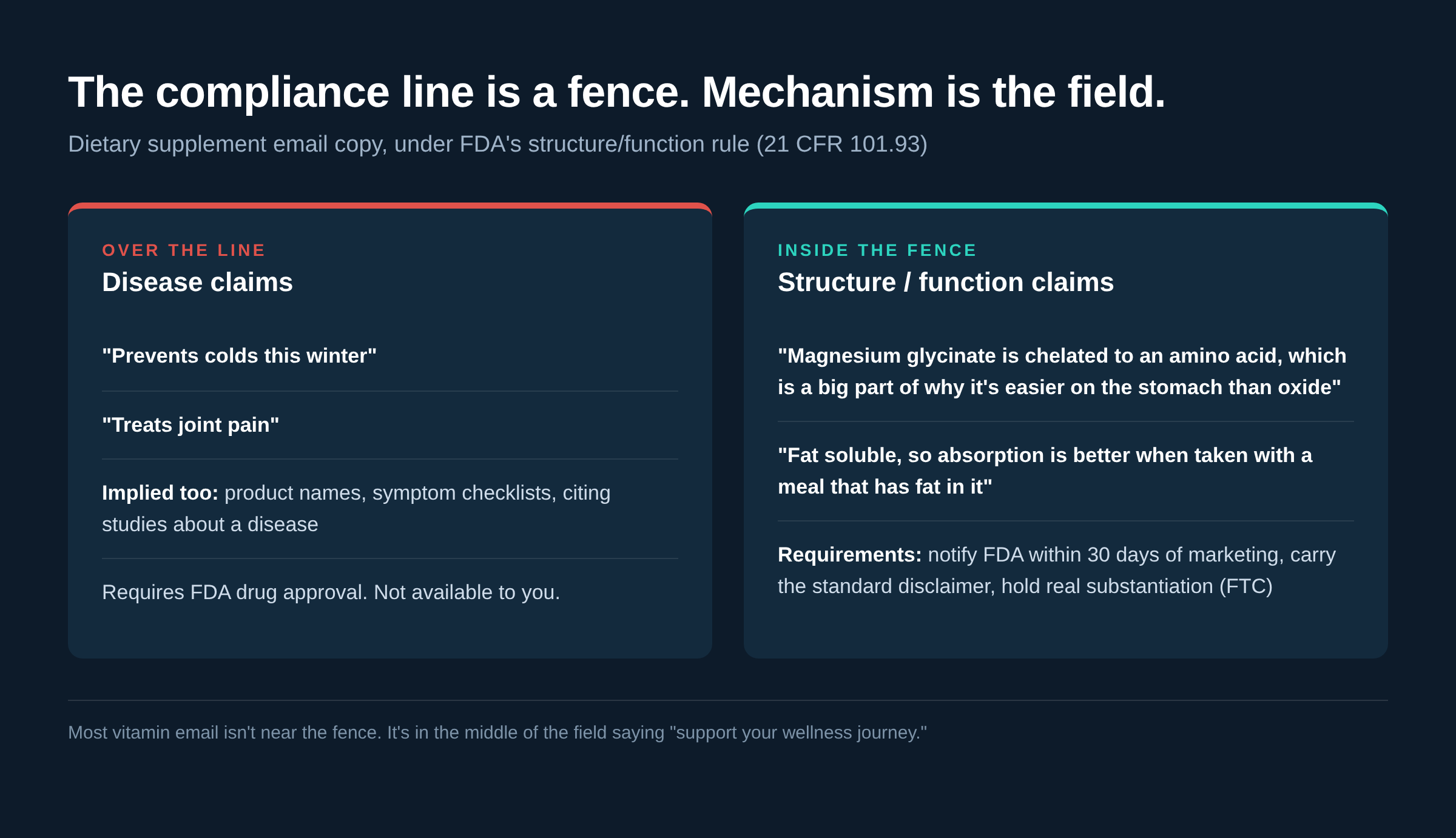
The rules here are narrower than people think in one direction and much wider in the other. Under FDA's rules for dietary supplements, you can't make a disease claim. You can't say a product treats, prevents, cures, or mitigates a condition, and that includes doing it sideways through a product name, a symptom list, or a study citation about a disease. That's real and you should take it seriously.
What you can make is a structure/function claim: a statement about how a nutrient or ingredient affects the normal structure or function of the human body. You notify FDA of the claim within 30 days of going to market, and you carry the standard disclaimer that the statement hasn't been evaluated by FDA and the product isn't intended to diagnose, treat, cure, or prevent disease. Separately, the FTC expects real substantiation behind anything you claim in advertising, which includes your email.
So the fence is: no disease. The field inside the fence is: mechanism. And the field is enormous. "Magnesium glycinate is chelated to an amino acid, which is a big part of why it's easier on the stomach than the oxide form most cheap supplements use" is a sentence about structure and function. It's specific, it's checkable, and it's more persuasive than anything in the "support your wellness journey" genre.
Most brands are nowhere near the fence. They're standing in the middle of the field yelling nothing.
Why the copy comes out vague
This is the part I find interesting, and it's not a legal story. It's a staffing story.
The people writing supplement email usually come out of marketing or, on the review side, out of legal. Marketing instincts default to the flashy claim because that's what marketing rewards. Legal instincts default to cutting anything with teeth. Neither of those backgrounds prepares you to write about mechanism of action, because mechanism is the one thing in this category you genuinely cannot bluff. If you don't know what's happening anatomically, you can't fake a paragraph about it. It shows up in one sentence.
So the copy retreats to the safe middle. "Feel your best." "Support immune health." "Wellness, elevated." Nobody gets in trouble for that, and nobody buys because of it either.
The fix is boring: get somebody with a science background into the drafting process, not just the approval process. Your formulator, your product development lead, whoever wrote the ingredient rationale in the first place. Not as a reviewer at the end who redlines the marketer's guesses, but as a source at the beginning. Twenty minutes on a call with the person who chose the ingredients will give you more usable email copy than a week of a copywriter staring at the product page.
And once you have that raw material, keep the mechanism in the email. The most common failure I see is a brand that does the science work, then lets it get sanded down through three rounds of "make it punchier" until the specific thing is gone.
Customers want the mechanism, not the promise
The old model assumed the customer needed to be sold a feeling. Read the reviews on any serious supplement brand and that assumption falls apart. People are comparing forms, dosages, and bioavailability. They're asking why your dose is 400mg when someone else's is 1,000mg. They're screenshotting ingredient panels.
Today's customer wants more information than anyone was giving them five years ago, and they want to make the decision themselves. Treat them like someone capable of reading a mechanism instead of someone who needs to be convinced by a mood. That's a shift in respect as much as it is a shift in copy.
Practically, that changes what goes in the emails:
- Welcome flow. Somewhere in the first three emails, explain why the formula is built the way it is. Not the origin story, the formulation logic. Why this form of the ingredient, why this dose, what happens with it in the body.
- Product education campaigns. One ingredient per send, explained properly. These consistently outperform the "here's 15% off" send in the accounts I've seen, and they don't cost you margin.
- Post-purchase. Timing and pairing instructions, with the reason attached. "Take it with a fat source" lands differently when you explain that the vitamin is fat soluble and won't absorb well otherwise. It also cuts the "it didn't do anything" refund emails.
- Winback. Instead of a bigger discount, address the actual reason people quit, which is usually that they didn't feel anything obvious. Explaining what's measurable versus what's felt, and on what timeline, is a better retention argument than 20% off.
There's a nice side effect: a mechanism paragraph is the kind of content people quote, link to, and increasingly the kind that gets pulled into AI answers. Vague benefit copy is invisible to all three.
The swap test
Here's the test I run on any supplement or vitamin email, and it takes about five seconds.
Take your subject line, your preview text, and your email design. Could you drop them onto a completely different product in a completely different category and have them still make sense? If the answer is yes, you're not marketing that product. You're marketing the idea of buying a supplement.
"Feel the difference" works for a pre-workout, a probiotic, a mattress, and a pair of running socks. That's how you know it's saying nothing.
Customers pick this up instantly, even if they'd never say it that way. It reads as a brand that either doesn't know its own product or doesn't think you're smart enough to hear about it. The failed version of the swap test is what most vitamin inboxes look like right now, which is genuinely good news if you're willing to be the specific one.
Where this shows up across health and wellness
This isn't only a vitamin problem. It runs through most of health and wellness email. Probiotic brands have strain-level specifics that almost never make it into a campaign, even though the strain is the entire argument. Recovery and wellness brands sit on protocol detail. Medical device brands have anatomy on their side and still write like a lifestyle brand. Fitness equipment brands have programming knowledge nobody's using in email.
Every one of those categories has a person internally who can explain exactly why the product works. In most companies that person has never been asked to help with an email.
Start there. The compliance line is real, but it's a fence at the edge of a very big field, and almost nobody in this category is using the room they already have.


