Most founders hit $2M doing what they're good at. Making the product. Running the ads. Sending the emails. Handling customer service at 11pm on a Tuesday. It works because you are the entire system.
Then you try to get to $5M by doing more of all of that. And it just... doesn't move.
We work with brands at every revenue stage, and the $2M-to-$5M range is where we see the most frustration. Not because the product stopped working. Not because Meta CPMs got too high (though that doesn't help). It's because the business itself hasn't changed shape.
You're Still the Ceiling
At $2M, the founder holding pricing, inventory, and campaign strategy in their head is a feature. You move fast. You make decisions in the shower. You know your numbers because you check them six times a day.
At $5M, that same founder is the bottleneck. Every decision still runs through you. Your team can't move without your input. And you're not scaling a brand - you're just working harder inside the same ceiling.
This is the part nobody talks about: it's not a revenue problem showing up as a revenue problem. It's an infrastructure problem showing up as a revenue problem.
More Headcount Doesn't Fix a Structural Issue
The instinct at this stage is to hire. Another marketer. A retention person. Maybe an agency for email. And those can be the right moves - but not if you're hiring someone to do what you're already doing.
Hiring another marketer to run the same playbook just adds headcount to the same bottleneck. You've got two people doing the thing that wasn't scaling when one person was doing it.
The brands that actually break through $5M don't just add people. They change how decisions get made. They build systems that don't require the founder to be in every Slack thread. They separate "strategy I set once a quarter" from "execution that runs without me."
It's Not an Ads Problem Either
This is the other trap we see constantly. Revenue stalls, so the first instinct is to spend more on acquisition. Crank up the Meta budget. Test TikTok. Launch a Google Shopping campaign.
And look - paid acquisition matters. But most founders at this stage try to ad-spend their way out of a problem that was never about ads. You don't have a traffic problem at $3M. You have a conversion-to-repeat problem. You have a margin problem. You have a "nobody comes back without a discount" problem.
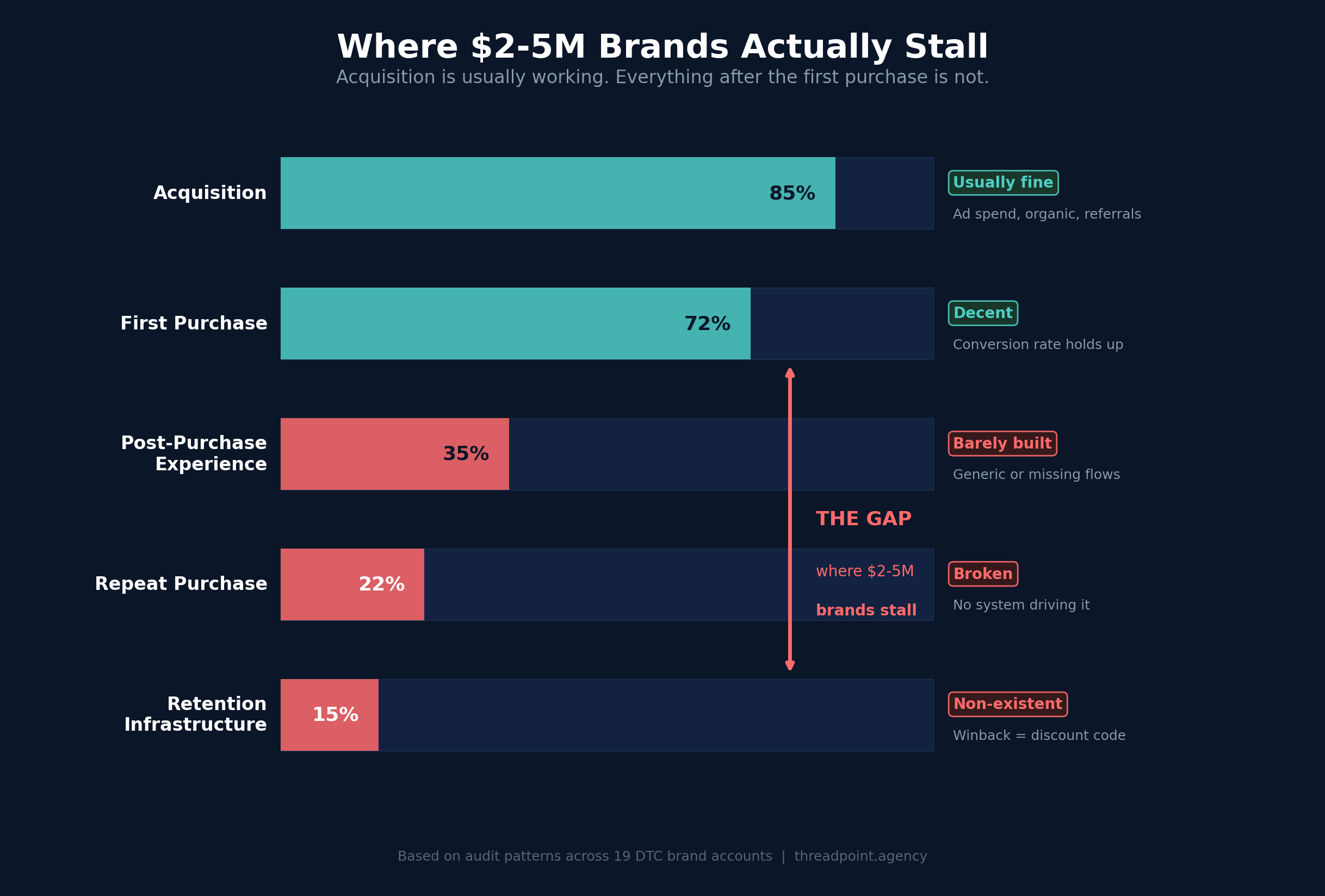
When we audit brands in this range, we almost always find the same thing: acquisition is working fine. It's everything that happens after the first purchase that's broken or barely built.
What Actually Changes Between $2M and $5M
The brands we've seen make this jump do a few specific things differently.
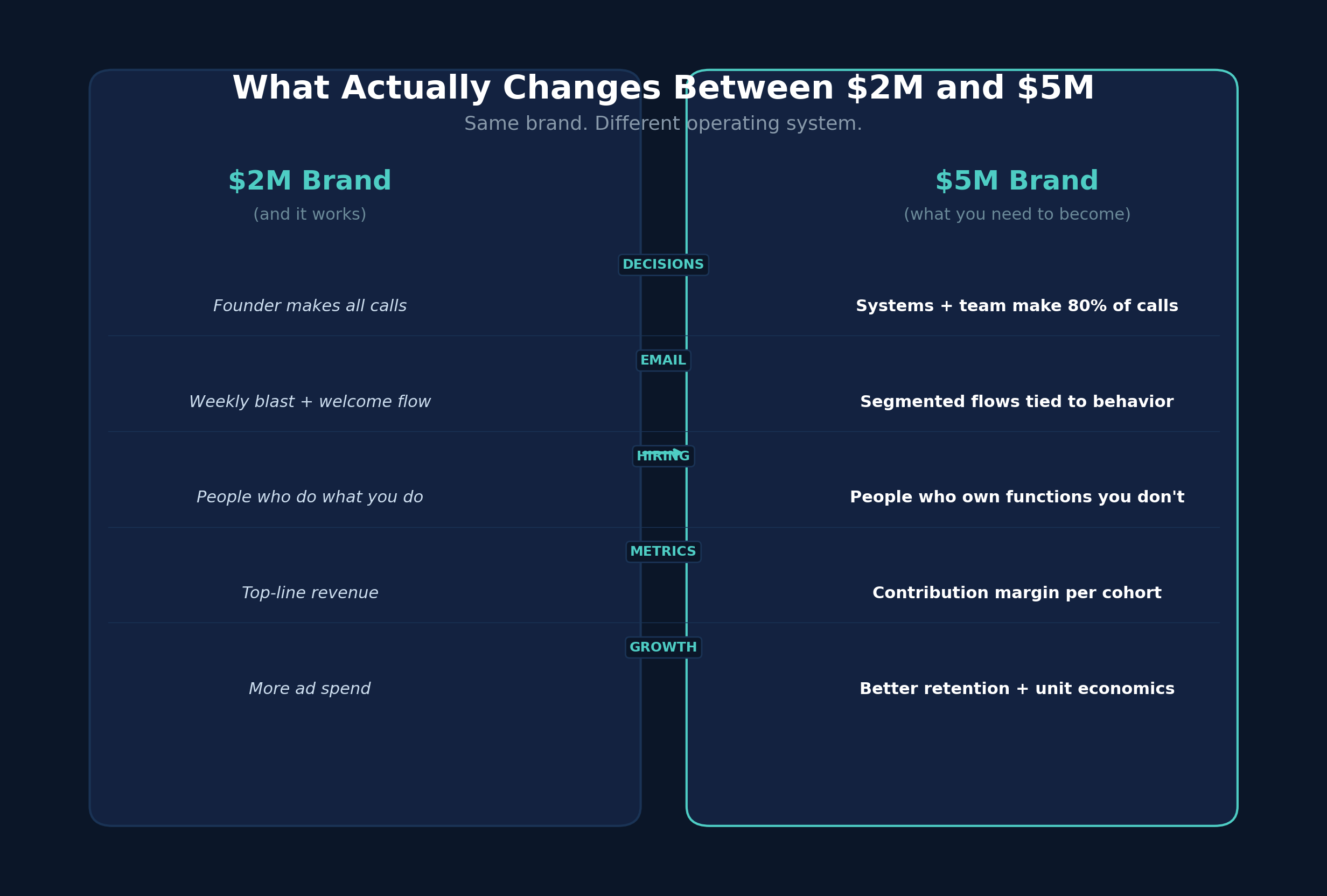
They stop treating email as "campaigns we send." At $2M, a weekly email blast and a welcome flow is enough. At $5M, you need actual infrastructure - post-purchase sequences that change based on what someone bought, winback timing that reflects your actual repurchase curve, segmentation that goes deeper than "engaged 30 days." The brands that make this shift typically see email go from 15-20% of revenue to 30%+ without sending more. They're just sending smarter.
They get real about their unit economics. Not top-line revenue. Actual contribution margin per customer, per channel, per cohort. The brands that stall here are usually growing revenue while margins quietly shrink. You can't see it in a Shopify dashboard. You see it when you sit down with a spreadsheet and track what a customer acquired in March actually did over the next six months. That number tells you whether your growth is real or just expensive.
They build systems before they need them. This is the biggest one. The brands that break through treat infrastructure as something you build three to six months before the revenue problem shows up. Not after. By the time you're feeling the ceiling, you should have already been working on what comes next. That means building the post-purchase flows, the segmentation logic, and the reporting before your revenue graph starts flattening.
They hire for the next stage, not the current one. Instead of "someone who can do what I'm doing," they hire for roles that don't exist yet at $2M. Someone who owns retention as a function, not as a task. Someone who builds the reporting that lets you stop checking dashboards six times a day. The difference between a $2M hire and a $5M hire isn't seniority - it's scope.
The Uncomfortable Truth
Nobody wants to hear that their business needs to change shape. Especially when it's working. $2M is a real business. It's profitable. It's growing. The product is selling.
But "working" and "scaling" aren't the same thing. And the longer you run a $5M business with $2M infrastructure, the harder the eventual rebuild becomes. We've seen brands push to $4M on sheer willpower and then spend six months rebuilding things they should have built at $2.5M.
The good news: you don't have to figure this out overnight. But you do have to start treating it as an infrastructure project, not a marketing project. The revenue follows when the foundation is right.


