If you run a DTC brand on Klaviyo, you've probably heard some version of this rumor in the last month: Salesforce is circling Klaviyo. The chatter's been loud enough in agency circles that we've had multiple clients ask us about it directly - so let's talk about it.
Here's the honest answer: we can't verify it, and neither can anyone else publicly. The reporting out there is built entirely on anonymous "sources close to the matter," with both companies declining to comment. That's not a confirmed deal, a term sheet, or even a leaked internal memo. Treat the specifics - deal size, timelines, who's at the table - as noise until something official drops.
But here's why we're writing about it anyway: the question underneath the rumor is worth answering regardless of whether this specific deal is real.
Salesforce has been on a genuine, well-documented acquisition run in 2026. They closed the Fin deal (formerly Intercom) for roughly $3.6 billion in June, plus a string of smaller AI-agent and data-infrastructure pickups. Consolidation in the martech stack is happening, and it's accelerating - even if Klaviyo isn't the next domino.
So the real question isn't "is this rumor true." It's "what should a Klaviyo-dependent brand be thinking about either way?"
What actually changes when a platform gets acquired
Look at Salesforce's own track record - ExactTarget in 2013, Pardot the same year, MuleSoft, Tableau, Slack. The playbook largely repeats, whether the acquirer is Salesforce, Adobe, or anyone else.
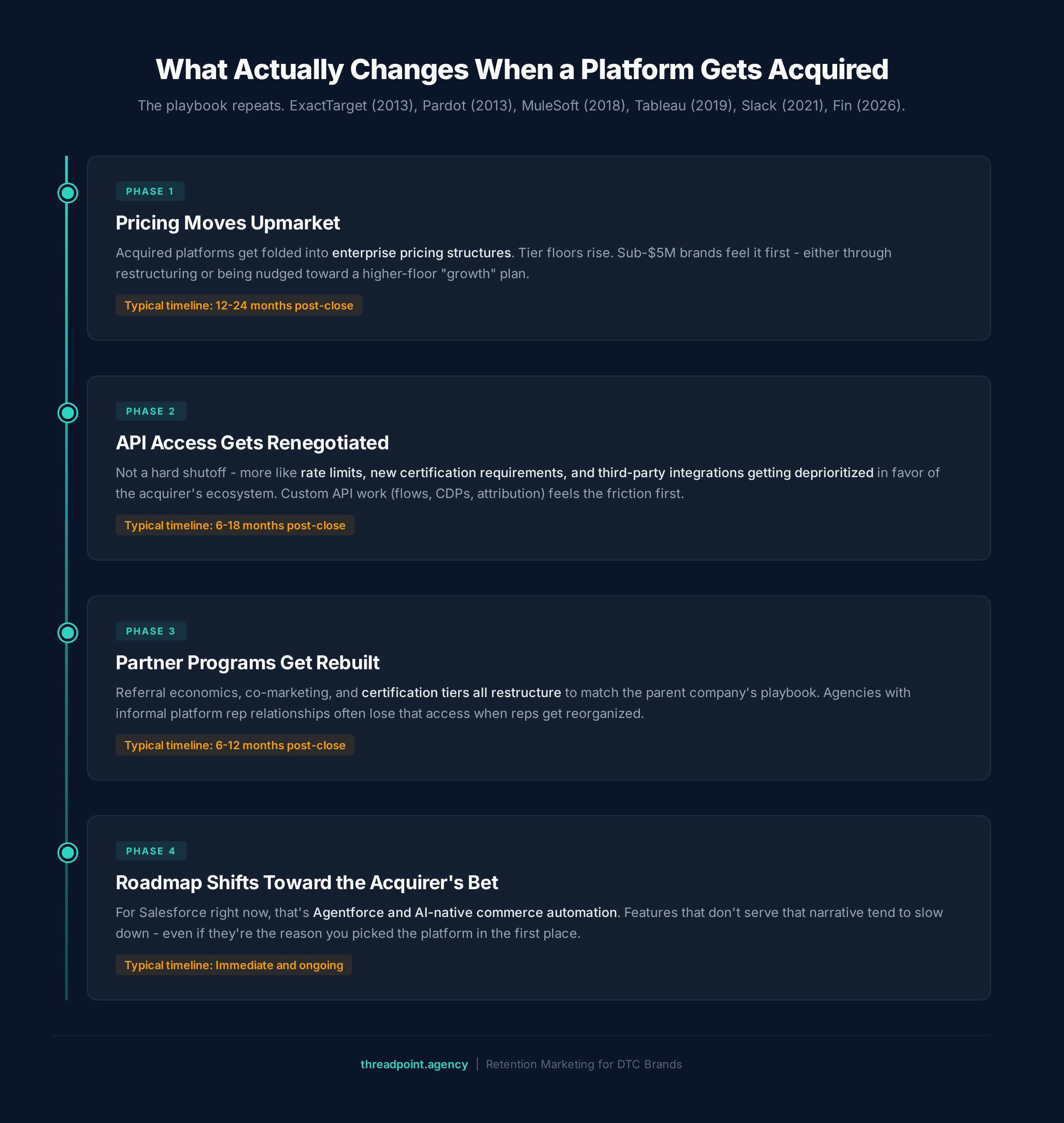
Pricing tends to move upmarket. Acquired platforms usually get folded into enterprise pricing structures over 12-24 months. Sub-$5M brands are typically the first to feel this - either through tier restructuring or by getting nudged toward a "growth" plan with a higher floor.
API access gets renegotiated, not cut. The bigger risk isn't a hard shutoff - it's rate limits, new certification requirements, or third-party integrations getting deprioritized in favor of the acquirer's own ecosystem. If your stack leans on custom API work (flows, CDPs, attribution tools), that's where you'd feel friction first.
Partner programs get rebuilt around the acquirer's model. Referral economics, co-marketing funds, certification tiers - pretty much all of it gets restructured to match the parent company's partner playbook. Agencies with deep, informal relationships with platform reps often lose that access when reps get reorganized into a bigger sales org.
Roadmap priorities shift toward the acquirer's strategic bet. For Salesforce specifically, that's Agentforce and AI-native commerce automation right now. Features that don't serve that narrative tend to slow down, even if they're the reason you chose the platform in the first place.
Why we're not hitting the panic button
We're a Klaviyo agency partner. We run retention programs on Klaviyo every day for brands across a dozen verticals. And honestly, nothing about this rumor changes our confidence in the platform.
Klaviyo is still the best retention marketing tool in the DTC ecosystem. The segmentation depth, the Shopify-native data layer, the flow builder - none of that evaporates because of a rumor, and it wouldn't evaporate overnight even if an acquisition did happen. Acquired platforms don't just vanish. They evolve, sometimes slowly, sometimes in ways that actually benefit the user base (Slack got better enterprise features under Salesforce, not worse ones).
That said, smart brands don't just trust that everything will stay the same forever. They understand their own stack well enough that they're never caught off guard - not by an acquisition, not by a pricing change, not by anything.
What good stack hygiene actually looks like
This isn't a contingency plan. It's just good practice - the kind of stuff every brand running a serious retention program should have buttoned up regardless of what's happening in the trade press.
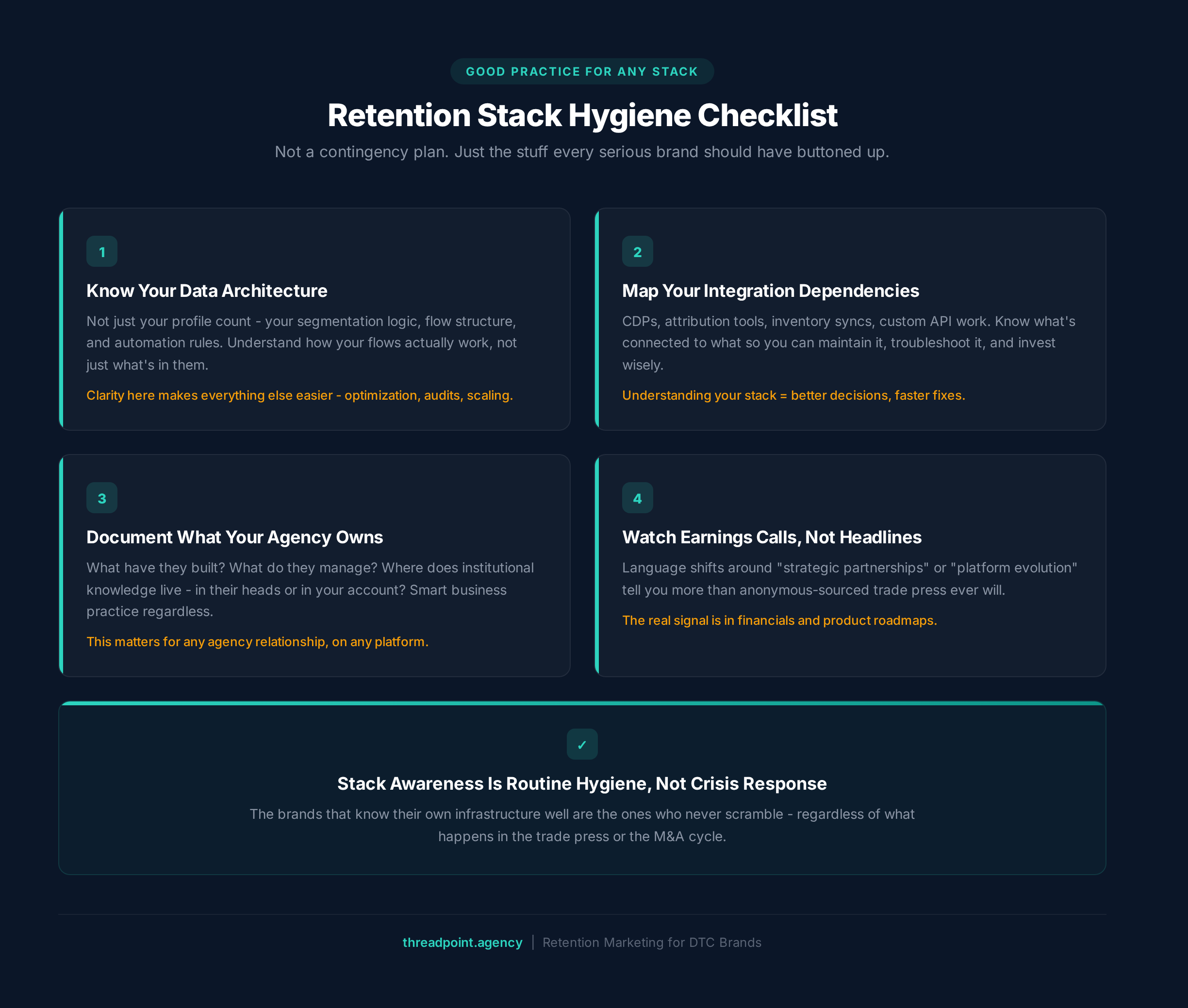
Know your data architecture inside and out. Not just your data - your segmentation logic, flow structure, and automation rules. Most brands can tell you how many profiles they have. Fewer can explain how their flows actually work, which segments drive which campaigns, and where their logic lives. That clarity is valuable no matter what platform you're on.
Map your integration dependencies. Custom integrations, CDPs, attribution tools, inventory syncs - know exactly what's connected to what. This isn't about being ready to leave. It's about understanding what you've built so you can maintain it, troubleshoot it, and make better decisions about where to invest next.
Document what your agency actually owns. If you're working with an agency (us or anyone else), make sure you know what they've built, what they manage, and what institutional knowledge lives in their heads vs. in your account. That's just smart business practice.
Pay attention to the earnings calls, not the rumor mill. Klaviyo's next earnings call and any language shift around "strategic partnerships" or "platform evolution" will tell you more than anonymous-sourced trade press. The actual signal is always in the financials and the product roadmap - not in speculation.
The bigger takeaway
Platform risk isn't a Klaviyo thing - it's a reality of building on any vendor. But understanding that risk and panicking about it are two very different things. The brands and agencies who treat stack awareness as routine hygiene (not crisis response) are the ones who can stay focused on what actually matters: building better retention programs, sending better emails, and growing revenue.
We're still all-in on Klaviyo. If something concrete surfaces, we'll talk about it plainly - but we're not losing sleep over anonymous sourcing, and you shouldn't either.


