Here's something that bugs me about how most ecommerce brands run their email program.
They spend 3-4 hours building a campaign. Design, copy, QA, scheduling. Then they send it to their list, check the numbers the next morning, and move on to the next one. Rinse and repeat, week after week.
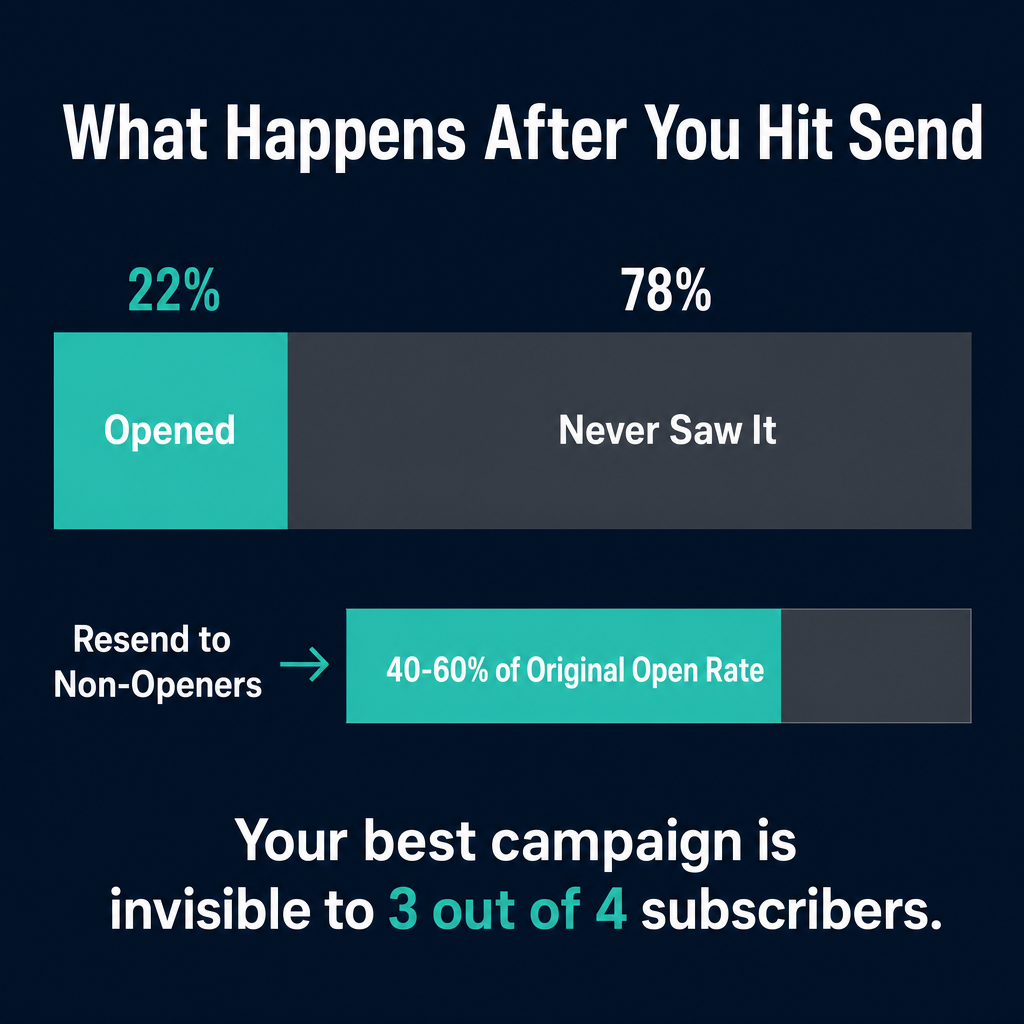
That campaign they spent half a day on? It landed a 22% open rate. Which means roughly 78% of the people on that list never saw it.
Related: what a good open rate looks like in 2026
And nobody goes back.
The email just sits there. Proven creative. Proven offer. Proven subject line performance. Collecting dust in the campaign archive while the team scrambles to build something new from scratch.
That's not a strategy problem. It's a habit problem.
Resending Isn't Lazy. It's Math.
There's this weird stigma around resending campaigns. Like it's cutting corners. Like your subscribers will notice and think less of your brand.
They won't. Because they literally never saw it the first time.
Think about why someone doesn't open an email. They were busy. They were in a meeting. Their inbox was slammed that morning. Maybe the subject line didn't land for them personally, but that doesn't mean the content inside wasn't exactly what they needed. Or maybe they saw it on their lock screen, meant to come back to it, and just forgot.
None of those reasons mean they'd ignore it a second time.
When you resend a top-performing campaign to people who didn't open it the first time, you're not sending something old. You're sending something they've never seen. It's a brand new email to them.
The Segment Is Everything
This only works if you do the segmenting right. And this is where most brands get sloppy.
A resend is not a blast to your full list. It's targeted at the people who didn't engage the first time around. In Klaviyo, you're building a segment of profiles who received the original campaign but didn't open it. That's your resend audience.
If you send it to everyone - including people who already opened, clicked, and maybe even purchased - you're going to annoy people and tank your engagement metrics. The whole point is reaching the segment that missed it.
Some teams get more specific than that. They'll layer in recency filters, engagement tiers, or exclude people who've purchased since the original send. That's smart. The tighter the segment, the cleaner the results.
Change the Subject Line. Keep the Creative.
Here's the part people overthink.
The email body - the design, the layout, the offer, the copy - already worked. That's why you're resending it. Don't touch it unless something is genuinely time-sensitive or outdated.
But the subject line and preview text? Change those. If someone scrolled past "Summer's Best Sellers Are Here" on Tuesday, maybe "These sold out last week - back in stock" gets them on Thursday. Different hook, same proven content inside.
That said - and this is important - you do need to actually review the content before hitting send. Some campaigns won't translate to a resend without modifications. A "flash sale ends tonight" email obviously can't go out three days later with the same urgency language. A product launch email might reference a date that's already passed. Use common sense. Most campaigns are fine as-is, but you need someone eyeballing it before it goes out.
Use Your Analytics to Find the Right Candidates
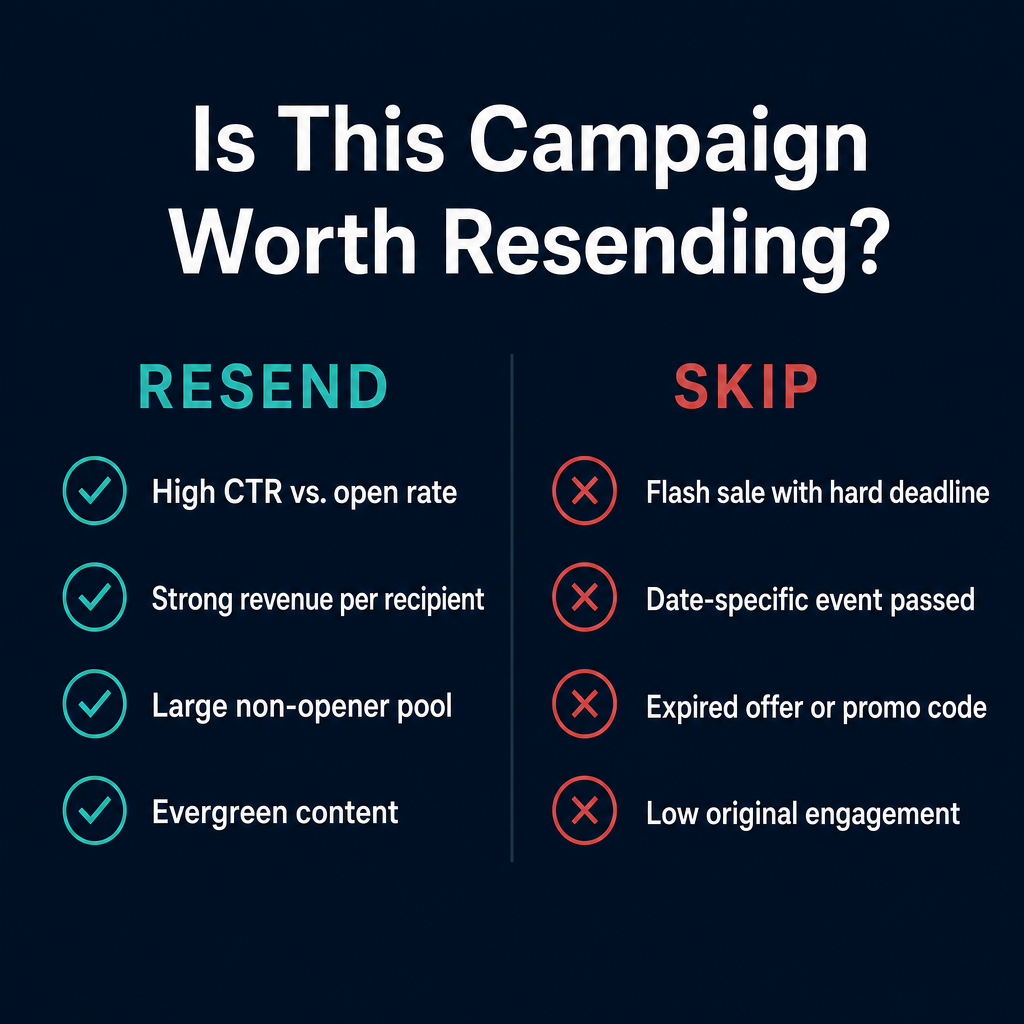
Not every campaign deserves a resend. The ones that do usually have a few things in common:
- Strong click-through rate relative to open rate (meaning the content resonated with people who actually saw it)
- High revenue per recipient among openers
- A large enough non-opener pool to make it worthwhile
- Content that isn't tied to a specific moment in time
Your best candidates are usually product launches, collection highlights, educational content, and seasonal campaigns that still have runway. Your worst candidates are flash sales with hard deadlines, event-specific sends, and anything where the offer has expired.
Pull up your last 90 days of campaigns. Sort by revenue or click rate. The top 5-10 performers are your resend shortlist. Now check how many non-openers each one has. If a campaign generated $15K on a 20% open rate, there's potentially another $10K+ sitting in the 80% who never saw it.
Monitor Everything. Compare Honestly.
Treat resends as their own performance category. Track them separately from your original campaigns so you can actually measure what they're worth.
The numbers you want to compare:
- Open rate on the resend vs. the original
- Click-through rate on the resend vs. the original
- Revenue per recipient on the resend vs. the original
- Unsubscribe rate on the resend (watch this one closely)
In our experience, resends typically pull 40-60% of the original campaign's open rate. Click rates tend to hold closer to the original because the people who do open are seeing proven content. Revenue per recipient can actually be comparable because the offer and creative already demonstrated they convert.
If your resend unsubscribe rate spikes, your segment is wrong. Go back and tighten it up.
The Agency Math That Nobody Talks About
If you're working with an email agency - or you are one - resending changes the economics of the entire engagement.
Think about what a typical campaign costs to produce. Strategy, copywriting, design, development, QA, scheduling. That's hours of work across multiple people. A resend takes maybe 15 minutes. Clone the campaign, swap the subject line, build the non-opener segment, review the content, schedule it.
From an agency perspective, resends are almost always in your favor. You add team efficiency that frees up bandwidth for higher-value work - new flow builds, A/B testing programs, strategy - while simultaneously generating additional revenue for your client. That's real value that didn't exist before, and it didn't require burning the team out to create it.
Related: post-purchase flows
But here's where it gets nuanced. You need to think about how resends fit into your client's contract. Is this in lieu of a net-new campaign that was already planned? Is it a bonus send on top of the existing calendar? The answer matters - both for how the client perceives value and for how you protect your own margins.
The best approach we've seen: frame resends as incremental. They're not replacing the campaigns you'd normally build. They're an additional revenue lever that your team can execute with minimal effort. Most clients love this framing because they're getting more sends, more revenue, and they're not paying extra for it.
Know your client, though. Some brands are sensitive about send frequency and don't want to increase volume. Others will ask why you weren't doing this already. Both reactions are valid. Read the room.
Start Small and Build the Case
If you've never resent a campaign before, don't start by resending everything from the last quarter. Pick your single best-performing campaign from the last 30 days. Build the non-opener segment. Swap the subject line. Send it.
Then compare. If the numbers hold up - and they usually do - you now have a data point to justify making this a regular part of your program.
Most brands we work with end up adding 2-4 resends per month once they see the first round of results. That's 2-4 additional revenue-generating sends that took almost zero creative effort to produce.
Your best emails shouldn't be one-and-done. The math doesn't support it, your team's bandwidth doesn't support it, and your subscribers literally didn't see them the first time.
Send them again.


