There's a number floating around right now that should bother every DTC founder who's looked at their P&L this year.
The median public DTC brand runs a 47% gross margin. That's healthy. That's the kind of number you'd show an investor and feel good about. The product economics work.
But here's the part nobody puts in the pitch deck: the median operating margin for those same brands is -2.4%.
Negative. After five consecutive years of sitting at or below break-even.
That's not a product problem. That's an everything-else problem.
The 49-Point Gap Nobody Talks About
Eightx Research published a report this summer analyzing 40+ public DTC and CPG brands. The headline: only 4 of 14 brands cleared 5% EBITDA in FY2025. Six of 19 are actively losing money. Even Lululemon - the poster child for DTC profitability - compressed 260 basis points year over year.
So where does 47% gross margin go? It gets eaten. Layer by layer.
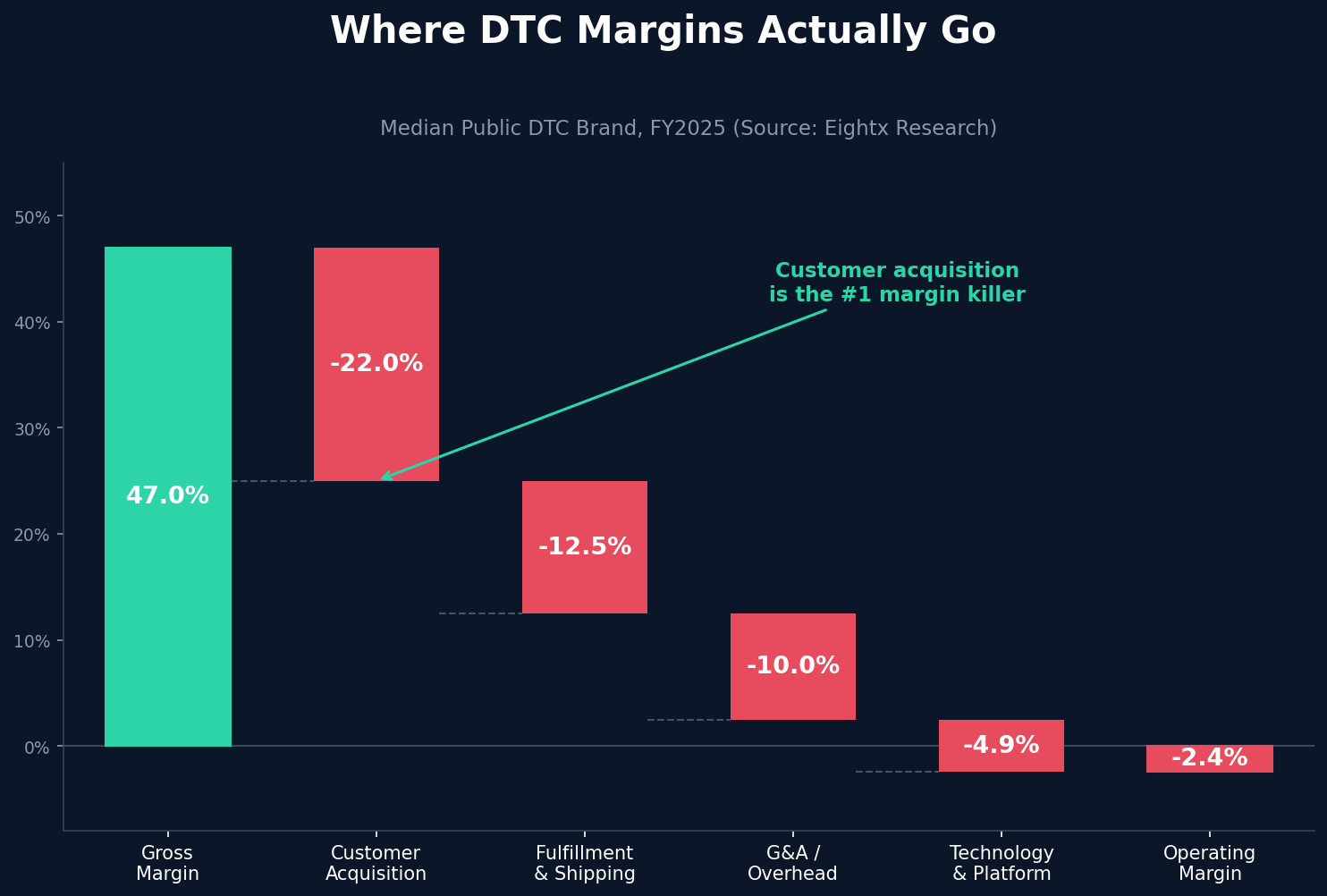
Customer acquisition takes the biggest bite. Then fulfillment and shipping (diesel is up 58% year over year, warehousing costs up 51% since 2021). Then G&A. Then platform and technology fees. By the time you've paid for everything it takes to find and deliver a customer, the product margin that looked so good on paper is gone.
And the single biggest line item in that stack - the one most within your control - is how you find customers.
Acquisition Costs Have Changed. Most Budgets Haven't.
Average ecommerce CAC now sits between $68 and $84, up 40-60% since 2023. Meta CPMs are up roughly 18% year over year for DTC apparel alone. Google CPC is up nearly 13%. TikTok prospecting costs are climbing too.
The math used to pencil out because you could acquire a customer for $30-40 and their first order covered it. That math doesn't work anymore for most brands. Top quartile CAC payback is now 8 months. Bottom quartile? 18 months or more. You're spending money you won't see back for over a year - if it comes back at all.
But here's what's interesting: most brands still allocate their marketing budget like it's 2021. Heavy on acquisition, light on retention. They're running the same playbook with costs that have fundamentally changed.
The Numbers When You Flip the Focus
This is where the math gets hard to argue with.
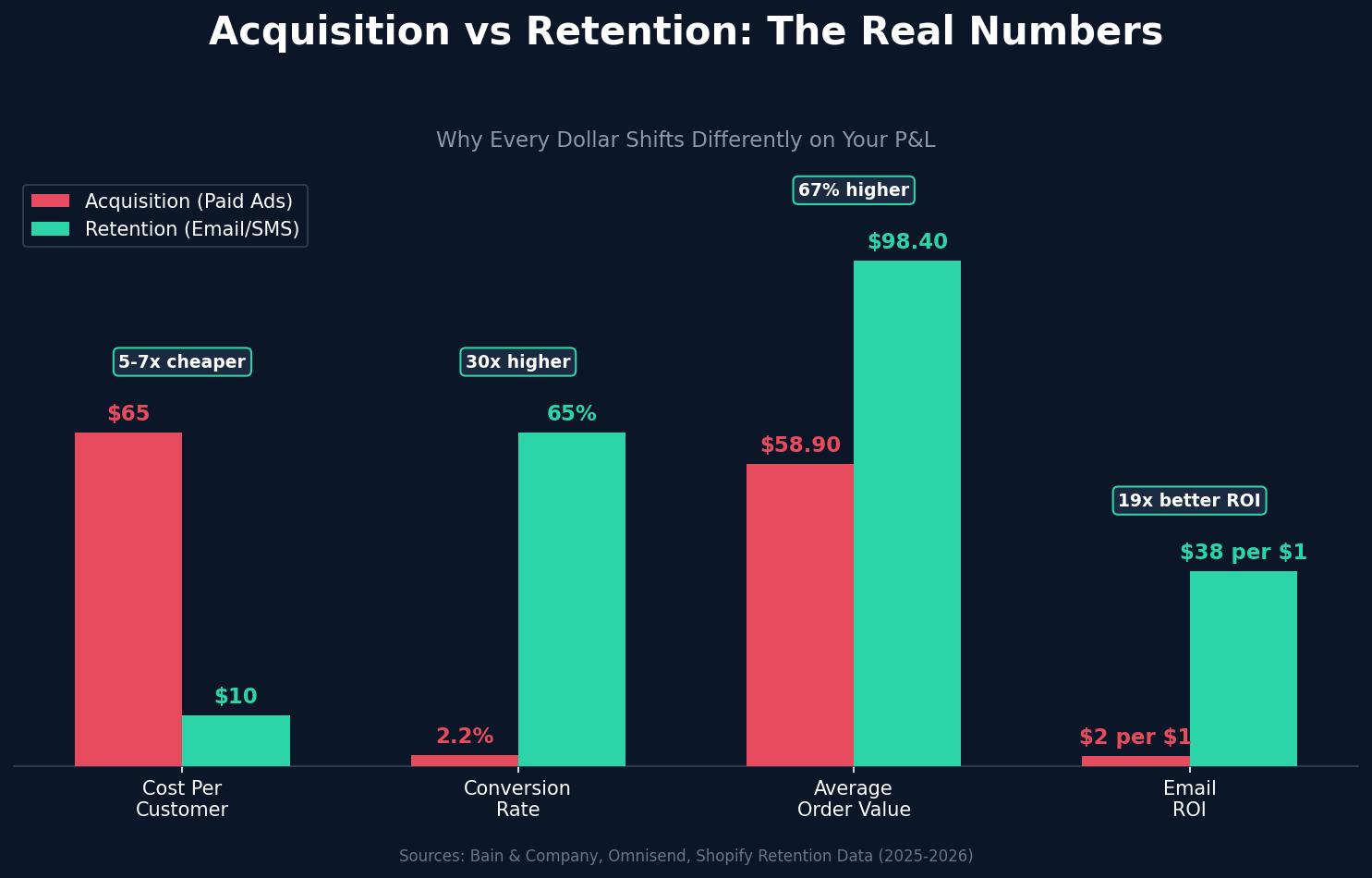
Acquiring a new customer costs $45-65 through paid channels. Retaining an existing one through email and SMS? $7-12. That's 5-7x cheaper, according to Bain & Company's research.
But cost is only part of it. The conversion rate gap is even bigger. Paid ads convert at 1.8-2.5%. An email to someone who's already bought from you? 60-70% probability of converting. That's not a marginal improvement. That's a completely different category of efficiency.
Returning customers also spend more. Average order value from a repeat buyer runs about $98, compared to $59 from a first-time purchase. That's 67% higher. They already trust the brand, they already know the product, they don't need convincing - they just need a reason to come back.
And the ROI difference is staggering. Email marketing generates $36-42 for every dollar spent. PPC? About $2 for every dollar. That's not a debate. That's a rounding error on one side and a growth engine on the other.
Why Email Is Built for This
There's a reason email sits at the center of this conversation and it's not just because it's cheap to send.
Email reaches people who already raised their hand. They're on your list because they opted in. They browsed your site. They bought something. They're not cold prospects sitting in a lookalike audience - they're real people who already showed interest in what you sell.
And because of that, you can do things with email that paid channels can't touch:
Behavioral triggers based on actual activity. Someone abandoned a cart? You know exactly what they were looking at and when. Someone bought running shoes three months ago? You know they're probably due for a new pair. Someone browsed a product category twice in a week but didn't buy? That's a signal you can act on. Paid ads can't read behavior at that level. Email flows are built for it.
Personalization that's real, not just a first name. You can segment by purchase history, browse behavior, AOV tier, buying frequency, product category preference - and build messaging around what each segment actually cares about. A VIP customer who buys every month gets a different message than someone who bought once six months ago. That level of tailoring isn't possible when you're bidding on impressions.
Timing you control. You can lean on the psychology of how people shop. Replenishment reminders timed to actual usage patterns. Post-purchase education sequences that build loyalty before the next buy. Win-back campaigns that hit right when someone starts to drift. You're working with the customer's own buying rhythm, not competing for attention in a feed.
No platform tax. Every email you send goes directly to someone who wants to hear from you, through infrastructure you already pay for. There's no auction, no algorithm deciding who sees it, no CPM that goes up 18% every year. The cost per send stays flat while the value of your list compounds over time.
What Shifting the Budget Actually Looks Like
This isn't about turning off Meta or pulling out of Google. You still need acquisition. The question is whether the current split makes sense given what the numbers are telling you.
If your brand is running a 70/30 acquisition-to-retention budget and your operating margin is negative, the fix isn't to find a cheaper ad platform. The fix is probably to move that split closer to 50/50 - or even 40/60 - and put the difference into the channels that convert 30x better at a fraction of the cost.
That means investing in email and SMS infrastructure that actually works. Not just a welcome series and an abandoned cart flow. We're talking about:
- Post-purchase sequences that turn first-time buyers into repeat customers
- Replenishment flows timed to your actual product usage cycle
- Browse abandonment that doesn't just push a discount but continues the conversation
- Win-back campaigns that re-engage lapsed customers before you have to re-acquire them
- VIP segmentation that rewards your best customers and drives higher AOV
Every one of those flows generates revenue from people who already know your brand. People you already paid to acquire. The marginal cost of getting them to buy again is a tiny fraction of what it cost to get them in the door the first time.
The P&L Case Is Pretty Simple
If you're a DTC brand with a healthy gross margin and a thin or negative operating margin, the lever isn't your product. The product's working. The lever is where you spend to generate the next dollar of revenue.
A dollar of revenue from a new customer acquired through paid ads costs you $45-65 in acquisition spend, runs through a 2% conversion rate, and generates a $59 average order. You might not see that money back for 8-18 months.
A dollar of revenue from an existing customer reached through email costs you $7-12 in retention spend, runs through a 60-70% conversion rate, and generates a $98 average order. The payback is immediate.
Same revenue line. Completely different impact on your operating margin.
For brands that want to either stay profitable or get back to profitability, this isn't a marketing theory. It's just math. And the math is saying that the way most brands allocate their marketing budget is the same reason their operating margins look the way they do.


