Your products are now showing up inside ChatGPT, Microsoft Copilot, Google AI Mode, and Perplexity. If you're on Shopify, this is already happening. You didn't have to turn anything on.
Shopify's Spring '26 "Everywhere Edition" shipped something called Shopify Catalog - a structured data layer that automatically syndicates your product information to AI platforms. Titles, descriptions, images, pricing, inventory, shipping. All of it, flowing to AI agents in real time. There's even an Agentic Storefronts dashboard in your Shopify admin showing you orders that came from AI channels.
And Shopify says their structured data drives 2x more conversion in AI chats compared to scraped data.
That's a big deal. But it also means something most brands haven't thought about yet: when an AI agent sells your product for you, your post-purchase email flow is doing a job it was never designed to do.
Your Product Data Is Your New Storefront
Here's how this works in practice. A shopper asks ChatGPT "what's a good moisturizer for sensitive skin under $40." ChatGPT queries Shopify Catalog, pulls structured product data from merchants who match, and recommends a product. The shopper clicks, checks out with Shop Pay, and they're done.
The brand never had a conversation with that shopper. Never showed them a homepage. Never ran a pop-up. Never told them the founder's story or why their formulation is different. The AI handled the entire pre-purchase experience.
And the quality of your product data determines whether the AI recommends you at all.
This is where most Shopify stores are going to fall short. Shopify Catalog pulls from your existing product fields - title, description, images, product type, vendor, tags, barcode, variants. Shopify's own optimization guide makes it clear: clean, accurate, detailed product data gets you surfaced. Sloppy data gets you skipped.
The brands that have been lazy with product descriptions, using vague titles or inconsistent variant naming, are going to get buried. The ones with precise attributes, complete specs, accurate inventory, and real product photography are going to win recommendations they didn't even ask for.
What "clean" actually looks like
This isn't just "write better descriptions." AI agents parse product data differently than humans browse a PDP. A few things that matter now more than they used to:
- Titles need to be specific and descriptive. "The Classic" doesn't help an AI agent. "Women's Organic Cotton Classic Fit T-Shirt - White" does.
- Product types and tags need to be consistent. If half your catalog says "t-shirt" and half says "tee," you're splitting your signal.
- Variant names should be standardized. "S / M / L" not "small / med / lrg" on some products and "S / M / L" on others.
- Barcodes and GTINs matter. AI agents use these to cross-reference and verify products. If you're not filling these in, start.
- Your store policies need to be current. When a customer asks the AI about your return policy mid-chat, it pulls from your Shopify settings. If that's out of date, you're giving wrong answers before you even know the customer exists.
You can also create custom metafields that feed enriched data to AI channels - think detailed ingredient lists, use cases, or compatibility info that goes beyond what standard product fields capture. There's a solid walkthrough here on how to set that up with a CSV bulk update.
The bottom line: your product data is now your storefront for an entire channel you didn't build. Treat it that way.
The Post-Purchase Flow Just Became Your Welcome Series
Here's the part that changes things for email marketers.
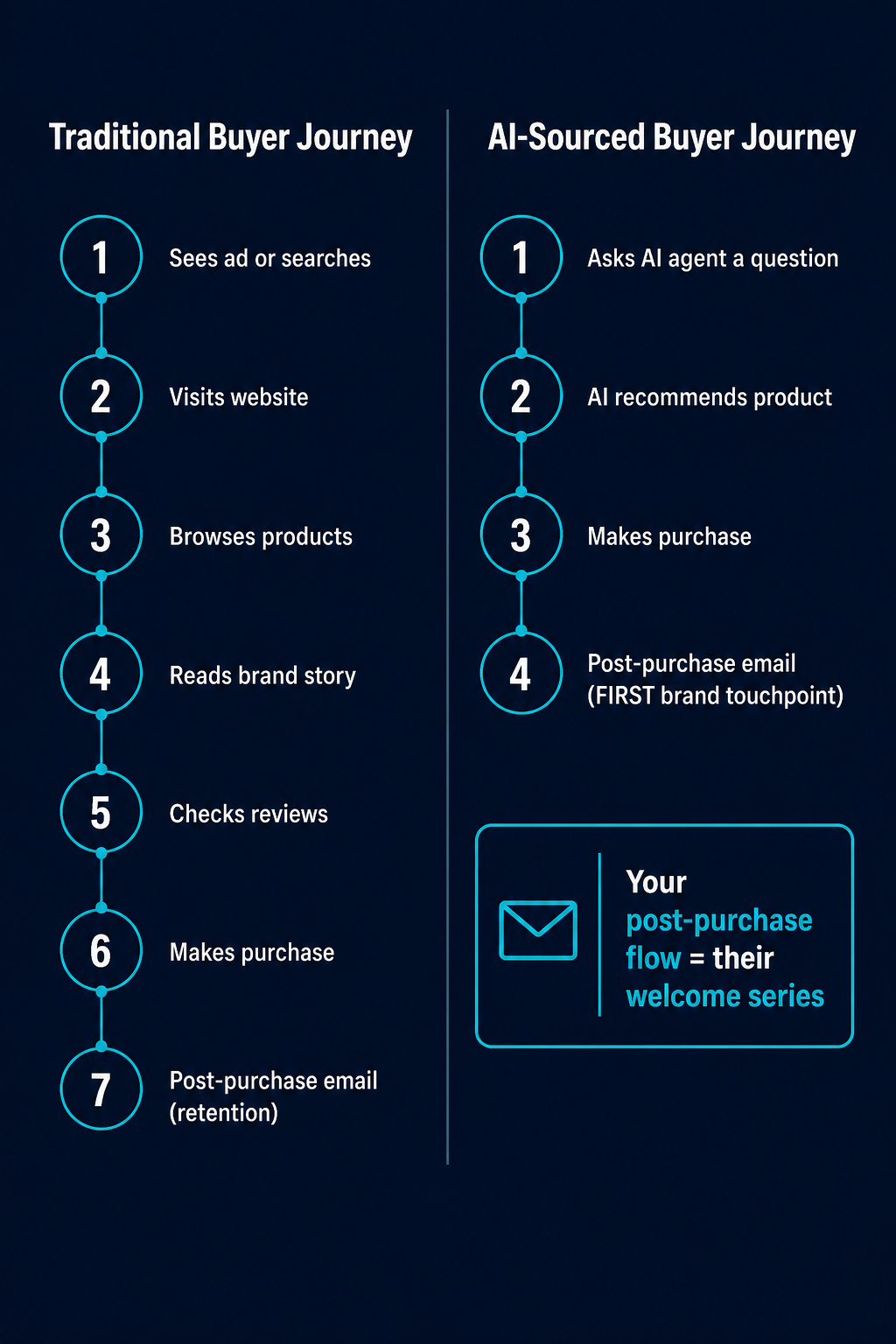
When someone buys through an AI agent, the brand controls almost nothing about the pre-purchase experience. The AI picks what to recommend. The AI handles objections. The AI closes the sale. The buyer might not have seen your website, your Instagram, your about page, or a single piece of your brand content.
They bought a product. Not a brand.
That means your post-purchase email flow is the first real brand touchpoint. It's not just doing retention work anymore. For AI-sourced buyers, it's doing the job of a welcome series. It's introducing who you are, why you exist, and why they should come back.
And if you're still sending the same generic "thanks for your order, here's a tracking link" to every first-time buyer regardless of how they found you, you're wasting the one shot you have to turn an AI-sourced transaction into a real customer relationship.
Segmentation Isn't Optional Here
This is a branching exercise. It's really no different from giving first-time buyers different messaging than repeat buyers, or sending different content to someone who bought during a sale versus someone who paid full price. Context matters, and the message needs to make sense for the person receiving it.
The difference with AI-sourced buyers is intent. They were product-first. They asked an AI for a recommendation, got one, and bought it. They may not know anything about your brand. They may not care. Yet.
So you need to identify them.
In Klaviyo, you'll want to set up conditions or filters that flag first-time buyers specifically from AI channels. Shopify's Agentic Storefronts dashboard tracks which orders came from AI surfaces, and that data flows into your order properties. Use it. Build a segment. Create a conditional split in your post-purchase flow that catches these buyers and routes them into a different experience.
The nuance is that this gets layered on top of your existing branching logic. You're already (hopefully) splitting on first-time vs. repeat buyer, product category, and maybe AOV tier. Now you're adding acquisition source. It's one more branch, but it's an important one.
What the AI-Sourced Buyer Flow Should Actually Do
Think about what this person knows and doesn't know when they get their first email from you.
What they know: They have a product coming. An AI told them it was a good fit.
What they don't know: Who you are. Why your product is different. What your brand stands for. Whether you're worth buying from again.
Your post-purchase flow for these buyers should carry the weight of a welcome series. That means:
Email 1: Order confirmation (standard) - but with brand context. Don't just send a receipt. Include a brief, genuine "here's who we are" section. Not a manifesto. Just enough to start the relationship. Who makes this product, why it exists, what makes it different from what an AI might recommend next time.
Email 2: The "here's what you actually bought" email. This is where you go deeper on the product itself. Usage tips, care instructions, things the AI didn't tell them. Content that makes the buyer feel like they made a smart choice and that there's real expertise behind this brand.
Email 3: The brand story. Now that they have the product in hand, this is where you earn the relationship. Founder story, mission, what customers say about you. This is the content that turns "I bought a moisturizer an AI recommended" into "I buy from this brand."
Email 4+: Standard post-purchase flow. From here, you can start folding them into your regular cadence - review requests, cross-sells, loyalty program, whatever your normal post-purchase sequence looks like. By this point, they should have enough brand context for those messages to actually land.
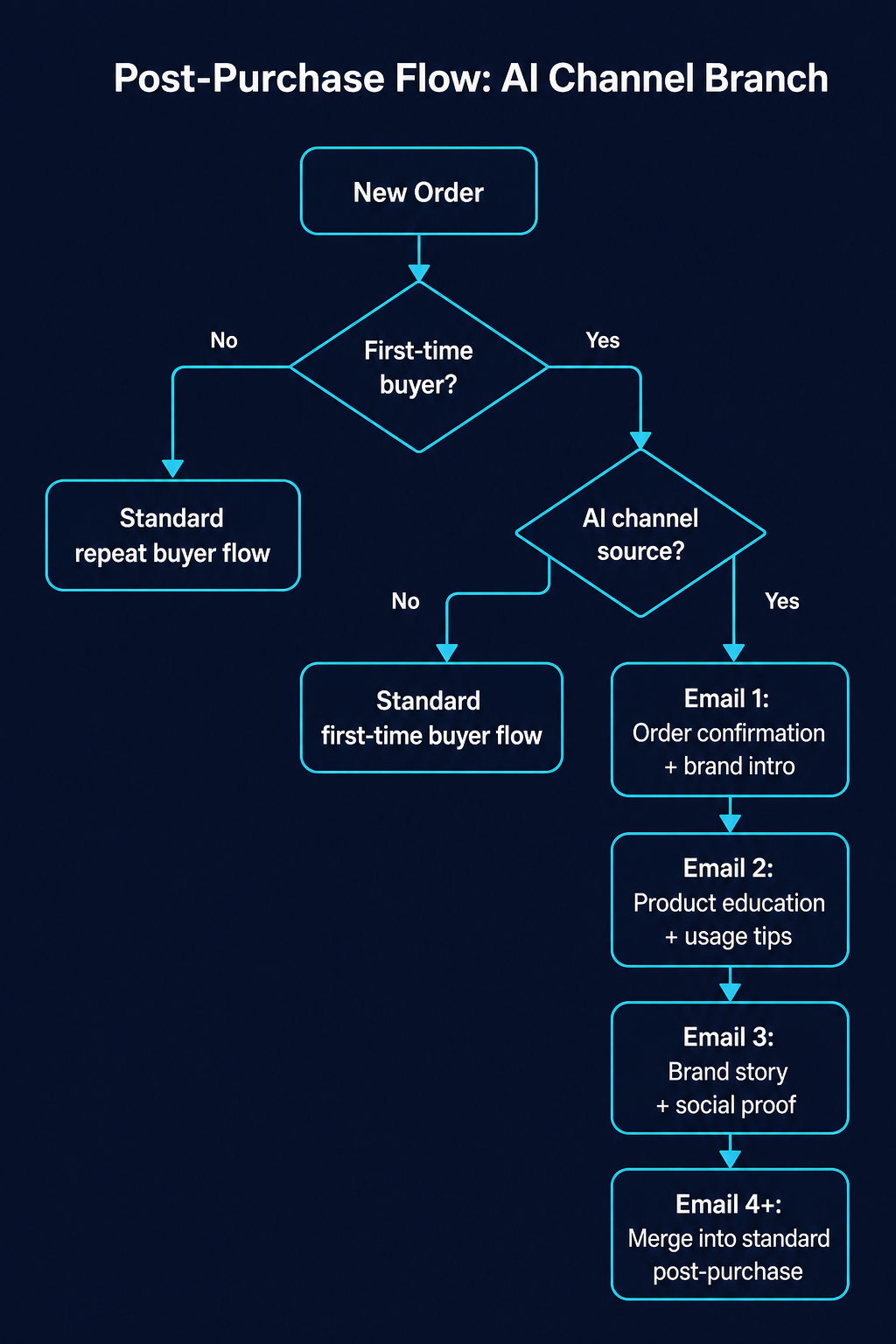
The key is front-loading the brand building. Your regular post-purchase flow probably assumes the buyer already has some brand affinity. AI-sourced buyers have zero. You need to build it before you start selling again.
This Is Happening Whether You Set It Up or Not
That's the part that makes this urgent. Shopify Catalog is on by default for eligible products. Your products are already being syndicated to AI platforms. Orders from AI channels are already coming in for some merchants.
If you haven't adapted your flows, those AI-sourced first-time buyers are getting the same post-purchase emails as everyone else. And those emails are probably assuming a level of brand awareness the buyer simply doesn't have. The messaging doesn't resonate. The cross-sell feels random. The brand story never gets told.
You're getting the acquisition, but you're losing the customer before you even had them.
The fix is straightforward:
- Audit your product data. Go through your Shopify Catalog, clean up titles, descriptions, tags, and variants. Make sure your store policies are current. Add custom metafields where they add value.
- Set up AI channel tracking. Use Shopify's Agentic Storefronts data to identify which orders come from AI surfaces. Build the segment in Klaviyo.
- Branch your post-purchase flow. Add a conditional split for first-time buyers from AI channels. Build a sequence that introduces your brand before it tries to sell again.
- Collect reviews aggressively from these buyers. AI agents weight review signals when deciding what to recommend. More reviews, better data, more AI-sourced orders. It's a flywheel.
We wrote about agentic commerce a month ago when the concept was still mostly theoretical. It's not theoretical anymore. Shopify just made it the default for every merchant on their platform.
The brands that treat this as a new channel - with its own data requirements, its own buyer psychology, and its own post-purchase strategy - are going to build a real advantage. The ones that ignore it are going to watch AI send them customers they can't keep.
If you're looking at your Agentic Storefronts dashboard for the first time and realizing your flows aren't ready for this, that's a retention problem worth fixing now.


