Here's something we see all the time.
A brand comes to us doing $3 million, $5 million, maybe $8 million in revenue. They've got a solid product. Paid media is working - or at least it was working. They're acquiring customers. But growth has flatted out. The number keeps inching up, but the margin isn't moving. Sometimes it's actually getting worse.
And the instinct is always the same: spend more on ads. Find a new channel. Test a new creative angle. Basically, acquire harder.
But the problem usually isn't acquisition. It's that customers are coming in the front door and walking right out the back.
The math that makes this obvious
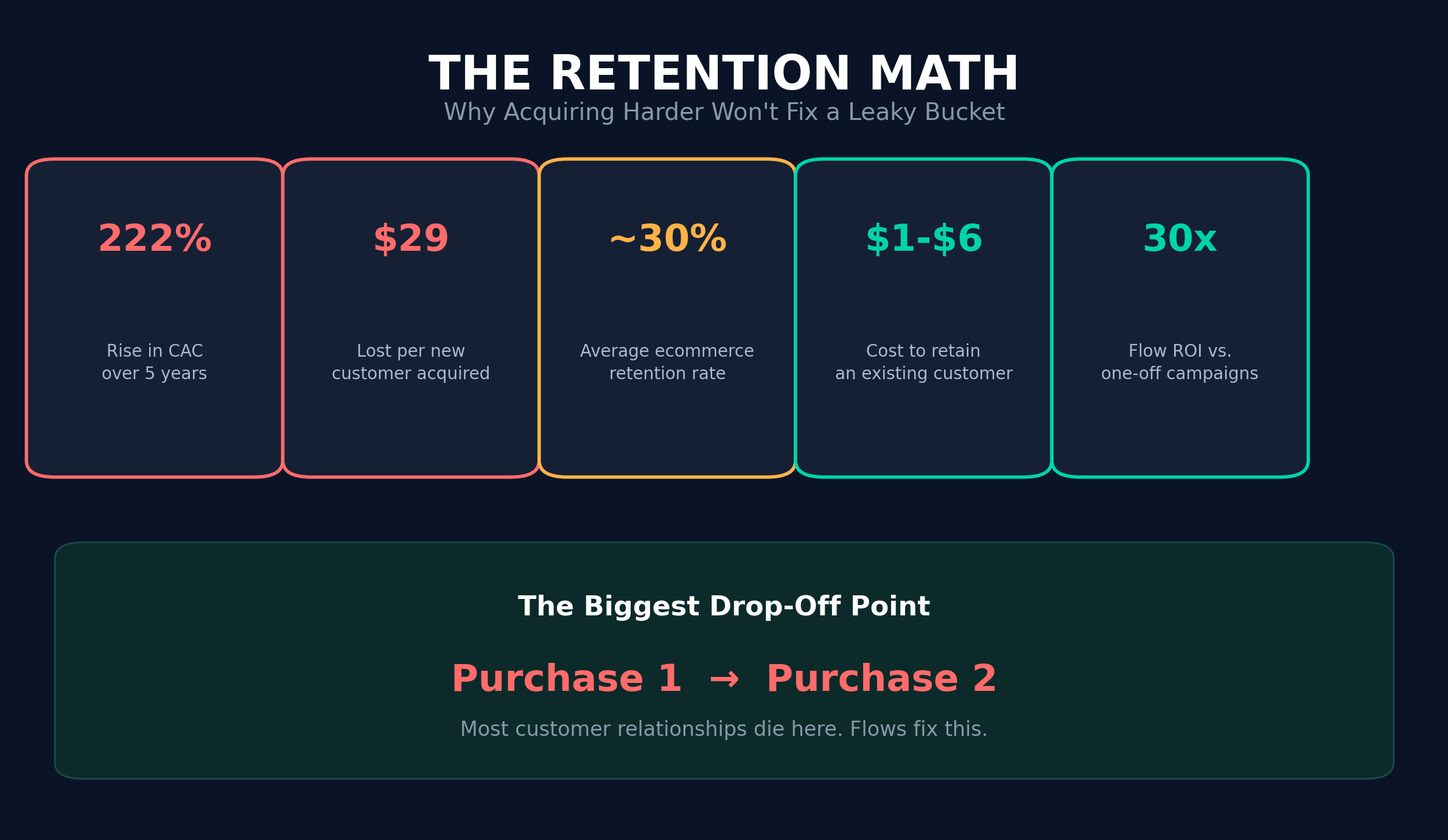
Customer acquisition costs have risen 222% over the last five years. Meta CPMs are up 20% year over year. Google Shopping CPCs jumped 34%. The average ecommerce brand is now losing about $29 on every new customer they acquire.
Meanwhile, retaining an existing customer costs somewhere between $1 and $6 per person.
So you're spending hundreds to get someone through the door, and then... hoping they come back? That's not a growth strategy. That's a leak.
The brands that break through that $5M ceiling aren't the ones spending more on acquisition. They're the ones who figured out how to make their existing customers worth more over time.
Campaigns are about you. Flows are about your customer.
This is the distinction that changes everything when it clicks.
Campaigns are scheduled around your calendar. Your product launch. Your sale. Your content schedule. You decide when to send, what to say, and who gets it. And campaigns aren't bad - they're necessary. But they put the customer into whatever headspace you need them to be in at that moment.
Flows are different. Flows are triggered by what the customer does. Or doesn't do.
A post-purchase flow fires because they just bought something. A browse abandonment flow fires because they looked at a product three times but didn't pull the trigger. A winback flow fires because it's been 90 days since they last opened an email. A birthday flow fires because, well, it's their birthday.
The customer is already in a specific mindset. You're meeting them there instead of trying to create a moment from scratch.
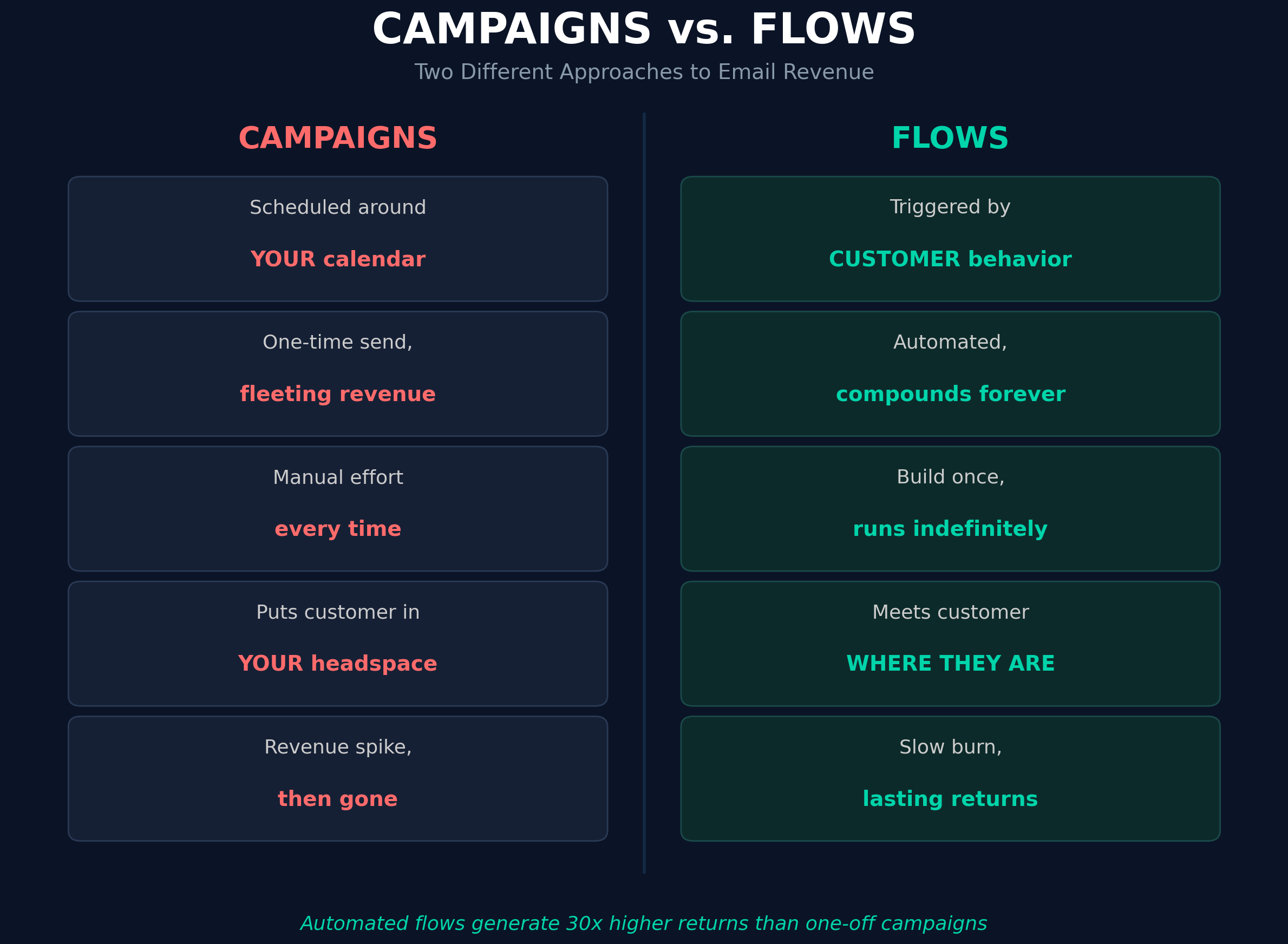
And here's the compounding part: you build a flow once, and it runs essentially forever. A campaign lives for a few days in someone's inbox, generates whatever revenue it's going to generate within the attribution window, and that's it. A flow keeps sending. Every new customer who triggers it gets the same thoughtful sequence. That investment pays dividends for years.
The data backs this up. Automated workflows generate roughly 30x higher returns compared to one-off campaign sends. That's not a marginal improvement. That's a fundamentally different ROI.
Different customers need different conversations
This is where most brands stop short. They'll set up a welcome flow and an abandoned cart flow and call it done. Maybe a winback email that says "we miss you" with a 15% off code.
But a first-time purchaser is a completely different person than a fifth-time purchaser. Someone who bought once six months ago and never came back needs a different message than someone who buys every 45 days like clockwork.
The biggest drop-off in ecommerce is from purchase one to purchase two. That's where most customer relationships die. And it usually happens because brands do one of two things: they either go silent after the sale, or they immediately start hammering the customer with promotional emails trying to get them to buy again before they've even received their first order.
Neither of those builds a relationship.
The smart play is understanding your customer lifecycle. When do repeat buyers typically come back? Is it cyclical? Seasonal? Product-dependent? When someone crosses the threshold from "might buy again" to "genuinely loyal," what happened to get them there?
Once you understand those patterns, your flows can actually reflect them. A segment of high-AOV one-time buyers at 45 days post-purchase gets a very different flow than a segment of customers who've bought three times but only during promotions. Both are valuable. Both need different conversations.
The average ecommerce retention rate sits around 30%. That means 70% of customers are buying once and disappearing. If you can move that number even a few points - by catching people at the right moments with messaging that actually makes sense for where they are - the impact on lifetime value is enormous.
What we actually do in the first 90 days
Whenever we take on a new client engagement, the very first thing we do is audit their flows. Not their campaigns. Not their templates. Their flows.
We're looking at a few things. Do they have the flows they need? Are the triggers set correctly? Are the filters doing what they're supposed to do? And most importantly, does the messaging match what's actually happening for the customer at that moment?
Sometimes it's a complete rebuild. Sometimes it's tweaking what's already there. But the lens is always the same: are these flows trying to connect with the customer, or are they trying to extract from the customer?
That's a real distinction, and you can feel it as a consumer. You know the difference between an email that says "here's something that might be helpful based on what you just bought" and one that says "BUY MORE STUFF." One builds trust. The other erodes it.
Flows are a slow burn. They're not going to generate the same immediate revenue spike as a well-timed campaign blast. But they build the foundation that makes everything else work. When your retention engine is running, your acquisition spend goes further because each new customer is worth more over their lifetime.
The retention engine isn't optional anymore
Five years ago, you could get away with mediocre retention because acquisition was cheap. Meta ads were practically giving away customers. Google Shopping was still reasonably priced. The math worked even if half your customers never came back.
That world is gone. Acquisition costs aren't coming back down. And every dollar you spend bringing in a customer who buys once and leaves is a dollar you're essentially lighting on fire.
The brands that are growing through this environment are the ones treating their email program like a relationship system, not a broadcast channel. They're investing in flows that meet customers where they are, segmenting based on actual behavior, and building sequences that make people feel understood rather than targeted.
It's not complicated. But it does require thinking about email differently - not as a revenue extraction tool, but as the primary way you maintain relationships with the people who already chose to buy from you.
That's the retention engine. And if you don't have one, you don't have a growth problem. You have a retention problem.


