I get asked this in almost every intro call, usually in the same shape: "Should we just hire someone for email instead?" It's a fair question, and the honest answer is that it depends less on your revenue and more on how the work actually breaks apart.
So let's break it apart.
Email isn't one job. It's five or six.
When people picture an email hire, they picture one person who "does email." In practice, running a program means covering a handful of pretty different skill sets, and not many people are strong in all of them.
There's design. Then there's building what got designed, which is its own thing and changes a lot depending on how you build. Image-based emails and hand-coded HTML are two different maintenance realities, and the choice you make there follows you for years.
Then there's strategy, and that splits in two. Campaign strategy is mostly about what the company is focused on right now: the launch, the promo, the story you want to tell this month. Flow strategy is about what the visitor is focused on. It's reading someone's behavior on the site and deciding what message that behavior should trigger. Those are related but they're not the same muscle. Plenty of people who are great at planning a campaign calendar have never built a browse-abandon branch in their life, and vice versa.
Then there's reporting, which is really two jobs again. Somebody has to set the measurement up correctly, and somebody has to look at it and understand what it's telling you. That's often a technical person and an analyst-minded person, and finding both in one hire is rare.
And then there's the coordination layer. Project management, making sure the calendar doesn't slip, making sure the right assets exist before build day. That's a real job when you're juggling a lot of moving pieces.
Here's the part worth sitting with: at most brands, none of those lanes is a full-time job on its own.
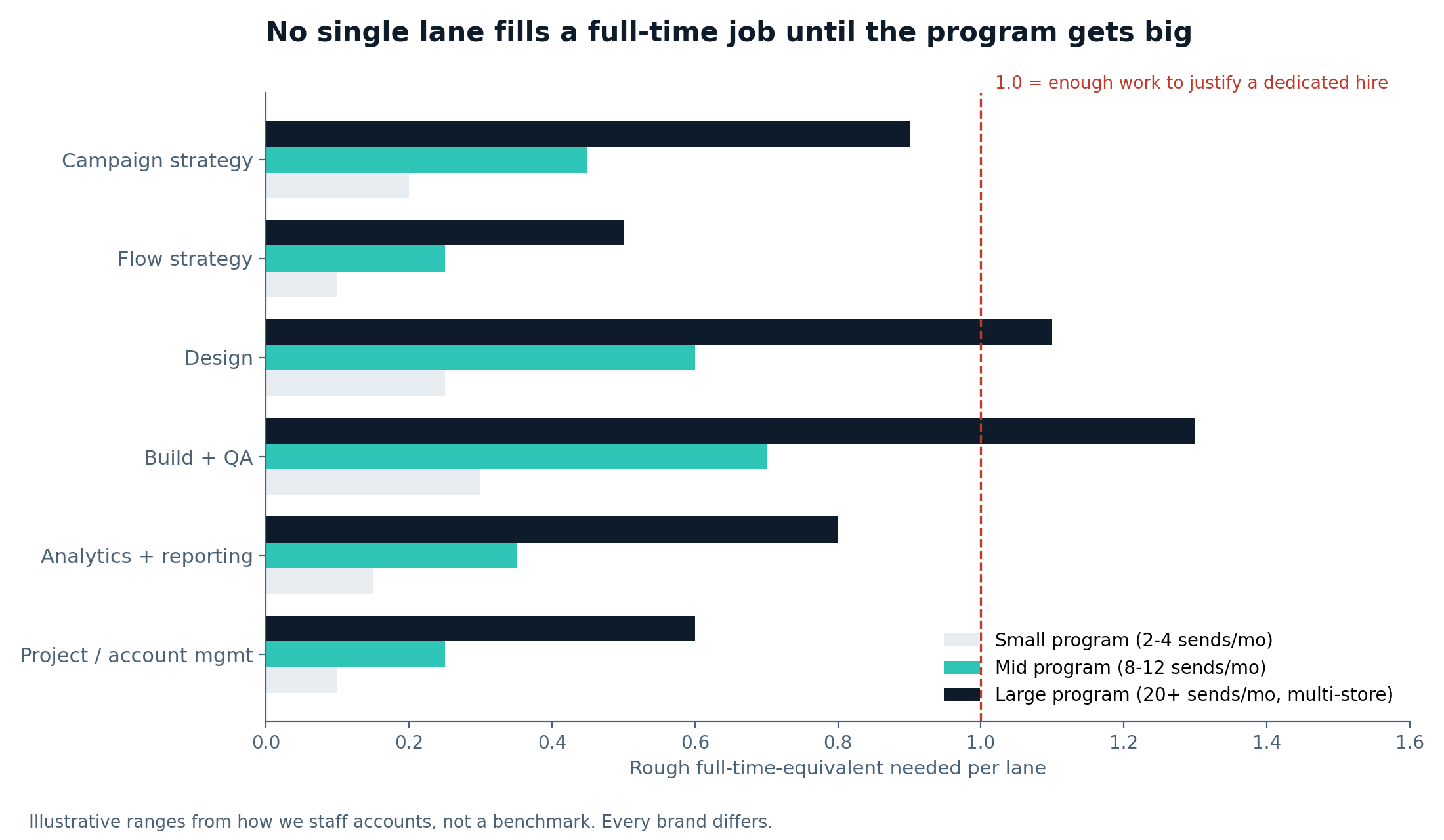
You can't hire a third of a designer. So a single in-house hire ends up covering all of it, which means you're trading skill depth for a smaller payroll line. Sometimes that's exactly the right trade. But you should make it on purpose.
The thing nobody puts in the spreadsheet
Cost comparisons usually go: agency retainer versus salary plus benefits. Fine. But that comparison misses the biggest structural difference between the two.
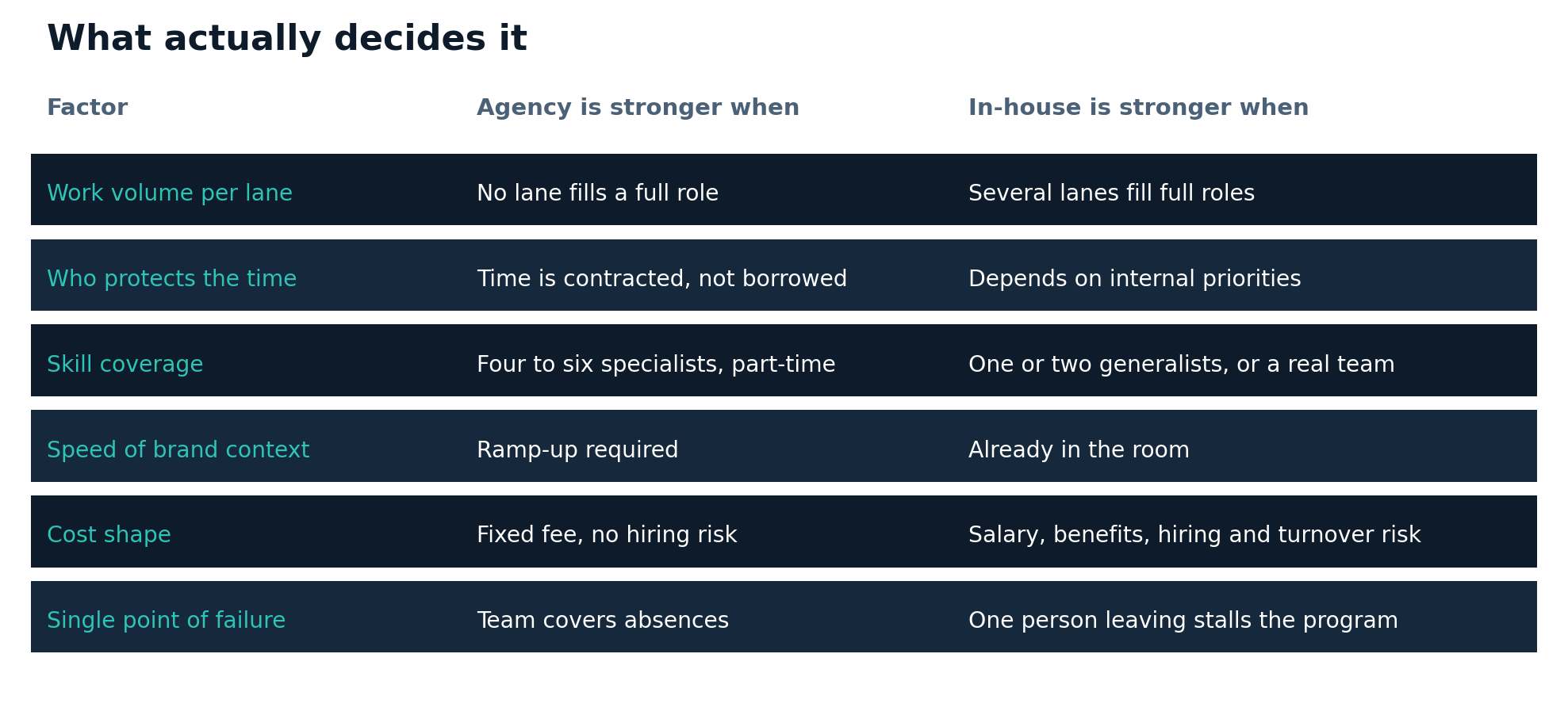
An in-house person is still an employee of your company. They go to the all-hands. They get pulled into the site migration. They cover for someone on leave. Anything that isn't email will, at some point, take priority over email. That's not a knock on them, that's just what it means to work somewhere.
An agency doesn't have that problem, because email is the only thing we're there to do. The time is contracted. It doesn't get borrowed for a Q3 initiative that has nothing to do with the inbox.
The flip side is real too: an agency has to be brought up to speed on your brand, your merch calendar, your inventory quirks. An in-house person already knows all of that because they were in the room when it was decided. That context is genuinely valuable and it's the strongest argument for hiring.
On cost: an agency can look more expensive per hour of work you're actually consuming. That's a different question from whether it's more expensive per deliverable, and the second one is the one that matters. And hiring itself is expensive, especially if the role doesn't exist yet. Starting from zero on a role you've never staffed is hard. Slotting someone in from another team is easier, but then you're right back in the pulled-away problem, because email won't be their only job.
So does a bigger program make the in-house case stronger?
Someone on our team pushed back on this with me and asked me to think it through instead of just nodding along, so here's where I land: mostly yes, but not for the reason people assume, and the size that matters isn't revenue.
A bigger program doesn't make in-house better because it's "big enough to justify it." It makes in-house better when the volume of work in each individual lane gets large enough to fill a real role. That's the actual threshold. Once you're sending often enough that design alone is a full week's work every week, you can hire a designer who does nothing but that, and you'll get someone better at it than a generalist ever would be.
Below that line, scaling up mostly just makes your one in-house person busier across all six lanes at once, and the quality gap shows up in the lanes they're weakest in. Usually that's flow strategy and reporting, because those are the ones with no deadline attached. Nobody notices an unbuilt flow the way they notice a campaign that didn't go out Thursday.
Two other things push in the same direction as size. The faster your merch and promo calendar moves, the more valuable it is to have someone who's already in the room, so context beats process. And the more your program is worth, the more a week of downtime costs you, which cuts both ways: one in-house person is also a single point of failure when they take vacation or take another job.
Two different sequences people mix up
There's a question that comes up here that's worth separating out, because I've argued both sides of it and they're not actually in conflict.
We're happy to start with everything, and honestly we like it that way. In practice, most brands are more receptive to starting with a testing phase, and we usually start with consultation and flow strategy before moving into design and the campaign side. Part of that is stakes: a strategy engagement is an easier first yes than handing over the whole program. Part of it is that the pieces are often already partly staffed. A lot of brands come to us with designers and a head of marketing, and that marketing lead is doing strategy, but it tends to be campaign strategy, the calendar and the promos. Flow strategy is the lane sitting open. So starting there isn't us withholding the rest, it's starting where the gap actually is, with the highest leverage per hour and the fewest hours in it. It also sets the standard the rest gets built against, which is easier than building 40 emails and then deciding what the program should have been.
But that's the engagement sequence, not the insourcing sequence. They run in opposite directions and that trips people up.
You hire strategy out first because what you're buying is pattern recognition across a lot of brands, and you can't build that from inside one account no matter how smart you are. You insource in the other direction, starting with the lanes that fill a real role first, and those are almost always the production lanes: design, build, QA. Volume is what creates a full-time job, and volume lives in production.
Where I'd revise what I said earlier: bring strategy in-house when you can hire an actual strategist, not when you can hire a generalist who will also be doing five other things. The failure mode I see most often is a brand that insources the thinking and keeps outsourcing the doing, and ends up with a very good plan nobody has hours to execute. The opposite mistake is rarer and cheaper to fix.
Most brands I'd point at the middle: an in-house owner who holds brand context, priorities and final say, plus outside hands for the lanes that spike. Production is the lane that spikes hardest around launches and Q4, so keeping some of that capacity flexible is usually worth more than owning all of it.
The question to ask instead
Forget "in-house or agency" for a second. Ask: which of these six lanes currently has enough recurring work to fill a full-time job, and which of them is nobody doing at all right now?
Answer that honestly and the staffing decision usually answers itself. If four lanes are half-empty, you don't have a hiring problem, you have a fractional-team problem. If two lanes are overflowing and one is being quietly ignored, you might genuinely be ready to hire, and you'll know exactly what the job description should say.
Most brands never do that inventory. They just look at a retainer, look at a salary, and pick the smaller number.


