Most hunting and fishing brands run their email calendar like the year has one big moment in it. Something goes out when the season opens, maybe a follow-up a week later, and then things go quiet until the next obvious date on the calendar. It's the same instinct that makes a supplement brand build one refill flow and call it done.
The problem is that the outdoor customer doesn't live in one season. They live in about nine of them.
I grew up in the northeast, which is probably the best place in the country to see this up close. You get quality versions of nearly everything. Spring trout and early bass, spring turkey, summer fishing, fall fishing, fall turkey, waterfowl, whitetail with a bow and then with a rifle, muzzleloader and black powder in December, rabbit and small game running through the winter, and ice fishing filling in the months when everybody else assumes the customer went dormant. There is no off-season. There's just a different pursuit.
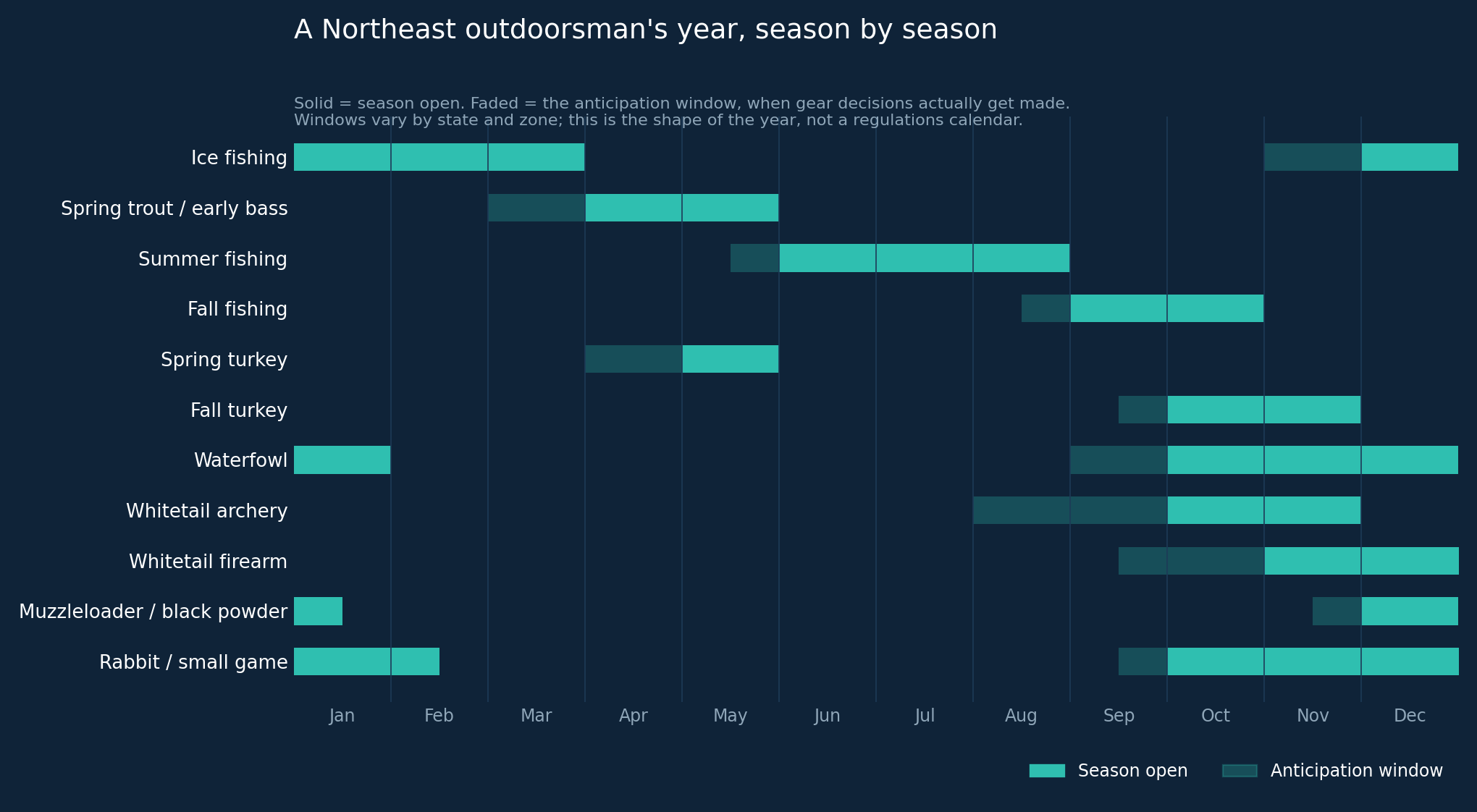
And the customers are not single-season people either. The guy buying arrows in August is the same guy buying an auger in November and a spool of fresh line in May. When a brand sends one seasonal campaign, they're not just missing a send. They're treating a year-round customer like a once-a-year customer, and then wondering why repeat rate looks the way it does.
The bigger mistake is when you start
Here's the part that costs the most money, and it's not segmentation. It's timing.
Most brands wait until the season opens to start marketing it. That feels right. The season is the news, so the season is the email. But by opening day, the serious customer is already out there. They bought what they needed weeks ago, sometimes months ago. Your "get ready for opening day" email lands in front of someone who is already ready, and the only thing left to sell them is something they forgot, which is a much smaller sale.
Think about how anyone who takes this seriously actually behaves. They start thinking about the next season well ahead of it. They're scouting, they're checking gear, they're reading regulations, they're replacing the thing that failed last year. As the date gets closer it turns into a daily thing. That anticipation window is where the buying happens. It's also, in our experience, the part of the year almost nobody is emailing into.
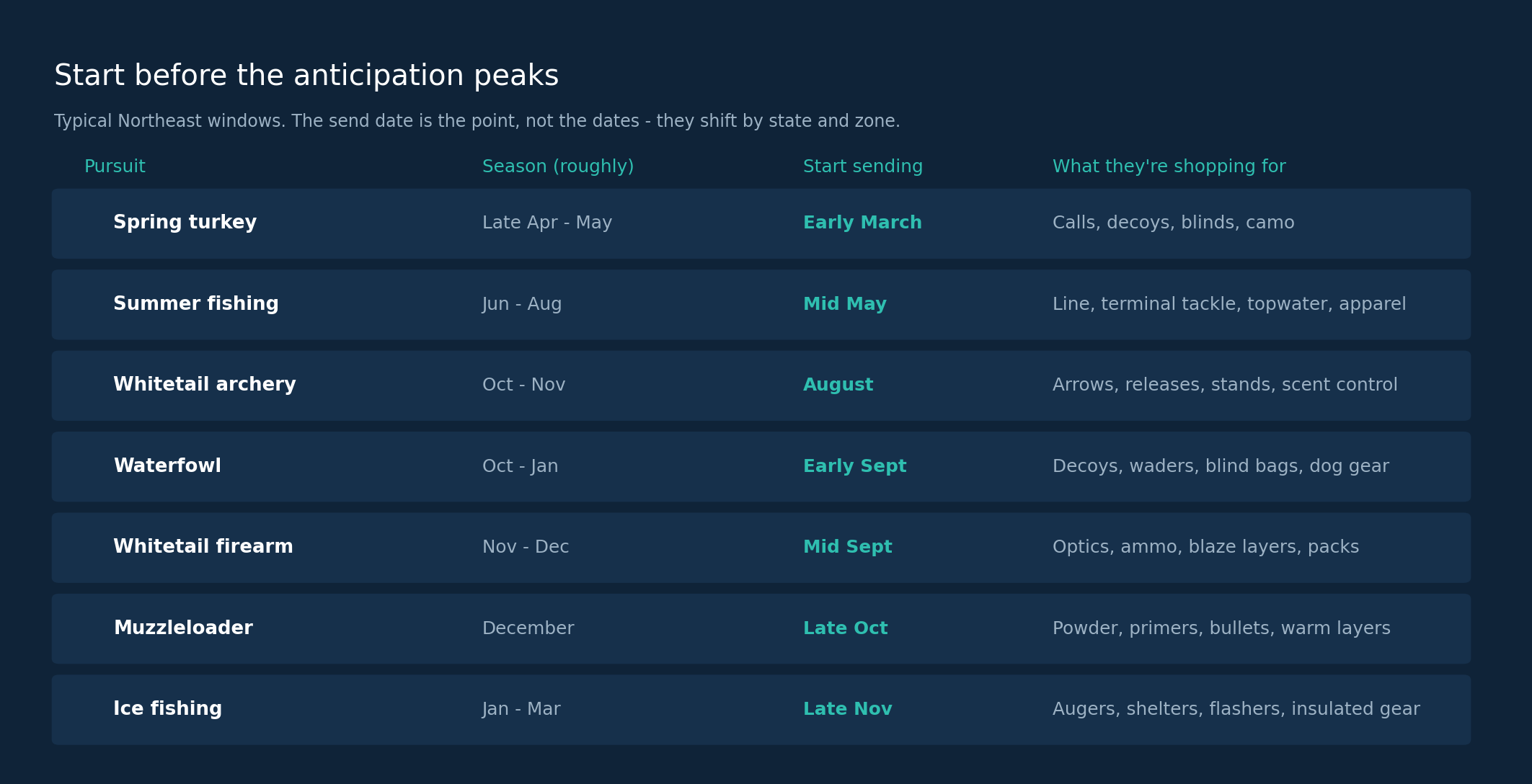
The dates in there shift by state and by zone, so don't treat them as gospel. The pattern is the thing worth copying: pick your send date off the anticipation window, not off opening day. For most pursuits that's four to eight weeks earlier than what a brand's calendar currently says.
What this looks like in Klaviyo
You don't need anything exotic to run this. You need the calendar written down and a few segments that respect it.
Segment by pursuit, not by last order date. Recency tells you who's warm. It doesn't tell you what they're warm for. If someone bought a duck call and waders last October, they're a waterfowl customer, and that's a durable fact about them for as long as they hunt. Build segments off product categories and collections purchased, plus anything you've collected in a preference center or a quiz. Then let a profile sit in more than one. Overlap is the point. The multi-pursuit customer is usually your best customer.
Build the anticipation campaign as a repeating series, not a one-off. The shape that works: something early that's about planning rather than product, something in the middle that's about the gear that fails or gets outgrown, and something close to open that handles the last-minute buyer and shipping cutoffs. Three sends into a window beats one send on opening day, and it beats blasting the whole list once in September.
Suppress the people it isn't for. This is where the year-round calendar goes wrong for brands that try it. If you're sending nine seasonal series a year to everybody, you've built a fatigue machine. The ice fishing series should go to ice fishing and cold-weather buyers, not to the guy who has only ever bought bass tackle. Same email volume, a fraction of the annoyance, and your engagement metrics stay in a place where the sends actually land.
Use the quiet months for the stuff that isn't a sale. The nine months between one specific season and the next are not dead air. They're where you send regulation changes, gear maintenance, a customer's photo from last year, restock notices on the thing that sold out. It keeps you in the inbox, which means when the anticipation window opens you're not a stranger asking for a purchase.
Why the calendar is the asset
We've seen a version of this in a few different outdoor and sports categories. When a brand's revenue looks brutally spiky, the instinct is usually to fix the spike: bigger promo, earlier promo, more sends during the peak. That mostly just moves margin around.
The thing that changes the shape of the year is knowing your customer's full calendar of seasons instead of the one your product is nominally "for." A brand that sells one category of gear still has customers who disappear into three other pursuits for eight months, and those months are where the relationship either holds or doesn't.
Write the calendar down first. Every season your customers care about, when it opens where they live, and the date you'd need to hit to reach them while they're still dreaming about it. Everything else, the segments, the flows, the sends, falls out of that document. Most brands in this space don't have it, which is a strange thing to be true about an industry where the whole customer base is looking at a calendar constantly.
This shows up across the outdoor category in slightly different forms. Fishing and archery brands have the clearest anticipation windows. Golf and cycling brands have weather-driven ones. Running and outdoor apparel brands have race calendars and trip planning doing the same job. If you want more on how we approach this side of the market, we put together a rundown of our email marketing work with sports and outdoor brands.
The short version: your customer's year has a lot more than one season in it, and they start spending before any of them open.


