Most brands that turn on Klaviyo's Customer Agent point it at the support queue and stop there. It answers "where's my order?", handles a return, explains the shipping policy, and the ticket count goes down. That's a fine first week. It's also the smallest job the thing can do.
The people who message your support channel after they buy are about as warm as customers get. They already paid you. They're in a live conversation with your brand, and the agent answering them can see what they ordered, what they've bought before, and what Klaviyo predicts they'll do next. If all it does with that is close the ticket, you're paying for a very polite FAQ page.
What Customer Agent actually is
Customer Agent is Klaviyo's AI service agent. It's part of Klaviyo Service, next to Helpdesk and Customer Hub, and it runs on the same profiles and events your flows use. That's the whole reason it's interesting. A standalone chatbot knows your help docs. This one knows the customer.
Out of the box it comes with pre-built skills for order tracking, returns, loyalty, subscriptions and promotions. Klaviyo says it resolves about 65% of questions without a human across its paying customers, and it now works in 100+ languages with locale detection through Shopify Markets. The brand case studies Klaviyo publishes run higher than that average (Naked Wardrobe reports 86% of queries resolved by AI over 90 days), but I'd plan around the average and be happy if you beat it.
Pricing is per AI conversation, billed as its own line on your Klaviyo plan. As of this week, Klaviyo's page lists 50 free conversations to start, and 1,000 conversations a month at $1,000, currently marked down 30% to $700. So roughly 70 cents to a dollar a conversation. Keep that number in your head, because it changes how you judge everything below.
Where it can actually make money
Klaviyo recently published a write-up from one of its partner agencies on using Customer Agent as a sales tool, and it lines up with how I'd think about it. A few of the ideas are worth stealing.
Order edits. Someone messages in to fix a shipping address or swap a size. They're not browsing. They already bought. The agent fixes the order, then suggests one thing that goes with what's in it. If they say yes, it gets added to the same order and ships together. There's no discount and no new checkout, just a relevant suggestion at the moment they're already paying attention.
Sizing and fit. A size chart answers "what size am I." A good sales associate answers that and then says "and this pairs well with it." The agent can do both, and the fit answer itself is worth keeping (more on that below).
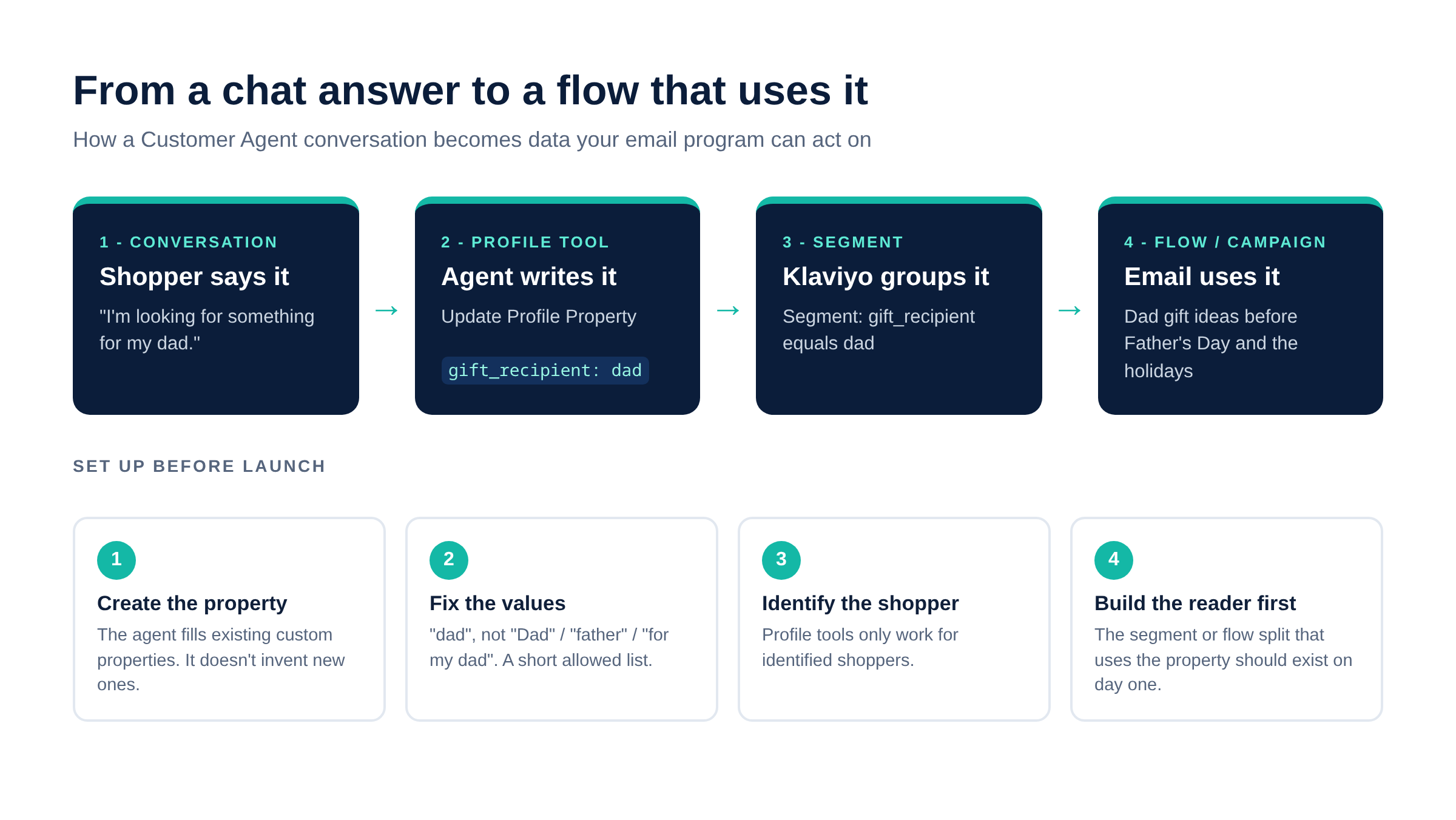
Gift questions. "What should I get my dad?" is a support question on the surface. Underneath, it's the customer telling you exactly who they shop for. The agent can save that answer to their profile, and now you know to send them dad-focused gift ideas before Father's Day next year.
Abandonment, with a question instead of a coupon. This one isn't support at all. The same partner reported testing a plain-text browse abandonment email that just asks "what stopped you?" When the shopper replies, Customer Agent picks up the conversation and answers the actual hesitation. They saw roughly a 10% conversion lift over their standard email-plus-discount version. That's one agency's test, not a benchmark, but the logic holds up: a discount assumes the problem is price, and a lot of the time it's sizing, timing, or "is this right for me."
The part nobody sets up
Here's where most rollouts fall short. The gift idea and the fit idea only work if the answer ends up somewhere your email program can use it.
Customer Agent has a tool called Update Profile Property that writes a custom property to the shopper's Klaviyo profile mid-conversation. "It ran small" becomes last_return_reason: sizing. "It's for my wife" becomes a gift recipient property. Once it's on the profile, flows, segments and campaigns can all use it.
But there are catches, and they're all data work, not AI work:
- The property has to exist first. According to that partner write-up, the agent can't invent a new custom property on its own. Somebody has to decide the property names and create them in Klaviyo before launch.
- The values need a format. If one conversation writes "Dad", another writes "father" and a third writes "for my dad", your segment catches one of the three. Pick a short list of allowed values and tell the skill to stick to them.
- It only works for identified shoppers. The profile tools need to know who they're talking to. Anonymous chat visitors don't get properties written until they're identified.
- Something has to use the data. A property nobody segments on is just clutter. The flow or segment that reads it should exist before the agent starts writing it.
None of that is hard. It's just the part that gets skipped because the demo looks finished without it.
How I'd roll it out for a brand
If we were turning this on for a client, I wouldn't flip every idea on at once. Roughly:
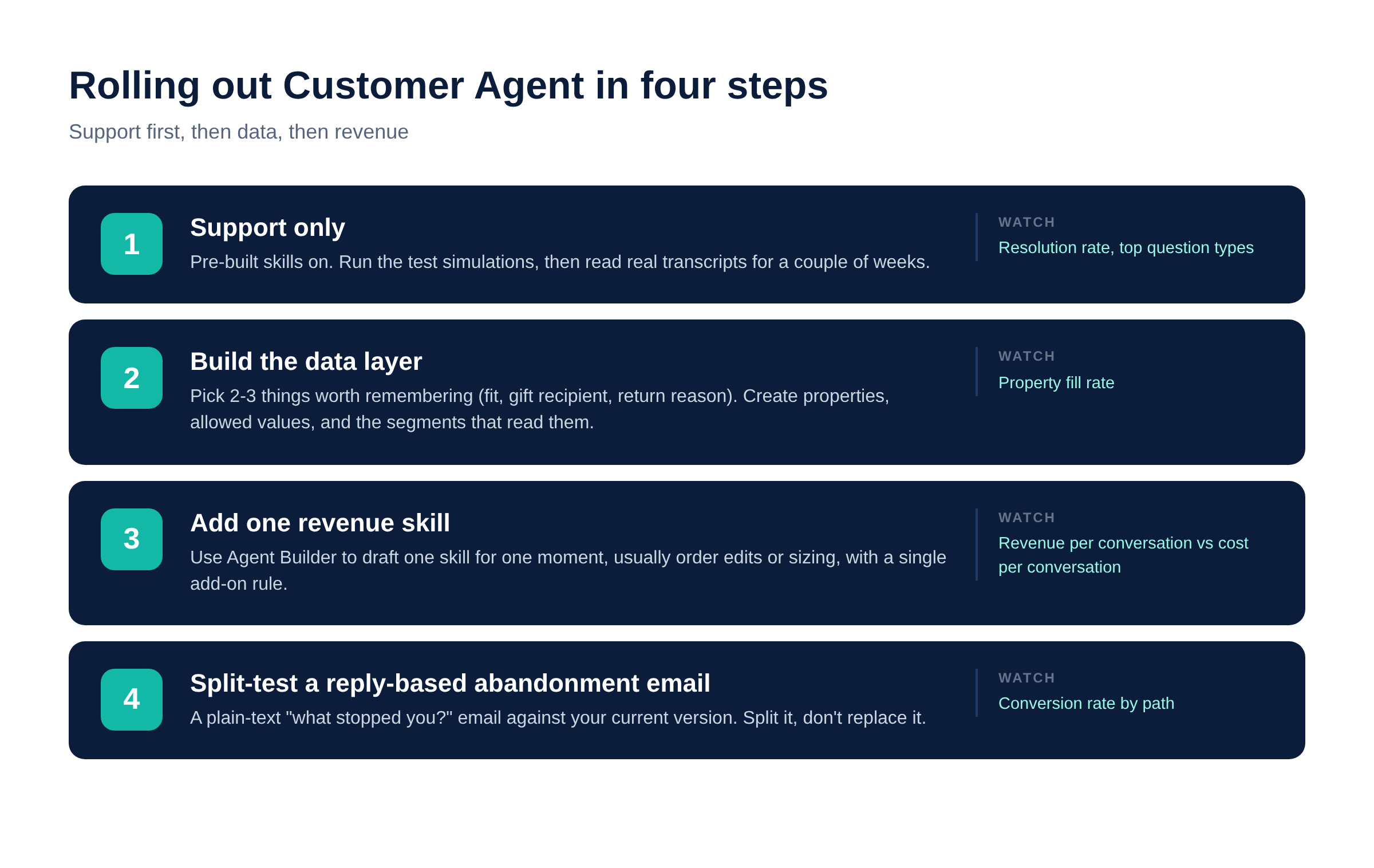
- Start with support only. Turn on the pre-built skills, run the built-in test simulations, and read transcripts for a couple of weeks. You learn what customers actually ask, which is usually different from what the FAQ page assumes.
- Build the data layer. From those transcripts, pick two or three things worth remembering (fit, gift recipient, reason for return are good starting points). Create the properties, define the allowed values, and build the segment or flow split that uses each one.
- Add one revenue skill. Custom skills are in beta, and Agent Builder lives in a sidebar inside Customer Agent where you describe what you want in plain English and it drafts the skill. Pick one moment, usually order edits or sizing, and give it a single, specific add-on rule.
- Test the reply-based abandonment email as a split against your current version. Don't replace the flow, split it.
What to measure
Resolution rate is the number Klaviyo leads with, and it's the one that justifies the support savings. For the revenue side, I'd watch three other things:
- Revenue per conversation. Compare it to what you're paying per conversation. If it clears 70 cents to a dollar, the agent pays for itself before you count a single deflected ticket.
- Property fill rate. Of the conversations where a gift or fit question came up, how many actually wrote a clean value to the profile?
- Revenue from the flows that use those properties. This is the slow payoff. The gift answer from October earns its money the following spring.
I wouldn't set targets for any of these up front. Each brand's customers differ, and the first month is really about finding out what your customers bring to the chat. But I'd expect the revenue side to be small in month one and grow as the properties pile up, which is the opposite of the support savings, which show up right away.
The short version: Customer Agent is good at support, and that alone may justify it. But the brands that get the most out of it will be the ones that treat every conversation as a chance to learn something about the customer, and then build the place for that information to go.


