If you're running a DTC brand right now, you already know the math changed. Tariffs in 2026 have pushed COGS up anywhere from 15 to 30 percent across beauty, supplements, CPG, pet - basically every category that sources materials or manufactures overseas. That's real money off the bottom line, and it showed up fast.
So what's the instinct? For a lot of brands, it's to lean harder into discounts. Push more promos, run more sales, try to keep volume up because the per-unit economics got worse. And that's exactly the wrong move.
The double whammy nobody's talking about
Here's what's actually happening to a lot of ecommerce P&Ls right now: costs went up, and the brands that were already discount-heavy are getting squeezed from both directions. Your margins shrank because your costs went up. And then you're voluntarily shrinking them even further by running 20% off, 25% off, BOGO, whatever it is.
That's not a strategy. That's a death spiral with extra steps.
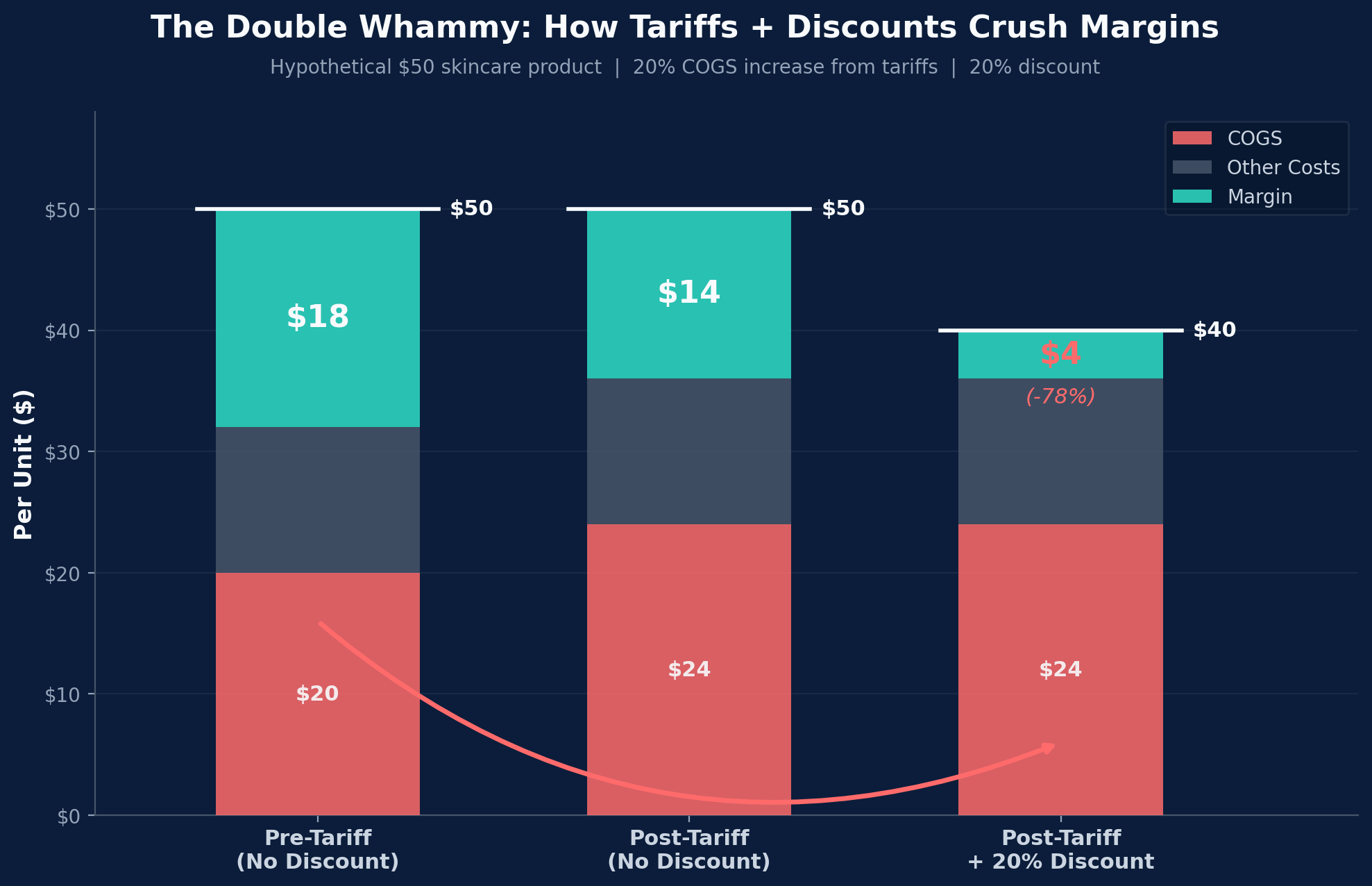
Hypothetical $50 skincare product showing how tariff-driven COGS increases compound with discounting to crush margins by 78%.
We've talked about the discount problem before - it was an issue even before tariffs entered the picture. But now? The math is even less forgiving. If your COGS went up 20% and you're still running the same promo calendar, you're literally paying to lose money faster.
Your customers aren't living under a rock
Here's the thing a lot of brands forget: your customers are going through this too. Inflation is everywhere. Grocery bills, gas, rent - people feel it. This isn't a problem that only exists on your side of the transaction.
And that actually gives you something to work with. Because when your customer is already aware that everything costs more, you don't need to pretend your prices exist in a vacuum. There's a shared understanding that the world got more expensive. The question is what you do with that.
Reframe the value, not the price
Instead of leading every email and every flow with "Save 20%" or "Here's your exclusive discount," this is the moment to shift the conversation entirely.
What if the message was: "This product is going to last you three years. That's what makes it worth it." Or: "Here's what actually goes into making this, and why we think it's worth every dollar." Or even just: "We know things are tight. Here's why our customers keep coming back anyway."
That's not spin. That's just reminding people of the actual reasons they bought from you in the first place. And most brands have plenty of material to work with here - they've just buried it under coupon codes.
People buy for a lot of reasons. Price is one of them, but it's rarely the only one. Quality, how the product makes them feel, trust in the brand, convenience, identity - all of those are real purchase drivers. If your email program has been treating price as the only lever, you've been leaving all of that on the table.
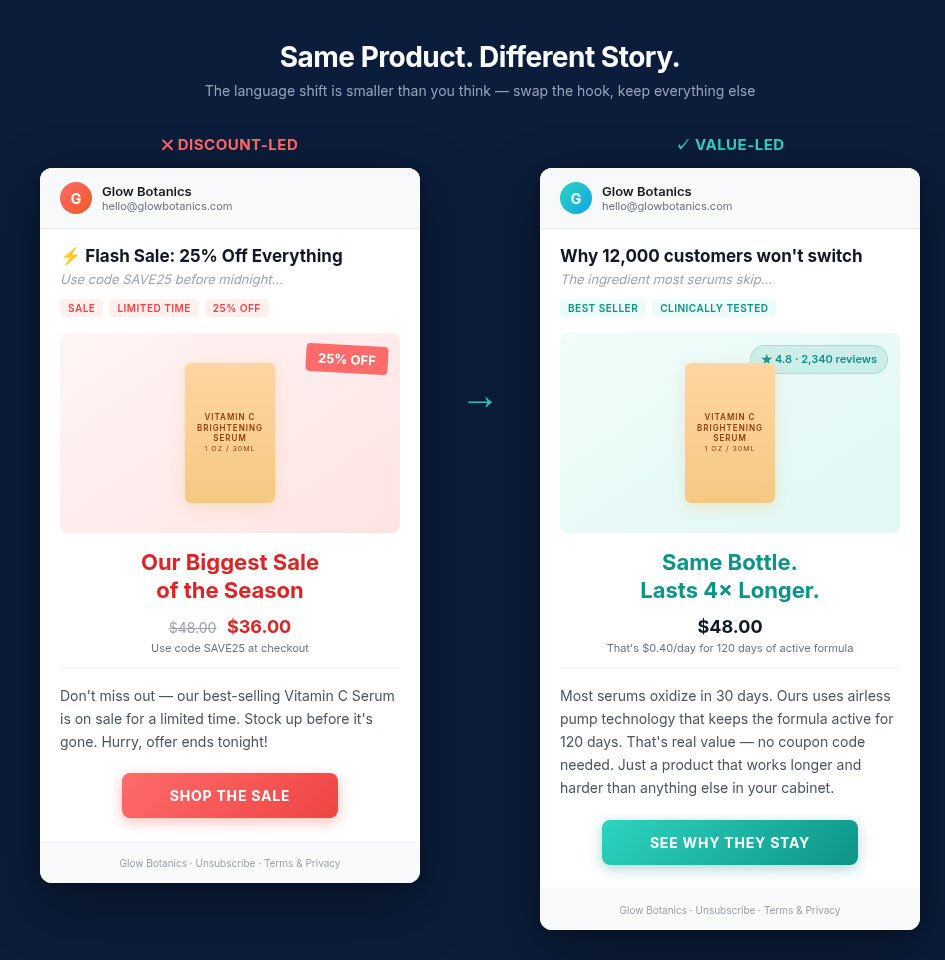
Same product, same layout, same brand. The only thing that changes is the language. That's how small this shift actually is.
Lead with loyalty - but don't demand it
One of the smartest moves right now is to lean into the relationship you've already built with your existing customers. Not in a "we need you now more than ever" guilt-trip kind of way. More like reminding them of why they chose you.
There's a difference between demanding loyalty and earning it. You earned it by making a good product, by showing up consistently, by not being annoying. So remind people of that. Your winback flows, your post-purchase sequences, your VIP segments - those should all be reinforcing the reasons someone became a customer, not just dangling another discount to get them back.
Think about it like any relationship. If someone only reaches out when they need something from you, that gets old fast. But if they show up and just remind you why you like spending time with them? That's different.
If you raise prices, say so
This one's important: if you have to raise prices, be upfront about it.
There's a real sentiment out there - especially right now - that companies are using inflation and tariffs as cover to pad margins. Whether that's fair or not, it's what people think when they see prices go up with no explanation. And the last thing you want is for your customers to quietly put you in the "greedy corporation" bucket.
So if costs went up and you have to pass some of that along, tell them. Not in a dramatic, pity-party way. Just be honest. "Our costs went up because of tariffs on imported materials. We absorbed as much as we could, but we had to adjust pricing on a few products. Here's what changed and why."
That's it. Most customers will respect that, especially when they're already seeing prices rise everywhere else. What they won't respect is a quiet 15% price bump with no explanation.
Now - if you don't have to raise prices, you don't need to lean on this angle at all. Not every brand is in the same boat. But if you are raising prices, your customers deserve to know why. They're not just a number in your Klaviyo dashboard. They're real people making real decisions about where their money goes.
Pick your lane
So you've basically got two paths here:
Path 1: Reframe your messaging away from discounts and toward value. Remind people why your product is worth it. Lead with quality, loyalty, and the actual reasons they bought from you. This works whether or not your prices are changing.
Path 2: If you do need to raise prices, communicate it honestly. Be transparent, be human about it, and trust that your customers can handle the truth.
Both paths work. What doesn't work is doing nothing - just continuing to blast the same 25%-off campaigns while your margins evaporate, or quietly bumping prices and hoping nobody notices.
The math behind full-price customers
Here's the part that makes this whole conversation worth having: full-price customers aren't just better for your margins today. They're better for your business over time.
When someone buys at full price, they're buying because they actually want the product - not because they got a deal they couldn't pass up. That changes everything about their behavior afterward. They repurchase when they need to, not when the next sale hits. They churn less. And they don't anchor their entire perception of your brand to a discount.
Discount buyers do the opposite. They train themselves to wait. They're not coming back in 60 days because they ran out - they're coming back whenever your next 20%-off email shows up in their inbox. Their purchase cycles stretch out, their AOV is lower every time, and they're the first to leave when a competitor runs a bigger promo.
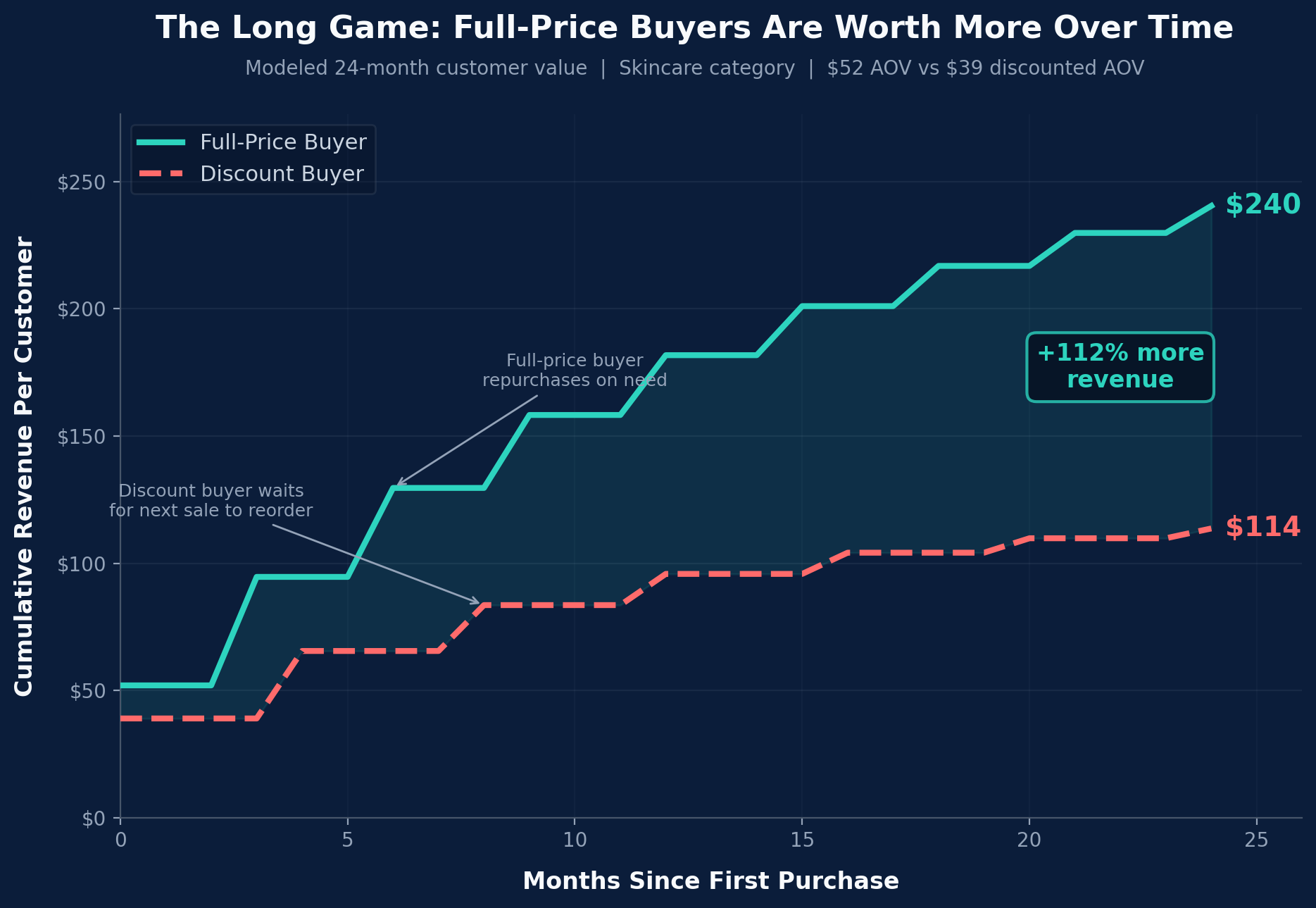
Over 24 months, full-price buyers generate roughly double the cumulative revenue of discount-conditioned buyers.
Over 24 months, the gap is massive. A full-price customer in a typical skincare brand is worth roughly double what a discount-conditioned buyer is. Not because they're buying more often - but because every purchase is at full value, and they stick around longer doing it.
That's the real inflection point here. Tariffs might be the thing forcing the conversation, but the payoff for shifting to value-led messaging goes way beyond absorbing a COGS increase. You're building a fundamentally healthier customer base.
This might be the reset you needed
Honestly? If your brand has been leaning too hard on discounts, the tariff situation might be the push you needed to finally fix that. It's hard to justify a strategy that was already questionable when the costs behind it just went up 20%.
Take this as the inflection point. Revisit your promo calendar, look at your flows, and ask yourself: are we leading with price because it works, or because it's easy? Because those are two very different things.
The brands that come out of this in good shape will be the ones that treated their customers like adults, reinforced the value of what they sell, and stopped trying to buy loyalty with coupon codes.


