If you open almost any customer profile in a Klaviyo account that's been selling for a while, there's a date sitting on it called Expected date of next order. Klaviyo worked it out on its own. Nobody on the team asked for it, and it isn't a paid add-on. Every Klaviyo account comes with predictive analytics once there's enough order data behind it.
When we audit an account, one of the first things I check is whether anything actually uses that date. Usually nothing does. The data is sitting right there and not a single flow is triggered off it.
It's not a magic flow. But for one specific job, getting a one-time buyer to come back for a second order, it's one of the most useful things already in your account. Here's how I'd set it up and where I wouldn't use it.
First, check if you even have it
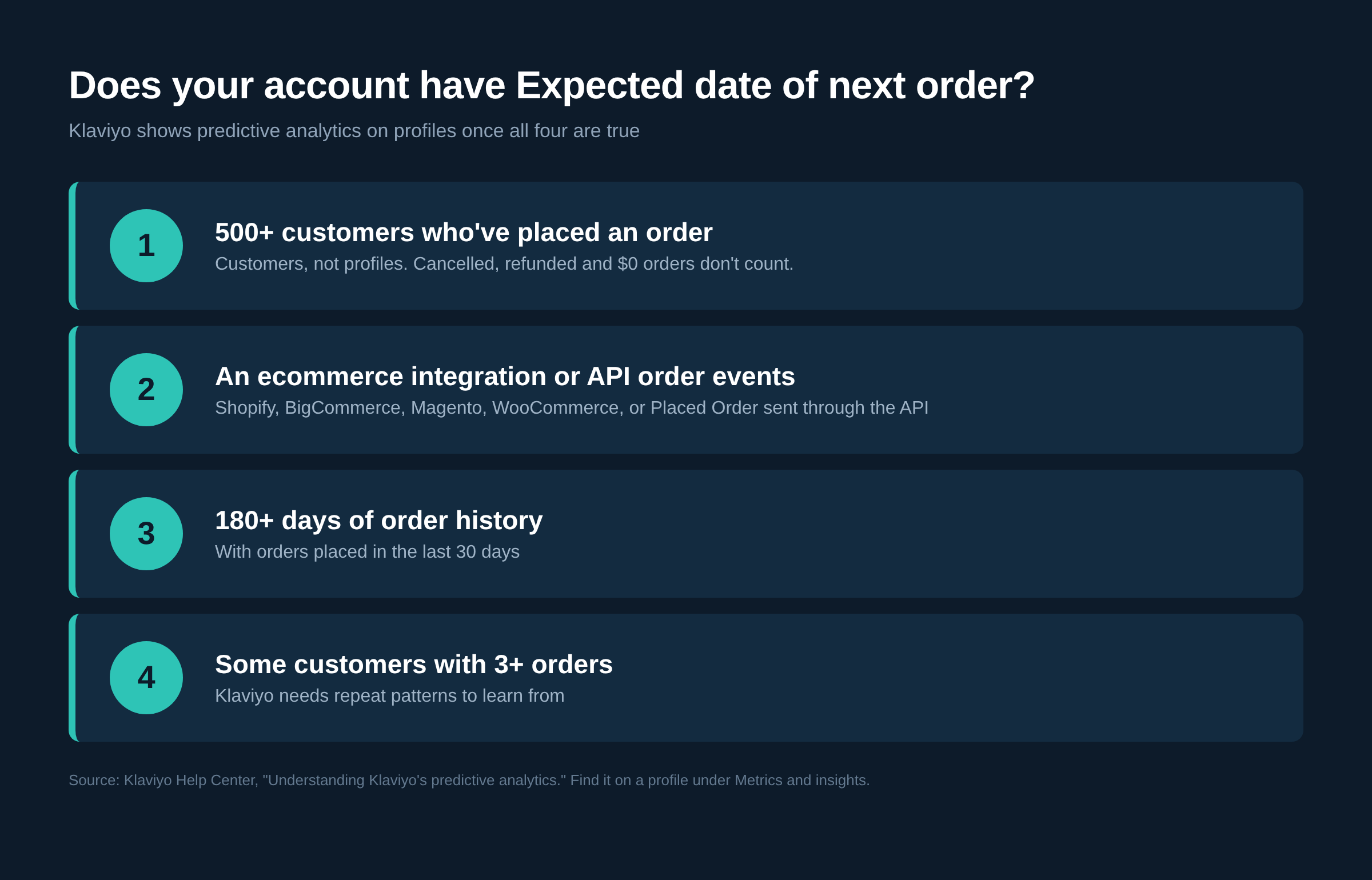
Klaviyo only shows predictive analytics when your account clears a few bars. Per Klaviyo's help center, you need:
- At least 500 customers who've placed an order (real orders, not cancelled, refunded or $0)
- An ecommerce integration like Shopify, or placed order events sent through the API
- At least 180 days of order history, with orders in the last 30 days
- Some customers who've placed 3 or more orders
If you're there, open a profile, go to the Metrics and insights tab and look for the Predictive analytics section. You'll see predicted CLV, churn risk, average time between orders and the expected date of next order. If the section shows up but it's blank for a specific person, Klaviyo just doesn't have enough on them yet.
What the date actually is
Klaviyo looks at that customer's own order pattern plus the pattern across all your customers. If the customer has a rhythm, it uses that. If they don't, or they've only bought once, it makes a reasonable guess based on how your other customers behave.
That second part is why this is useful. Most brands' "come back" email for first-time buyers goes out on a flat delay. 30 days after the order, 45 days, whatever someone picked when the flow was built. The expected date is at least built from how your customers actually reorder, not a number somebody made up three years ago.
One thing to keep in mind is that it's a prediction. Klaviyo says so itself: the predictions work best averaged across a lot of customers, and they're not supposed to be exact for any one person. So don't write copy like "you're due for a refill on Thursday." Use the date for timing, not as a promise.
How I'd build it
It's a date-based flow. Here's the setup:
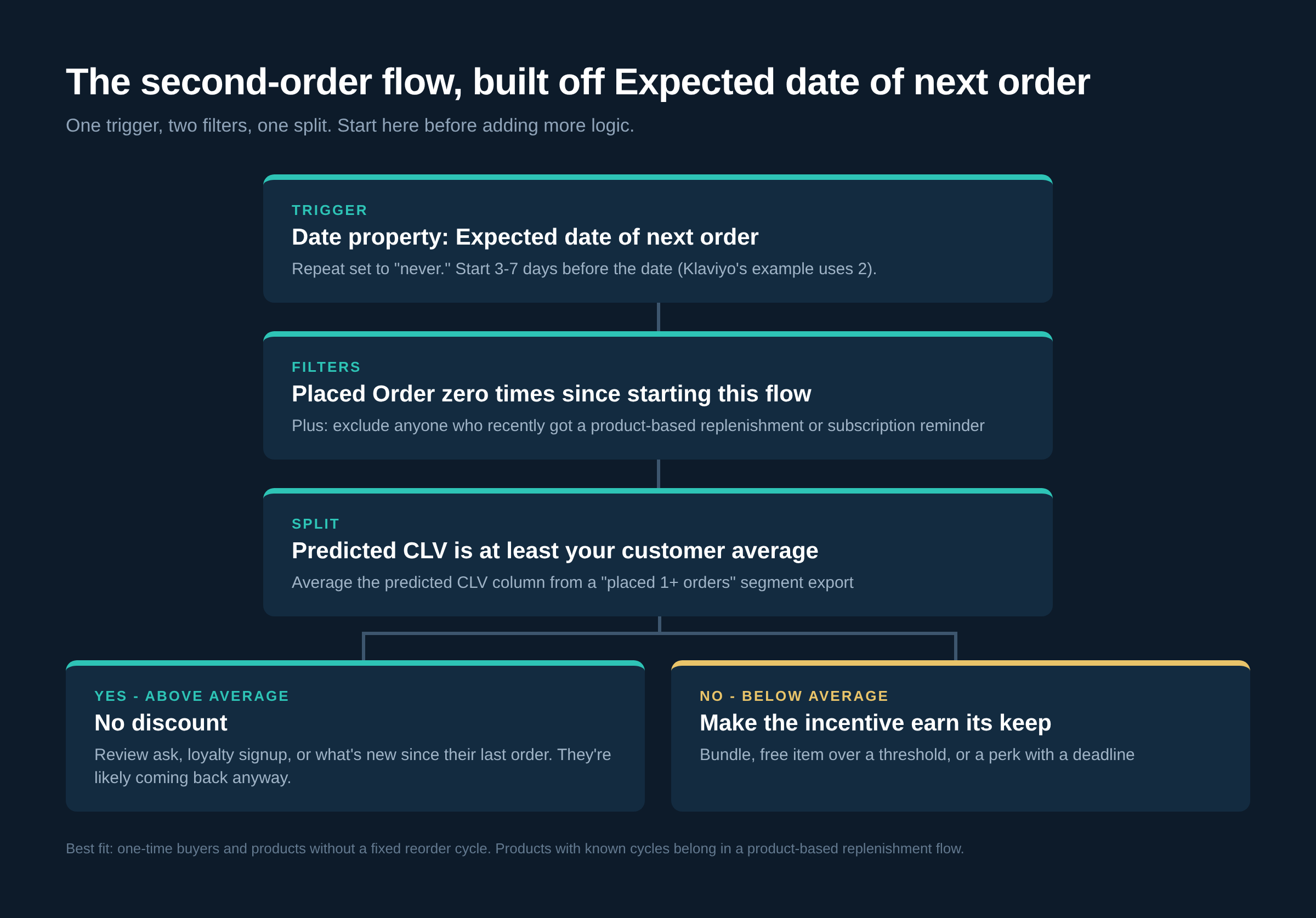
Trigger: Date property, Expected date of next order. Set it to never repeat. If you set it to repeat monthly or yearly, it keeps firing on fixed intervals, which isn't what you want.
Timing: Start a few days before the date, not on it. Klaviyo's own example starts 2 days before. For most brands I'd start somewhere in the 3 to 7 day range, because you want to land while they're thinking about it, not after they've already gone and bought somewhere else. That window depends on how fast your product runs out, so test it.
Filters: - Placed Order zero times since starting this flow. If they buy, they're out. - If you already run a product-based replenishment or subscription reminder flow, filter out anyone who got one of those recently. Otherwise the same person gets two "time to reorder" emails in the same week.
One split, on predicted CLV. This is the only split I'd start with. Export your "placed 1 or more orders" segment, average the predicted CLV column, and split the flow on "predicted CLV is at least" that number.
- Above average: these people are probably coming back anyway. Don't hand them a discount. Use the send for a review ask, a loyalty signup, or what's new since they last bought.
- Below average: this is where an incentive earns its keep. A bundle, a free item over a threshold, or a perk with a deadline.
You can add more logic later. But start with one clean split you can actually read the results of.
Where I wouldn't use it
Klaviyo is pretty upfront about the limits here, and I agree with them.
It doesn't know what they bought. The prediction is based on order timing, not products. If you sell a 30-day supplement and a 90-day one, the expected date doesn't know which one's in the cabinet. If your products have known reorder cycles, a product-based replenishment flow (Placed Order trigger, filtered by product, with a delay that matches the cycle) is the better tool. Use the expected date for everything that doesn't have a clean cycle.
Don't count down to every order. For a customer who's ordered six times, the date just keeps moving forward. If the flow fires every time, they get the same sequence before every single order, and that's how you get unsubscribes. Klaviyo's own suggestion is that if you have a lot of repeat buyers, use this only for people who've bought once. That's where I'd start too.
Why the second order is where to aim
The one-time buyer is where most of your acquisition spend is sitting. You already paid to get them, and for most brands, most of them never come back. Your welcome flow is done with them and your campaigns treat them like everyone else. A flat 30-day winback is guessing.
This flow is a better guess, it's already paid for, and it takes an afternoon to build. If you're sitting over the 500-customer line and it's not built, it's probably the cheapest retention win in your account right now.


