Jewelry is one of those categories where the person opening the box and the person who bought it are often two completely different people.
Think about what that means for your email program. Someone who bought a pair of gold hoops for themselves has a completely different relationship with your brand than someone who grabbed a bracelet for their girlfriend's birthday. But most jewelry brands send them the exact same welcome series, the exact same browse abandonment emails, the exact same campaigns.
That's not just lazy. It's leaving money on the table from two distinct customer types - both of which can drive serious repeat business if you treat them right.
The Two Customers You're Actually Emailing
Let's keep this simple. You've got two buyer types:
The self-purchaser. This person knows what they like. They've probably browsed your site multiple times, maybe favorited a few pieces, and finally pulled the trigger. They're into your brand aesthetically. They want styling content, new drop alerts, care tips for the piece they just bought. They're the start of a long relationship.
The gift buyer. This person might not know your brand at all. They needed a present. You had something at the right price point. Transaction complete. They might never think about you again unless you give them a reason to. But here's the thing - gifting is habitual. Anniversaries come around every year. So do birthdays, holidays, and "just because" moments. If you can stay on their radar, you've got a customer with a built-in repurchase cycle that practically times itself.
The problem is that most jewelry brands are messaging both of these people like they're self-purchasers. And that mismatch is costing them.
How to Actually Tell Them Apart
Before you can message them differently, you need to know who's who. Here are the approaches that actually work, in order of effort:
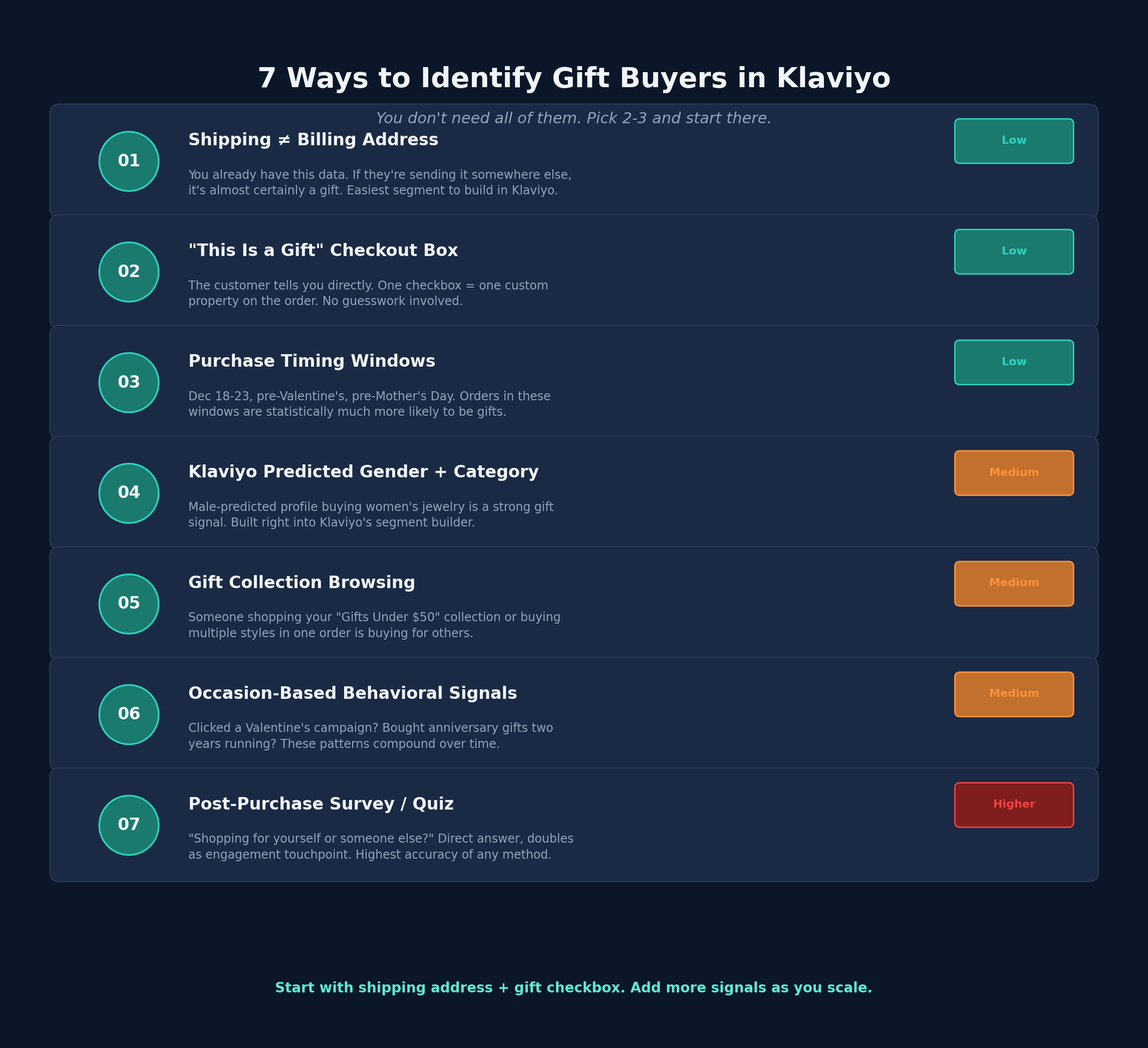
Shipping vs. billing address. If those two addresses don't match, you're almost certainly looking at a gift purchase. You already have this data in Shopify - you just haven't used it yet. In Klaviyo, you can build segments based on order properties where the shipping address doesn't match the billing address. Probably the easiest win here.
Gift wrapping or gift message at checkout. If your store offers a "this is a gift" checkbox or gift wrapping, that's someone literally telling you they're a gift buyer. Tag it on the profile. Done.
Purchase timing. Orders placed in the December 18-23 window, the week before Valentine's Day, or right before Mother's Day are statistically more likely to be gifts. Not definitive on its own, but it stacks well with other signals.
Cross-gender purchasing. Klaviyo has predicted gender built in. A male-predicted profile buying women's jewelry is a strong gift signal. You can build this directly in the segment builder - predicted gender plus product category purchased. Simple and surprisingly effective.
Collection and category patterns. Someone buying from your "Gifts Under $50" collection or grabbing multiple items in different styles in one order is probably shopping for other people. One item in a style they've previously browsed? Probably for themselves.
Occasion signals. Did they click through from a Valentine's Day campaign? Have they bought anniversary gifts two years in a row? These behavioral breadcrumbs build over time and let you tag profiles with occasion intent for future targeting.
Just ask. Post-purchase survey or a question in your welcome flow: "Were you shopping for yourself or someone else?" Some brands bake this into a quiz at signup. It doubles as a segmentation tool and gives you the answer straight from the customer.
You don't need all seven of these. Pick two or three that fit your store and start there. The point is giving yourself the data to message these groups differently.
Why the Same Email Doesn't Work for Both
This is where most brands get it wrong. They nail the segmentation but then send essentially the same content with slightly different subject lines. The messaging itself has to be fundamentally different.
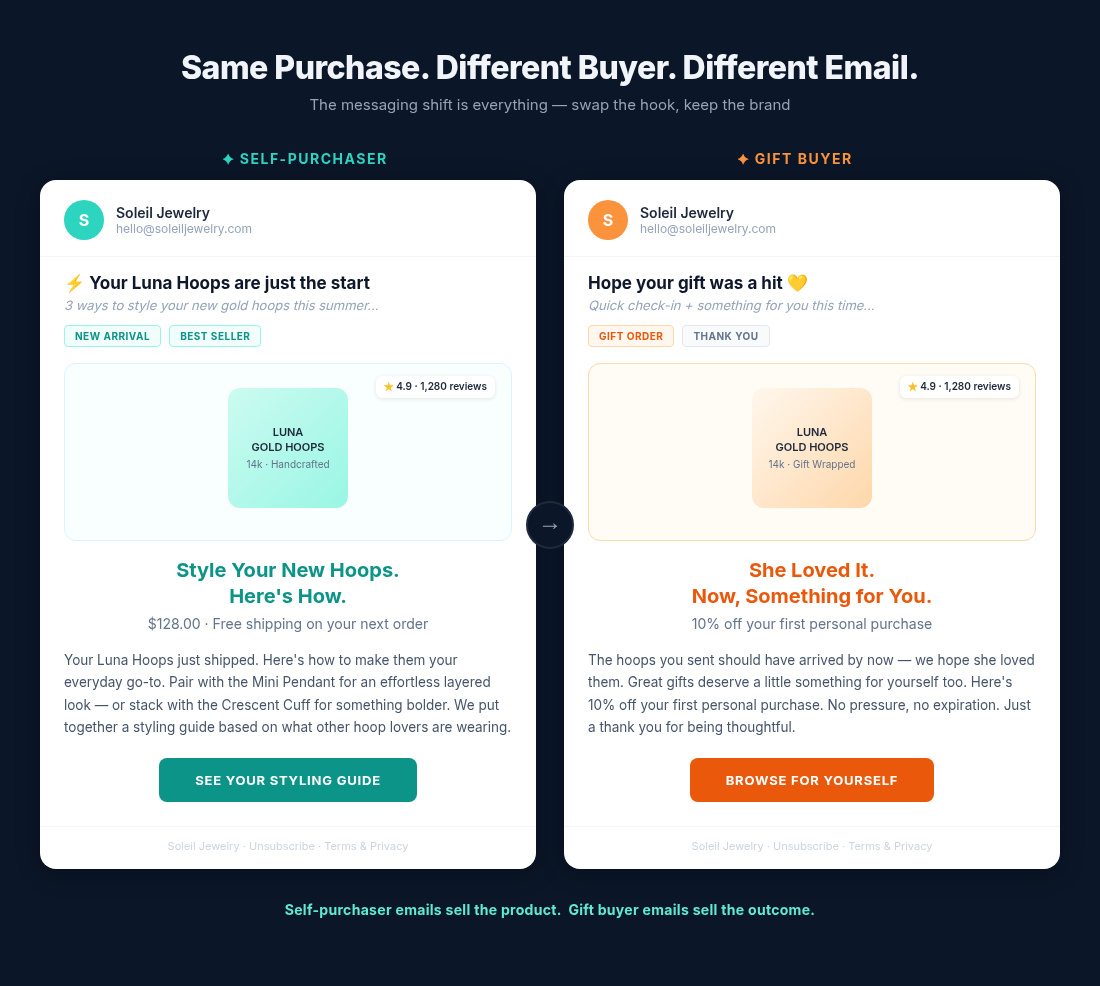
Subject lines are a completely different sell. For a self-purchaser, you're leaning into personal desire. "The gold hoops you've been eyeing" or "New pieces that match your style." It's about them.
For a gift buyer, the emotional hook is totally different. You're not trying to get this person excited about wearing the jewelry. You're trying to get them to recognize that this would make someone else happy - and that they'd look thoughtful for thinking of it. "Still have time to make her birthday unforgettable" or "The anniversary gift that actually says something." The subject line has to speak to the gifting mindset, not the wearing mindset.
Email content needs a different angle. Your self-purchaser emails can go deep on styling tips, how pieces pair together, care guides for specific metals and stones, behind-the-scenes craftsmanship content. This person is building a relationship with your brand.
Gift buyer content is different. It's less about the product details and more about the outcome. Will this make someone happy? Will the buyer look great for picking this out? Gift guides organized by recipient type ("for the minimalist," "for the statement piece lover"), price-tier navigation, and clear sizing or exchange info go a lot further here than a story about your design process.
Think about it this way: a self-purchaser cares about the jewelry. A gift buyer cares about the reaction when someone opens it. Your emails need to reflect that.
Post-purchase follow-up is where it really diverges. For self-purchasers, you're in relationship-building mode. Care instructions for the specific piece they bought. Styling suggestions. New arrivals that complement what they already have. You can afford to go slower - one email every five to seven days - because these people are engaged with your brand.
For gift buyers, you want to check in. "Hope your gift was a hit." That's it for the first touchpoint. Keep it human, keep it short. Then you've got two plays:
- Try to convert them into a self-purchaser. "Now that the gifting is done, here's something for you" with a modest discount. This won't work for everyone, but the ones it does work for become dual-purpose customers.
- Get them back for the next gifting occasion. This is where date-based triggers become your best friend.
The Trigger Calendar That Runs Itself
Gift buyers have something most customers don't - predictable repurchase windows. And if you're paying attention, you can build an email calendar around them that practically runs on autopilot.
Known dates. If someone bought an engagement ring from you, you now have a wedding anniversary date. Forever. If someone bought a birthday gift, you know that birthday rolls around every year. A "your anniversary is coming up in a couple of months - maybe time to start thinking about this" email two months out is incredibly effective. It's not pushy. It's helpful.
Holiday triggers. Valentine's Day, Mother's Day, Christmas, graduation season. If someone bought during one of these windows last year, set up a trigger to reach out three to four weeks before the same window this year. "Last year you nailed it. Ready to do it again?"
Occasion reminders. If you capture the occasion at the point of purchase (anniversary, birthday, "just because"), you can build a reminder flow around it. This is where asking that post-purchase question pays off exponentially.
The beauty of this approach is that gift buyers, when triggered right, can become more predictable repeat customers than self-purchasers. Self-purchasers buy when they feel like it. Gift buyers buy when the calendar tells them to. You just need to be the one reminding them.
Shorter Sequences, Different Cadence
One more thing that most brands miss: gift buyers need a tighter, more focused email sequence. You don't need to nurture them for weeks on end with brand storytelling. They're not here for the journey.
A gift buyer post-purchase sequence can be three emails over 90 days:
- The check-in (two weeks after purchase): "Hope your gift was a hit. Here's something for you." Include a small self-purchase incentive.
- The seasonal prompt (timed to next relevant gifting window): "Last time you crushed it. Here's what's new."
- The re-engagement (if no activity): One last nudge, then move them to your standard list.
Compare that to a self-purchaser, where you might run an eight to twelve email nurture with care content, styling tips, new arrivals, and community content over three to four months. Totally different cadence, totally different content, totally different intent.
Where to Start If You've Never Done This
If your jewelry brand has never segmented for gifting, here's the simplest first step: go into Klaviyo and build a segment where shipping address doesn't equal billing address and the order was placed during a peak gifting window (December, Valentine's week, Mother's Day week). That's your gift buyer segment. It won't catch everyone, but it'll catch enough to start testing different messaging.
Add a "this is a gift" checkbox to your checkout if you don't have one. That single data point will improve your segmentation more than any amount of behavioral modeling.
Then build two versions of your post-purchase flow - one for self-purchasers, one for gift buyers. Different subject lines, different content, different cadence. Run it for 60 days and look at the numbers.
Most brands are surprised by how much of their customer base is actually gift buyers. And once you start treating them differently, the repeat purchase rates from that segment tend to climb fast - because you're the brand that reminded them about their wife's birthday before they forgot.
That's not email marketing. That's just being useful.
For more on building email programs for jewelry and other fashion and accessories brands, check out our fashion and accessories email marketing page.


