Klaviyo shipped something on August 4 that is genuinely useful. Composer, their AI marketing agent, will now take a single plain-language prompt and draft a whole flow: the structure, plus the email, SMS, push and MMS messages inside it. You describe a welcome flow with an email, a push and an SMS step, and it comes back with the sequence built and copy written for each channel.
If you have ever stared at an empty flow builder at 4pm on a Thursday, you know why that matters. The blank canvas is the expensive part. And the copy it drafts isn't generic filler, it's coming from a platform that has been the email spine for a few hundred thousand ecommerce brands for the better part of a decade. That's a lot of accumulated pattern recognition about what a cart reminder or a post-purchase note usually needs to say.
So we like it. We're planning to run it on real accounts and see how far it gets.
But we want to be clear about what it is, because "AI builds your flow" gets read as "flow is done" and those are very different statements. Klaviyo themselves are pretty direct about this in their docs: the output is fully editable, and there is no send-as-is. You review and approve the draft before anything goes live. Take them at their word on that.
What it hands you, and what's still on you
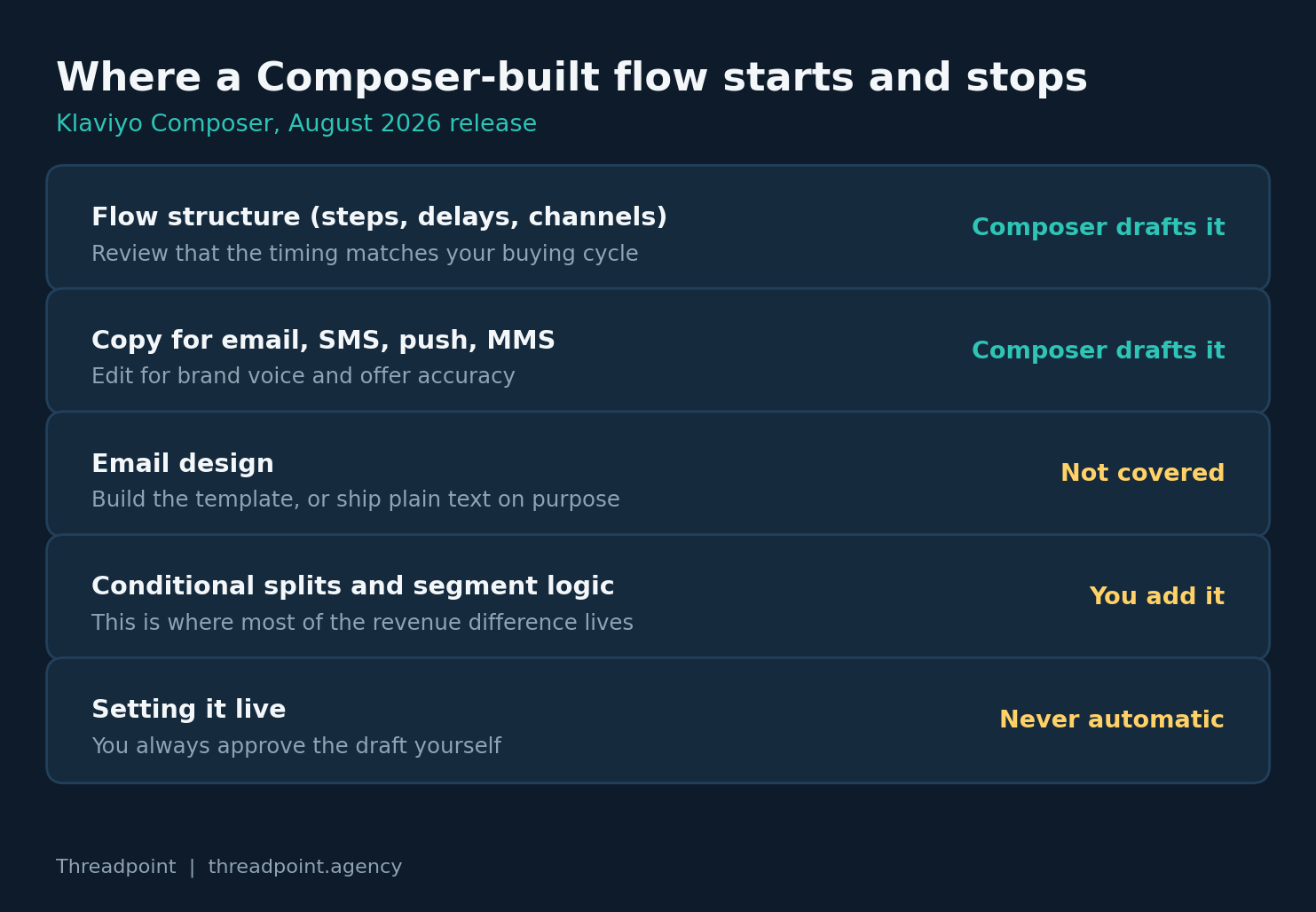
Two of those rows are worth sitting with.
The first is design. Composer writes copy and assembles structure. It does not build your email template. For SMS and push that doesn't matter, plain text is the format. But if your brand's emails are image-led or built on a specific template system, you still need someone to design the thing. You can absolutely ship plain text email on purpose, we do it for clients all the time and it often outperforms the pretty version. Just make that a decision, not a default you backed into because the AI didn't hand you a design.
The second is the splits. And this is the one that actually moves revenue.
The flow structure is the easy half. The branching is the strategy.
Take abandoned cart. Every brand runs one. The trigger is obvious, the timing is fairly well understood, three to four messages is typical. Composer can draft that in a minute and the draft will be reasonable.
But the person abandoning their first cart and the person who has bought from you nine times do not need the same three emails. Neither does the customer with a $40 cart versus the one with a $400 cart, or the one who came in off a paid social ad versus the one who has been on your list for two years. Same trigger, same flow purpose, completely different message.
That's what a conditional split is for, and it's the part of the build that comes from knowing the business rather than knowing the platform. It requires you to have an opinion about which customer differences are worth branching on. An AI drafting from a prompt has no way to know that your repeat buyers respond to restock urgency while your first-timers need the return policy spelled out. You know that. It doesn't.
One flow with splits beats four flows that are almost the same
Here's the trap we see when brands start generating flows quickly: they end up with four near-duplicate flows instead of one flow that branches.
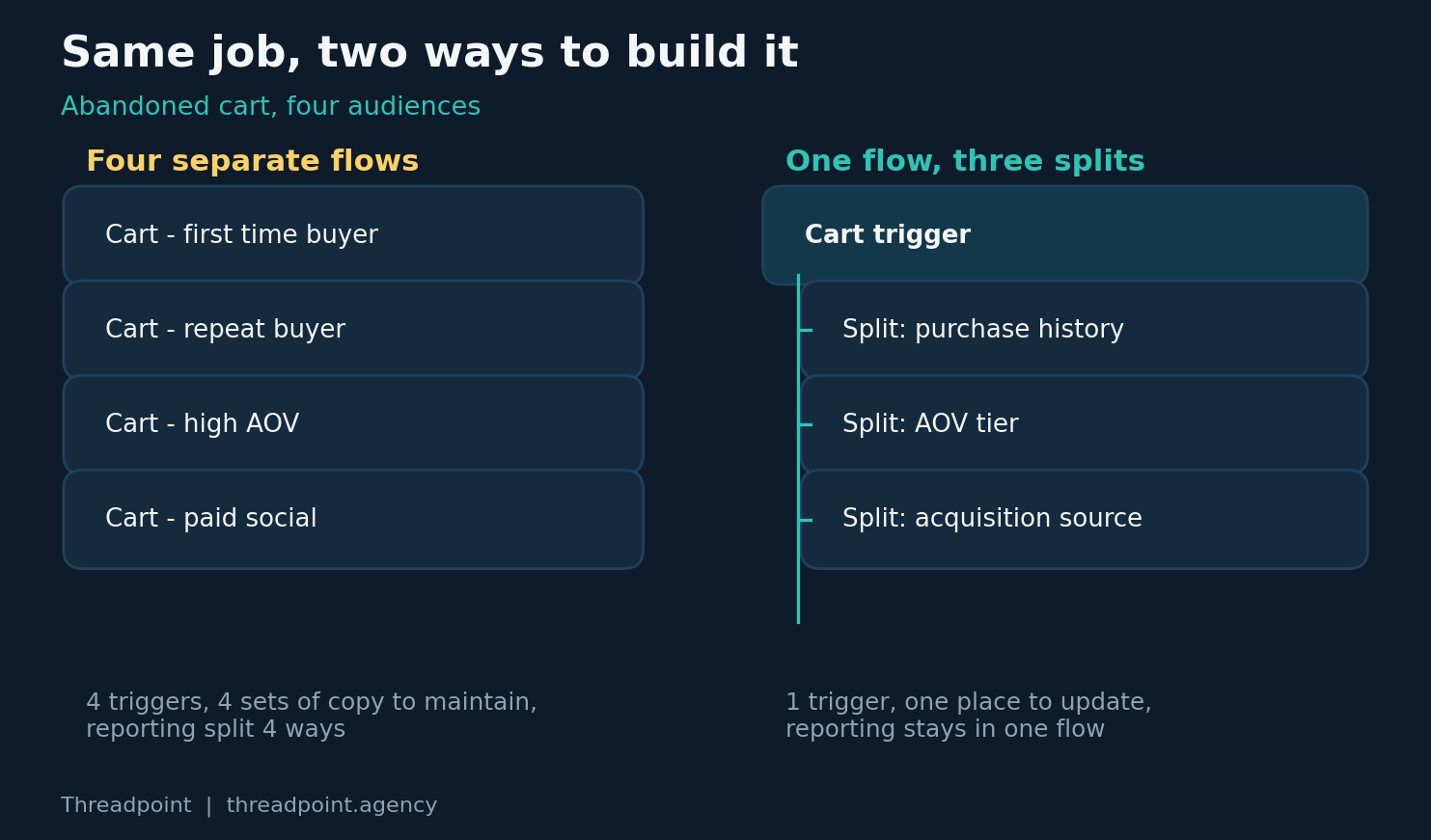
Four separate cart flows means four triggers to keep straight, four sets of copy to update every time your offer or your shipping threshold changes, and reporting that's split four ways so you can never quite tell which version is carrying the channel. It works, technically. It's just miserable to maintain and it makes the numbers harder to read.
One flow with the trigger at the top and splits underneath keeps the whole thing in one place. When the offer changes you change it once. When you want to know how cart is performing, you look at one flow. And you can still say something different to each group.
So the way we'd use the new Composer capability: let it draft the sequence and the copy for a given audience, then do the structural work yourself. Get the trigger and the splits right first, then let Composer fill in the message content branch by branch. Structure is a human decision. Content generation is where the tool earns its keep.
One thing we'd love to see
Klaviyo's cloning tools are decent inside a flow. You can clone a flow message from the three-dot menu, you can clone a path in a multi-branch split to copy its conditions into a new path, and you can clone an entire flow. What we couldn't find documented is a clean way to take a sequence Composer just built and drop it underneath a conditional split in a flow that already exists. The long-standing workaround is to clone the whole flow and rework it, which is fine but not the same thing.
If that path exists and we've missed it, we'd genuinely like to know. And if it doesn't: Klaviyo, that's the feature. Let people generate a branch's worth of content with Composer and place it into an existing flow. It would push brands toward consolidated flows with real branching instead of a flow list that grows every time someone runs a prompt.
How to use this without making a mess
A few things we'd tell any client who wants to start generating flows with Composer this week:
- Build the skeleton yourself. Trigger, splits, exit conditions. Decide what the flow is supposed to do and who it treats differently before you generate anything.
- Use Composer for content per branch, and give it real context in the prompt. The output tracks the specificity of the brief.
- Read every message before it goes live. Offers, shipping thresholds, product claims and anything compliance-adjacent are the usual places a draft is confidently wrong.
- Decide on design deliberately. Template or plain text, but pick.
- Consolidate. If you already have three flows doing the same job for different audiences, collapsing them into one flow with splits is usually a bigger win than any new flow you could generate.
The short version: Composer just took a real chunk of work off the pile, mostly copywriting and first-draft structure, and it does that well. The strategy underneath it, which customers get treated differently and how, is still the job. That part hasn't been automated and we don't think it's close.


