We're in the middle of this on a live client account right now, so everything below is the actual process we're running, not a theory post.
Here's the short version: sunsetting unengaged profiles isn't optional maintenance anymore. It's the same category as paying your Klaviyo bill. Gmail and Yahoo both look at how people interact with your sends, and a big block of profiles who haven't opened anything in two years is a signal that drags every send you make. Not just the campaigns to those people. Everything.
But almost nobody actually does it. And the reason is simple: the list is a number people are attached to, and cutting it feels like cutting revenue. So brands agree it needs to happen, agree it should happen "soon," and then it sits on the list of things nobody wants to be responsible for.
The fix isn't being braver about it. It's not cutting all at once. You layer the dead list in gradually, in waves, and you read the data between each one.
Why one big purge is the wrong move
If you suppress 60% of your list on a Tuesday and your numbers wobble on Thursday, you have no idea what caused it. Was it the suppression? A bad subject line? A deliverability issue that was already brewing? You cut too many variables at once and now you're guessing.
Waves solve that. Each cut is small enough that you can attribute what happened to it, and you always have the option to stop after any wave instead of finding out you went too far when it's already done. The suppression itself is reversible in Klaviyo, sure, but reputation damage isn't something you undo by unsuppressing people.
The wave structure we use
Segment by engagement window, then work from the safest cut to the least safe one.
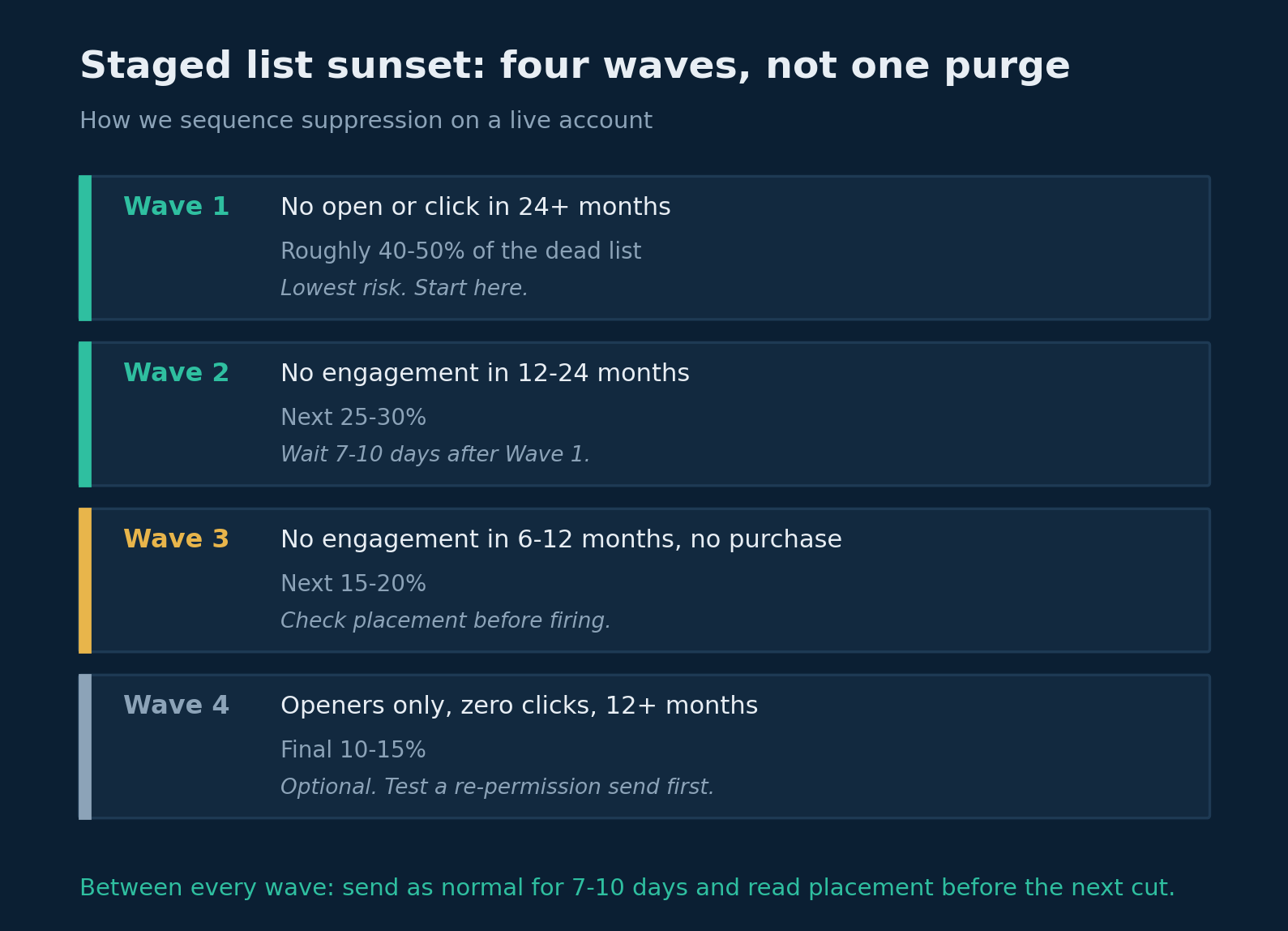
A few notes on that.
Wave 1 is nearly always the biggest and it's the one you should feel zero anxiety about. If someone hasn't opened or clicked anything in two years, they aren't a customer you're losing. They're a mailbox that's either dead, filtered, or an abandoned address that's quietly turning into a spam trap.
Wave 3 is where people get nervous, and that's the right instinct. Six to twelve months without engagement isn't dead for every brand. If you sell something with a long purchase cycle - furniture, mattresses, high-ticket equipment - twelve months of quiet can be completely normal behavior for a customer who's going to buy again. So we always cross-reference purchase history before suppressing anything in that band, and past purchasers usually get held back or handled with a separate winback push first.
Wave 4 is optional and we skip it plenty of times. Openers with zero clicks over a year are a weird group. Some of them are real people who just read and never tap. Some are machine opens from Apple Mail Privacy Protection, which means the "open" tells you almost nothing. If you want to keep them, a re-permission send is a fairer test than suppression.
Cadence matters more than the segment definitions
The part people get wrong isn't the segmentation. It's the timing.
Give each wave 7 to 10 days and at least three or four normal sends before you cut again. You're not waiting for the sake of caution, you're waiting because you need enough send volume to actually see the effect. One campaign after a suppression wave doesn't tell you anything. Four does.
And keep your regular sending cadence steady through the whole thing. Don't suppress half the list and simultaneously drop your send frequency, or ramp it up because "the list is cleaner now." Change one thing at a time. If you cut volume and cadence together, you've got two variables and no read.
One more thing: don't do this in the two weeks before a big sales moment. Doing a staged sunset in August is smart. Doing it the week before Black Friday is not.
What to actually watch in the first two weeks
This is where brands panic and undo good work, because the first number they look at is total opens, and total opens go down. Of course they do. You're sending to fewer people.
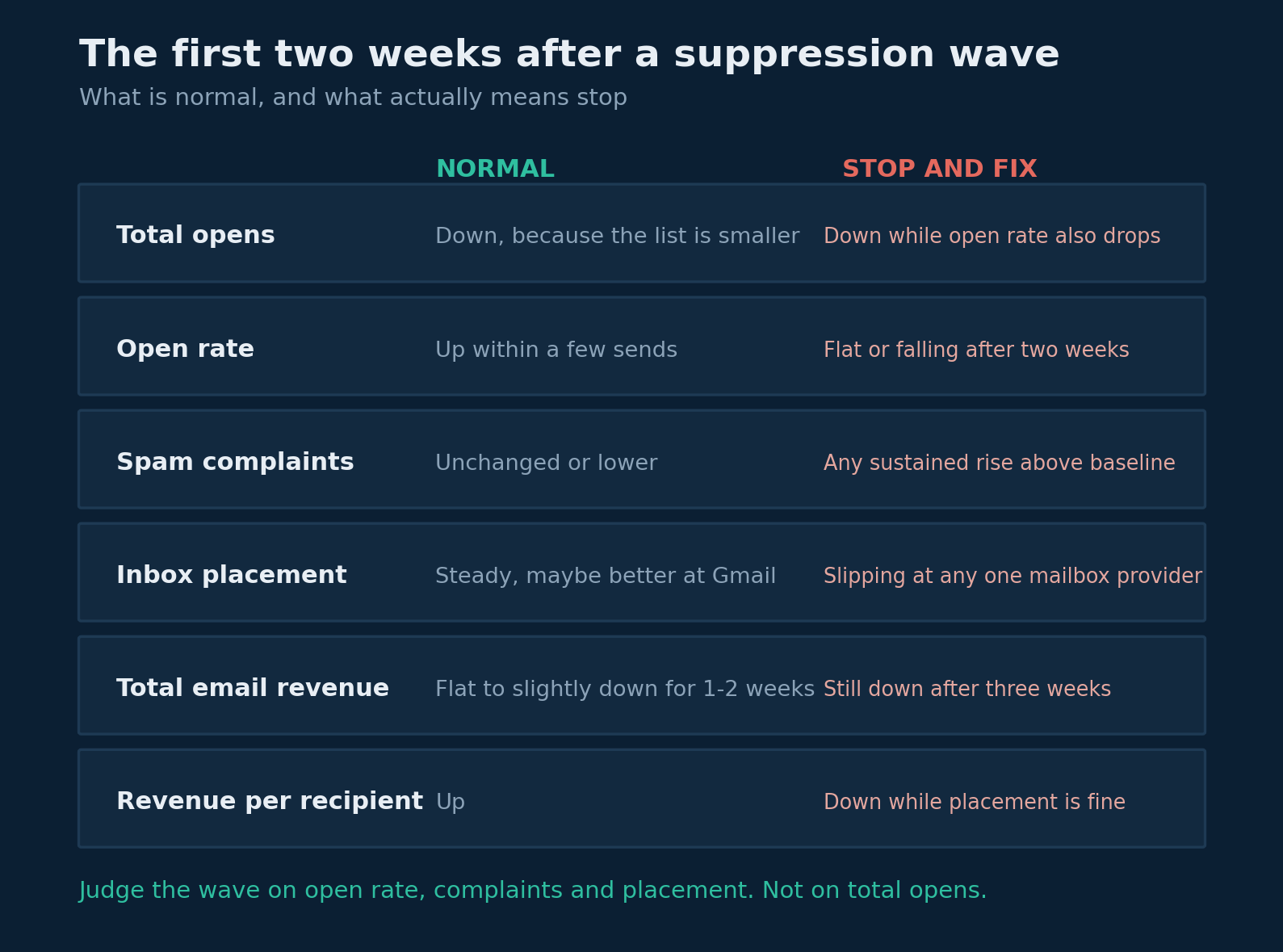
Rate metrics are the read. Volume metrics are noise for the first couple of weeks.
Open rate should climb within a few sends, and it usually climbs faster than people expect, because the denominator dropped and the people left are the ones who actually engage. Spam complaints should be flat or better. If complaints go up after removing your least engaged people, something else is wrong and it isn't the suppression.
Placement is the one worth checking manually rather than trusting the dashboard. Look at it per mailbox provider, not as one blended number. Gmail, Yahoo and Microsoft don't behave the same way, and a problem at one of them will hide inside an average that looks fine.
On revenue: expect flat to slightly down for a week or two. That's the honest expectation and it's worth setting it out loud before you start, because if nobody warned the founder, week one is going to feel like a mistake. Revenue per recipient should be up immediately, which is the leading indicator that the rest is coming.
The part that's actually the payoff
Cleaner data is the boring benefit. The real one is what it does to your flows.
Klaviyo's smart sending, send time optimization, and engagement-based logic are all reading your profile behavior to decide who gets what and when. When a large chunk of your profiles are inert, that system is making decisions around dead weight. Your welcome series, your cart flow, your winback - all of them are being tuned against a population that includes a huge group who will never respond to anything.
Pull that group out and the flows get sharper without you touching a single email. Your engaged segments actually mean engaged. Your A/B tests reach significance faster because the sample isn't diluted. Your winback flow stops firing at addresses that stopped existing in 2023.
That's usually where the revenue rebound comes from, and it's why the number typically comes back higher than where it started rather than just recovering. You didn't lose subscribers. You stopped paying a tax on people who were never going to buy, and every automated decision your ESP makes on your behalf got better as a result.
If you're going to do it
Pick a quiet month. Define the waves before you fire the first one. Write down what you expect to happen so you're not renegotiating with yourself in week one. Keep cadence steady. And check placement by provider between waves, not just the blended rate.
It takes about six weeks end to end for most accounts. Which is a lot less painful than the alternative, which is finding out your deliverability has been slowly bleeding for a year and now every send is a rescue mission.


